
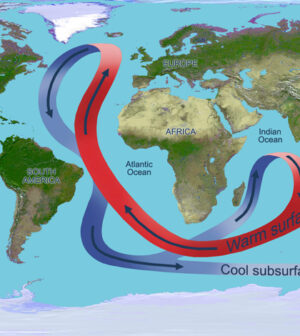
The Atlantic Meridional Overturning Circulation is weakening because warming melts polar ice, freshens surface waters and alters wind patterns, reducing the density‑driven flow that moves heat northward and affecting climate, sea level and marine ecosystems.
Quick Answer
The Atlantic Meridional Overturning Circulation (AMOC) is a large‑scale ocean current system that transports warm, salty water northward at the surface and returns cold, dense water southward at depth. Climate‑driven warming melts Greenland ice and Arctic sea ice, adding freshwater to the North Atlantic and weakening the surface‑density contrast that drives deep convection. Direct observations from the RAPID‑AMOC array show a 15‑30% decline in northward heat transport since 2004, and climate‑model ensembles project further weakening under continued greenhouse‑gas emissions. A weaker AMOC may lead to cooler winters in parts of Europe, higher relative sea level along the U.S. East Coast, and shifts in marine food webs, although the timing of any critical threshold remains uncertain.
Key Takeaways
- Freshwater from Greenland melt and Arctic sea‑ice loss reduces surface salinity, weakening deep convection in the North Atlantic.
- Direct monitoring (RAPID‑AMOC) shows a 15‑30% decline in northward heat transport since the early 2000s.
- All CMIP6 climate‑model ensembles consistently project further AMOC weakening under continued emissions.
- A weaker AMOC could cool parts of Europe, raise relative sea level on the U.S. East Coast, and alter marine productivity.
- High confidence exists for the physical mechanisms; uncertainty remains about the exact timing of a possible tipping point.
What Is Why the Atlantic Ocean Circulation Is Slowing Down?
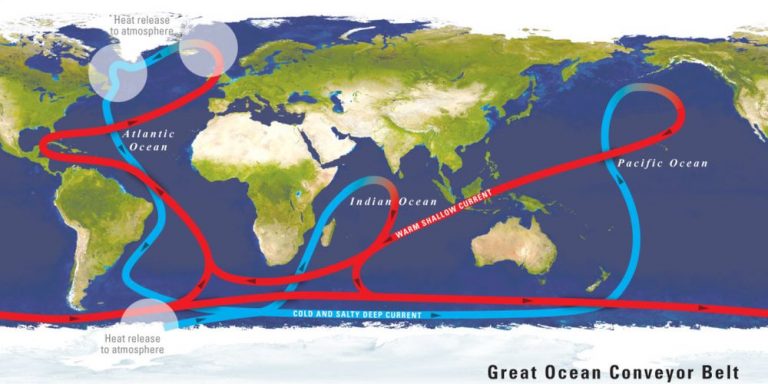
The phrase refers to the observed reduction in strength of the Atlantic Meridional Overturning Circulation, a key component of the global thermohaline conveyor belt. AMOC moves warm, salty surface water from the tropics into the North Atlantic, where it releases heat to the atmosphere, cools, becomes dense enough to sink, and then returns southward as deep water. This overturning redistributes heat, influences regional climate, and helps regulate sea‑level gradients. A slowdown means less heat is carried north, altering weather patterns and marine ecosystems.
How Does It Work?
Physical Mechanism of the AMOC
- Warm, salty water travels northward along the Gulf Stream and North Atlantic Current.
- In high‑latitude regions, the water cools, increasing its density.
- When density exceeds a threshold, water sinks, forming North Atlantic Deep Water (NADW).
- Dense deep water spreads southward at depth, completing the overturning loop.
How Freshwater Disrupts the Loop
Freshwater from melting ice or increased precipitation lowers surface salinity, which reduces density. If surface water becomes too light, it cannot sink, weakening deep convection and thus the entire overturning circulation. Warmer upper‑ocean layers also increase stratification, making sinking more difficult and creating a reinforcing feedback.
What Does the Evidence Show?
Multiple independent lines of evidence converge on a slowing AMOC:
- Direct monitoring: The RAPID‑AMOC array at 26° N, operating since 2004, records a ~15 % decline in northward heat transport compared with the early 2000s (NOAA, 2023).
- Historical reconstructions: Sediment‑core and ice‑core proxies indicate that the recent weakening exceeds natural variability observed over the past millennium (IPCC AR6, 2021).
- Model simulations: All CMIP6 models show AMOC weakening under anthropogenic forcing, with stronger declines under high‑emission scenarios (World Climate Research Programme, 2022).
- Satellite altimetry: Sea‑surface height trends in the North Atlantic are consistent with reduced meridional overturning strength (ESA, 2020).
These observations provide moderate to strong confidence that the AMOC is weakening in the 21st century.
Main Causes or Drivers
Freshwater Input from Ice Melt
Greenland ice melt contributes roughly 0.3 Sverdrups (Sv) of freshwater per year (NASA, 2022), freshening the Labrador and Irminger Seas where deep convection occurs.
Arctic Sea‑Ice Decline
Loss of sea ice reduces brine‑rejection during winter freezing, a natural process that historically increased surface salinity and promoted sinking. Arctic sea‑ice extent has declined by about 13 % per decade since the 1970s (NSIDC, 2021).
Changing Wind Patterns
Shifts in the North Atlantic Oscillation and westerly wind stress modify the northward advection of warm water. Reanalyses show a slight weakening of the prevailing northerly winds that help push surface waters into the convection zone.
Thermal Stratification
Warmer upper‑ocean layers increase stratification, making it harder for surface water to sink even without freshening. This thermally driven stratification works in concert with salinity changes.
Environmental and Human Impacts
Environmental Impacts
- Reduced northward heat transport may lead to cooler winters in north‑western Europe, affecting agriculture and energy demand.
- Sea‑level gradients can cause a relative rise of several centimeters along the U.S. East Coast over the next century.
- Changes in deep‑water formation can alter nutrient supply to surface waters, impacting fish stocks and biodiversity.
Human Health and Social Impacts
Altered storm tracks could increase the frequency of intense Atlantic hurricanes, raising flood risk for coastal communities. Cooler regional climates may shift the distribution of vector‑borne diseases, although the net effect remains uncertain.
Economic and Infrastructure Impacts
- Fisheries that rely on cold‑water species such as Atlantic cod may experience reduced catches.
- Tourism that depends on milder European winters could see lower visitation.
- Infrastructure built on assumptions of stable sea‑level rise may need reassessment in light of accelerated regional rise.
Regional Differences
The consequences of a slower AMOC are not uniform:
- Europe: Cooler winters and increased snowfall are projected for the British Isles and Scandinavia (ECMWF, 2023).
- North America: The U.S. East Coast could experience higher relative sea level because less water mass is transported northward.
- Tropical Atlantic: Shifts in the Intertropical Convergence Zone may modify rainfall patterns over West Africa and the Caribbean.
What Scientists Know With High Confidence
- The AMOC is a density‑driven circulation that moves heat northward in the Atlantic.
- Freshwater input from Greenland melt and Arctic sea‑ice loss reduces surface density and weakens deep convection.
- Long‑term observations show a measurable decline in AMOC strength since the early 2000s.
- Climate models consistently project further slowdown under continued greenhouse‑gas emissions.
What Remains Uncertain
Key uncertainties include the precise timing of a possible AMOC tipping point, the relative contribution of wind‑stress changes versus freshwater forcing, and how regional climate feedbacks will interact with a weaker circulation. Improved high‑latitude observations and higher‑resolution models are needed to narrow these gaps.
Common Misconceptions
Misconception: A slowing AMOC will trigger a new ice age.
Reality: While a very weak AMOC could produce regional cooling, the dominant global warming signal from greenhouse gases makes a full‑scale ice age highly unlikely.
Misconception: The AMOC has stopped.
Reality: Observations show a reduction in strength, not a complete shutdown. The circulation still transports roughly 15 Sv of water, albeit at a lower rate than in the mid‑20th century.
Misconception: Only the Atlantic is affected.
Reality: The AMOC is part of the global thermohaline circulation, so changes can propagate to the Pacific and Indian Oceans, though with delayed and attenuated effects.
Misconception: Cutting carbon emissions will instantly reverse the slowdown.
Reality: Oceanic thermal inertia means the AMOC may continue to weaken for decades even after rapid emission cuts; recovery, if any, will be gradual.
Solutions and Limitations
Addressing the slowdown requires both mitigation of climate change and enhanced ocean monitoring:
- Mitigation: Reducing CO₂ emissions limits further warming, slowing ice melt and freshwater input. However, mitigation alone cannot quickly restore AMOC strength because the ocean responds on multi‑decadal timescales.
- Enhanced Observation Networks: Expanding the RAPID‑AMOC array and deploying autonomous floats improve early detection of changes. Funding and international coordination remain challenges.
- Adaptation: Coastal planning that incorporates higher regional sea‑level rise and shifting storm patterns can reduce vulnerability, but does not address the root cause.
What Individuals, Communities, and Governments Can Do
What Individuals Can Do
Support policies that accelerate the transition to renewable energy, reduce personal carbon footprints, and advocate for increased funding of ocean research.
What Communities and Organizations Can Do
Integrate climate‑resilient designs in coastal infrastructure, develop early‑warning systems for extreme weather, and partner with scientific institutions for citizen‑science monitoring of sea temperature and salinity.
What Governments Can Do
Implement ambitious net‑zero targets, fund long‑term ocean observing systems, and incorporate AMOC projections into national climate‑adaptation plans, especially for agriculture and coastal management.
Closing Synthesis
The Atlantic Meridional Overturning Circulation is slowing because warming melts polar ice, freshens surface waters and alters wind patterns that drive the current. Robust observations and climate‑model ensembles give high confidence in this trend, while uncertainties remain about the exact timing of any critical threshold and the magnitude of regional impacts. Mitigation of greenhouse‑gas emissions, expanded monitoring, and proactive adaptation together offer the most realistic pathway to limit further disruption and safeguard the climate and societies that depend on a stable Atlantic circulation.
Frequently Asked Questions
What is the Atlantic Meridional Overturning Circulation (AMOC)?
The AMOC is a large‑scale ocean current system that transports warm, salty water northward at the surface and returns cold, dense water southward at depth, redistributing heat across the Atlantic.
Why is the AMOC weakening?
Warming melts Greenland ice and Arctic sea ice, adding freshwater that lowers surface salinity and reduces the density contrast needed for deep convection, while changing wind patterns also weaken the overturning.
What evidence shows the AMOC is slowing?
Direct measurements from the RAPID‑AMOC array indicate a 15‑30% decline in northward heat transport since 2004, and climate‑model ensembles consistently project further weakening under continued emissions.
How could a weaker AMOC affect Europe?
A weaker AMOC may lead to cooler winters and increased snowfall in parts of north‑western Europe, influencing agriculture, energy demand and winter tourism.
Can reducing carbon emissions quickly restore the AMOC?
No; because the ocean has high thermal inertia, the AMOC may continue to weaken for decades even after rapid emission cuts, and any recovery would be gradual.







Leave a Comment