

Ocean warming causes seawater to expand, raising global sea levels even though no new water is added, with profound implications for coastlines and climate.
Quick Answer
When the ocean absorbs excess heat from the atmosphere, its temperature rises and the water molecules move farther apart, a process called thermal expansion. This expands the volume of the ocean and lifts sea level worldwide. The Intergovernmental Panel on Climate Change (IPCC) reports that thermal expansion contributed roughly 30% of observed sea‑level rise between 1993 and 2018. While the exact amount varies by region, the mechanism is well‑established. Uncertainty remains about how quickly deep‑ocean warming will add to sea‑level rise in the coming decades.
Key Takeaways
- Thermal expansion is a physical response of seawater to warming and does not require additional water input.
- It accounts for about one‑third of the sea‑level rise observed over the past three decades.
- Both surface and deep‑ocean layers are warming, but deep‑ocean heat uptake is slower and less observable.
- Rising seas increase flood risk, threaten coastal ecosystems, and can displace communities.
- Mitigation of greenhouse‑gas emissions and adaptive coastal management are both needed to address the challenge.
What Is How Ocean Heating Raises Sea Levels Without Adding Water?
Thermal expansion refers to the increase in volume that occurs when a substance’s temperature rises. In the ocean, warmer water expands because its molecules require more space to move. The term does not imply that extra water is entering the ocean; rather, the same quantity of water occupies a larger volume. This phenomenon is distinct from sea‑level contributions caused by melting glaciers or ice sheets, which add new water to the ocean basin.
How Does It Work?
Physical Process of Thermal Expansion
- Solar radiation and greenhouse‑gas‑driven warming heat the atmosphere.
- The heated air transfers energy to the ocean surface through convection and radiation.
- Water molecules gain kinetic energy and vibrate more vigorously, increasing the average distance between them.
- Because seawater is nearly incompressible, this increase in molecular spacing translates directly into a measurable rise in volume.
- Expanded water raises the ocean surface, contributing to global sea‑level rise.
Depth‑Dependent Heating
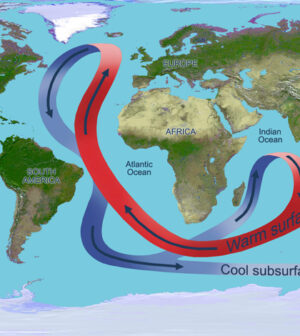
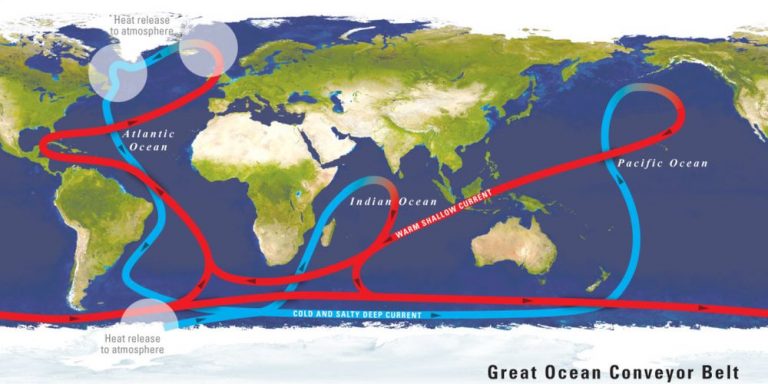
Surface waters warm relatively quickly, but heat also penetrates deeper layers via mixing and thermohaline circulation. Deep‑ocean warming is slower, yet it represents a large heat reservoir that will continue to expand sea level for centuries, as documented by the Argo float network (NOAA, 2020).
What Does the Evidence Show?
Long‑term tide‑gauge records, satellite altimetry, and in‑situ temperature measurements provide converging evidence of thermal expansion. The IPCC Fifth Assessment Report (AR5, 2014) concluded with high confidence that the ocean’s heat content increased by about 0.5 × 10²³ J per year from 1971 to 2010, driving measurable sea‑level rise. Satellite data from the Jason‑3 mission (2022) show a global mean sea‑level increase of 3.3 mm yr⁻¹, of which roughly 1.0 mm yr⁻¹ is attributed to thermal expansion. Peer‑reviewed syntheses (e.g., Cheng et al., 2017, *Nature Climate Change*) confirm that models reproducing observed temperature profiles also reproduce the observed expansion signal.
Main Causes or Drivers
Direct Causes
- Increased atmospheric greenhouse‑gas concentrations (CO₂, CH₄, N₂O) trap long‑wave radiation.
- Enhanced oceanic heat uptake due to reduced radiative loss to space.
Underlying Drivers
- Fossil‑fuel combustion and land‑use change that raise global mean temperatures.
- Feedbacks such as reduced sea‑ice albedo, which allow more solar energy to be absorbed by the ocean.
Environmental and Human Impacts
Environmental Impacts
Even a few centimeters of sea‑level rise can alter tidal wetlands, increase coastal erosion, and shift the distribution of marine habitats. Coral reef exposure to air during low tides can intensify bleaching events, while salt‑marsh inundation changes species composition.
Human Health and Social Impacts
Higher sea levels raise the baseline for storm surges, increasing flood frequency in low‑lying cities such as New York, Jakarta, and Dhaka. Repeated flooding can damage water and sanitation infrastructure, elevating risks of water‑borne diseases and displacing vulnerable populations.
Economic and Infrastructure Impacts
Coastal property values decline as flood risk rises, and public expenditures on flood defenses grow. The World Bank estimates that without adaptation, sea‑level rise could cost coastal economies up to 0.5% of GDP annually by 2050.
Regional Differences
Sea‑level rise is not uniform. Thermal expansion is greatest in regions where the ocean is warming fastest, such as the western Pacific and the North Atlantic. In contrast, areas with strong ocean currents, like the Gulf Stream, can experience locally amplified rise. Satellite gravimetry shows that the Indian Ocean has seen slightly higher rates of expansion than the Southern Ocean, reflecting regional heat uptake patterns (ESA, 2021).
What Scientists Know With High Confidence
- Greenhouse‑gas emissions are the primary driver of global warming.
- The ocean has absorbed more than 90% of excess heat since the mid‑20th century.
- Thermal expansion contributes a substantial, quantifiable portion of observed sea‑level rise.
- Sea‑level rise will continue for centuries, even if emissions were halted today, because of delayed deep‑ocean warming.
What Remains Uncertain
Key uncertainties involve the rate at which heat penetrates the deep ocean, the precise contribution of thermal expansion versus ice melt under future warming scenarios, and how regional ocean dynamics may amplify or dampen local sea‑level changes. Better coverage of deep‑ocean temperature measurements and higher‑resolution climate models are needed to reduce these gaps.
Common Misconceptions
Misconception: Sea‑level rise only comes from melting ice.
Reality: Thermal expansion accounts for roughly one‑third of observed rise and will remain a major contributor even if ice melt slows.
Misconception: Ocean heating only affects surface water.
Reality: Heat penetrates to depths of several kilometers, and the resulting expansion of deep water will add to sea level over many decades.
Misconception: Sea‑level rise is the same everywhere.
Reality: Ocean dynamics, gravitational effects of melting ice, and land movement cause regional variations of up to ±30% around the global mean.
Solutions and Limitations
Addressing sea‑level rise requires both mitigation of the root cause—greenhouse‑gas emissions—and adaptation to the inevitable rise.
- Mitigation: Rapid decarbonisation of energy, transport, and industry can limit future warming and thus reduce thermal expansion. Limitations include political feasibility, transition costs, and the time lag before the ocean cools.
- Adaptation: Coastal defenses such as sea walls, managed retreat, and restoration of mangroves and wetlands can buffer impacts. However, hard infrastructure can be expensive, may have ecological side‑effects, and can give a false sense of security if sea level accelerates faster than anticipated.
- Monitoring: Expanding the global Argo float network and satellite gravimetry improves detection of deep‑ocean warming, enabling better planning. Funding and international coordination are ongoing challenges.
What Individuals, Communities, and Governments Can Do
What Individuals Can Do
- Support policies that accelerate renewable‑energy deployment and carbon pricing.
- Reduce personal carbon footprints through energy efficiency, low‑carbon transport, and mindful consumption.
- Participate in local coastal‑resilience planning, such as advocating for nature‑based solutions.
What Communities and Organizations Can Do
- Implement community‑scale green infrastructure (e.g., living shorelines) to absorb wave energy.
- Develop and enforce zoning that discourages new development in high‑risk flood zones.
- Partner with scientists to monitor local sea‑level trends and share data.
What Governments Can Do
- Adopt ambitious nationally determined contributions (NDCs) under the Paris Agreement to curb emissions.
- Invest in large‑scale coastal adaptation projects and early‑warning systems.
- Fund ocean‑observing systems like the Global Ocean Observing System (GOOS) to improve predictive capacity.
Synthesis of Key Points
Ocean heating drives thermal expansion, a well‑understood physical process that raises sea level without adding water. Robust observations and model studies confirm that this mechanism already accounts for about a third of the observed rise and will continue to do so for centuries. While uncertainties remain about deep‑ocean heat uptake, the core science is solid. Effective responses combine aggressive emissions reductions with strategic coastal adaptation, recognizing that both mitigation and local resilience are essential to protect ecosystems and human societies from the slow but relentless advance of the seas.
Frequently Asked Questions
What is thermal expansion of the ocean?
Thermal expansion is the increase in seawater volume caused by rising temperatures, where water molecules move farther apart, raising sea level without adding new water.
How much does thermal expansion contribute to recent sea‑level rise?
According to the IPCC, thermal expansion contributed about 30% of the global sea‑level rise observed between 1993 and 2018, roughly 1 mm per year of the total 3.3 mm per year increase.
Why does sea‑level rise vary by region?
Regional differences arise from variations in ocean currents, local heat uptake, gravitational effects of melting ice, and land movement, causing some areas to experience higher or lower rise than the global average.
What are the main uncertainties about future ocean‑driven sea‑level rise?
Key uncertainties include the rate of deep‑ocean heat penetration, the balance between thermal expansion and ice‑sheet melt under different warming scenarios, and how local ocean dynamics will modify sea‑level changes.
What actions can help limit sea‑level rise caused by ocean heating?
Limiting sea‑level rise requires rapid reduction of greenhouse‑gas emissions to curb global warming, combined with coastal adaptation measures such as nature‑based buffers, managed retreat, and improved ocean monitoring.





Leave a Comment