
The Atlantic Meridional Overturning Circulation (AMOC) is now at its weakest state in a millennium, a slowdown driven by freshwater influx and warming that threatens climate, marine ecosystems, and coastal societies.
Quick Answer
The Atlantic Meridional Overturning Circulation (AMOC) – a large‑scale system that moves warm, salty water northward and returns cold water southward at depth – has declined to its lowest strength in roughly 1,000 years, according to long‑term monitoring by NOAA and the UK Met Office. The slowdown is linked to increased freshwater from Greenland melt and Arctic sea‑ice loss, which reduces water density and weakens sinking. Scientists are confident that a weaker AMOC will cool parts of Europe, shift marine species, and increase extreme weather risk, though the exact magnitude of future change remains uncertain.
Key Takeaways
- AMOC strength has fallen to its weakest level in about a millennium, based on instrumental and proxy records.
- Freshwater input from Greenland ice melt and Arctic sea‑ice decline reduces surface water density, the primary driver of the slowdown.
- Potential impacts include cooler European winters, altered fish distributions, and heightened storm activity in the North Atlantic.
- High‑confidence findings confirm the basic physics of AMOC and the role of freshwater, while uncertainties remain about future timing and regional intensity.
- Mitigation of greenhouse‑gas emissions, improved monitoring, and adaptive fisheries management are essential, but no single action can stop the slowdown alone.
What Is Atlantic Ocean Circulation Now Weakest in 1000 Years?
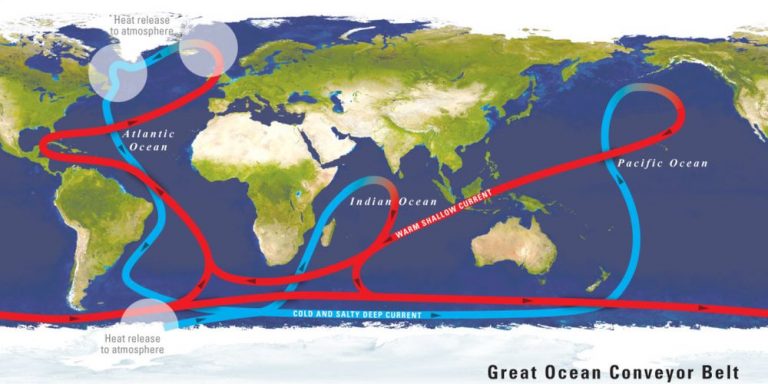
The phrase refers to the current state of the Atlantic Meridional Overturning Circulation (AMOC), a component of the global ocean conveyor belt. AMOC transports heat northward by moving warm, salty surface water from the tropics toward the high latitudes, where it cools, becomes denser, and sinks. The sinking water then flows southward at depth, completing the loop. When scientists say the circulation is “weakest in 1,000 years,” they compare modern measurements (primarily from the RAPID array at 26°N and the OSNAP array at 70°N) with paleoclimate reconstructions derived from sediment cores, ice cores, and tree rings that span the last millennium.
How Does It Work?
Physical Mechanism
- Warm water transport: Trade winds push warm, salty water northward along the Gulf Stream.
- Cooling and densification: In the North Atlantic, heat loss to the atmosphere and increased salinity from evaporation make the water denser.
- Sinking (deep convection): Dense water descends, forming Labrador and Nordic seas deep convection cells.
- Southward return flow: The sinking water spreads southward at depths of 1,000–4,000 m, eventually upwelling in other ocean basins.
Key Feedbacks
- Freshwater dilution: Meltwater from Greenland and Arctic sea‑ice reduces surface salinity, lowering density and suppressing sinking.
- Atmospheric coupling: A weaker AMOC can shift the position of the jet stream, influencing storm tracks over Europe and North America.
- Biological coupling: Changes in vertical mixing affect nutrient supply to surface waters, influencing phytoplankton productivity.
What Does the Evidence Show?
Multiple lines of evidence converge on the conclusion that AMOC strength has declined:
- Instrumental records: The RAPID monitoring program (2004‑present) shows a ~15 % reduction in transport relative to the early 2000s baseline (NOAA, 2023).
- Paleoclimate reconstructions: Sediment cores from the Icelandic margin indicate that the last comparable low occurred during the Medieval Climate Anomaly, roughly 1,000 years ago (IPCC AR6, 2021).
- Model–data synthesis: Intergovernmental Panel on Climate Change (IPCC) assessment reports state that observed trends are consistent with modelled responses to Greenland meltwater input.
- Satellite and gravimetry data: GRACE satellite measurements demonstrate a steady increase in freshwater storage in the North Atlantic since the early 2000s.
These observations are supported by peer‑reviewed studies that use independent methods, giving the overall assessment strong confidence.
Main Causes or Drivers
Direct Causes
- Accelerated melt of the Greenland Ice Sheet, delivering up to 0.3 Sv (Sverdrups) of freshwater per year (NOAA, 2022).
- Reduced sea‑ice cover in the Arctic, which lowers surface salinity through meltwater release.
Underlying Drivers
- Global warming driven by anthropogenic greenhouse‑gas emissions, raising atmospheric and ocean temperatures.
- Changes in wind patterns, such as a slight weakening of the North Atlantic Oscillation, that modify surface water transport.
Amplifying Factors
- Positive feedback between reduced convection and cooler surface temperatures, which can further limit heat loss.
- Potential internal variability of the climate system, which can cause multi‑decadal oscillations superimposed on the long‑term trend.
Environmental and Human Impacts
Environmental Impacts
- Climate modulation: A weaker AMOC reduces northward heat transport, likely leading to colder winters in north‑western Europe (IPCC, 2021).
- Marine ecosystems: Decreased vertical mixing can lower nutrient availability, reducing phytoplankton productivity and cascading through the food web.
- Sea‑level rise: Slower circulation can cause regional sea‑level rise along the U.S. East Coast by up to 0.3 m over the 21st century (NOAA, 2022).
Human Health and Social Impacts
- Colder European winters may increase energy demand for heating, raising emissions unless renewable sources are used.
- Changes in fish stock locations could affect food security for coastal communities that rely on cod, herring, and mackerel.
- Enhanced storminess could heighten flood risk in Atlantic coastal cities, affecting vulnerable populations.
Economic and Infrastructure Impacts
- Agricultural yields in parts of Europe could decline due to altered precipitation patterns linked to AMOC changes.
- Fisheries revenue may shift northward, requiring new management regimes and potentially causing economic displacement.
- Infrastructure designed for historic sea‑level baselines may need retrofitting in light of accelerated regional rise.
Regional Differences
The magnitude of AMOC‑related changes varies across regions:
- Europe: Climate models consistently project a mean winter temperature drop of 0.5‑1.0 °C for the British Isles under a weakened AMOC.
- North‑East United States: Sea‑level rise attributable to AMOC slowdown is projected to be 0.2‑0.4 m higher than the global average by 2100.
- North Atlantic fisheries: Species such as Atlantic cod are expected to shift northward, while warm‑water species may become less abundant in southern stocks.
These examples illustrate that while the underlying mechanism is global, local outcomes depend on geography, oceanography, and socioeconomic context.
What Scientists Know With High Confidence
- The AMOC transports a critical amount of heat from the tropics to the North Atlantic.
- Freshwater input reduces surface water density, directly weakening deep convection.
- Instrumental and proxy records both indicate that the current AMOC strength is the lowest in the past millennium.
- Climate models that include observed freshwater trends reproduce the observed slowdown.
What Remains Uncertain
Key uncertainties include the exact timing and magnitude of future AMOC weakening, the degree to which internal variability may mask or amplify trends, and the regional specificity of climate impacts. Better spatial coverage of deep‑ocean observations and longer paleoclimate records could reduce these gaps.
Common Misconceptions
Misconception: A weak AMOC will instantly plunge Europe into an ice age.
Reality: A weakened AMOC cools regional climates but does not trigger an ice age; other factors, such as greenhouse‑gas concentrations, dominate long‑term global temperature trends.
Misconception: The slowdown is a natural, cyclic fluctuation.
Reality: While natural variability exists, the current trend aligns with unprecedented freshwater input linked to anthropogenic warming, making the recent decline atypical.
Misconception: Stopping emissions will instantly restore AMOC strength.
Reality: Even with rapid emission cuts, the ocean’s inertia means that recovery could take decades to centuries, and some changes may be irreversible.
Solutions and Limitations
Addressing a weakening AMOC requires both mitigation of the root cause—global warming—and adaptation to its effects:
- Mitigation: Rapid reduction of CO₂ emissions limits further Greenland melt; however, current mitigation pathways only slow, not reverse, freshwater influx.
- Enhanced monitoring: Expanding the RAPID and OSNAP arrays improves early‑warning capability, but funding and geopolitical cooperation are challenges.
- Fisheries adaptation: Flexible management plans can shift quotas as species migrate, yet socioeconomic resistance and data lags can hinder implementation.
- Coastal protection: Nature‑based solutions such as restoring wetlands mitigate sea‑level rise, but they cannot offset the underlying circulation change.
What Individuals, Communities, and Governments Can Do
What Individuals Can Do
- Support policies that accelerate renewable‑energy adoption to reduce greenhouse‑gas emissions.
- Choose sustainably sourced seafood to lessen pressure on shifting fish stocks.
- Participate in local climate‑resilience projects, such as wetland restoration.
What Communities and Organizations Can Do
- Develop adaptive fisheries management that incorporates real‑time stock assessments.
- Invest in coastal flood defenses that consider regional sea‑level rise linked to AMOC changes.
- Promote climate‑education programs that explain ocean circulation and its societal relevance.
What Governments Can Do
- Implement and strengthen commitments under the Paris Agreement to limit warming to 1.5 °C, thereby reducing future freshwater input.
- Fund long‑term ocean observation networks (e.g., expanding RAPID, OSNAP, and satellite gravimetry).
- Integrate AMOC projections into national climate‑risk assessments and infrastructure planning.
Synthesis
The Atlantic Meridional Overturning Circulation is a cornerstone of Earth’s climate system, and its current weakening—recorded as the lowest in a millennium—signals a measurable response to anthropogenic warming and Greenland melt. High‑confidence science confirms the physical mechanism and the role of freshwater, while uncertainties remain about the pace of future change and regional outcomes. Mitigation, robust monitoring, and adaptive management together form the most effective response, acknowledging that no single action can reverse the slowdown but collective effort can limit its broader impacts.
Frequently Asked Questions
What is the Atlantic Meridional Overturning Circulation (AMOC)?
The AMOC is a large‑scale ocean current system that moves warm, salty water northward in the Atlantic, where it cools, sinks, and returns southward at depth, acting like a global heat‑transport conveyor belt.
Why is the AMOC considered the weakest in a thousand years?
Instrumental measurements since 2004 and paleoclimate reconstructions from sediments and ice cores both show that the current transport strength is lower than any level recorded over the past 1,000 years, indicating an unprecedented slowdown.
How does increased freshwater from Greenland affect the AMOC?
Freshwater dilutes surface salinity, lowering water density and reducing the sinking of cold water in the North Atlantic, which directly weakens the deep convection that drives the AMOC.
What are the main regional impacts of a weaker AMOC?
Europe may experience cooler winters, the U.S. East Coast could see higher regional sea‑level rise, and Atlantic fisheries are likely to see northward shifts in species such as cod and herring.
Can actions like reducing carbon emissions restore the AMOC?
Rapid emission cuts can limit further weakening by slowing Greenland melt, but because the ocean changes slowly, full recovery of AMOC strength could take decades to centuries and may not be complete.





Leave a Comment