
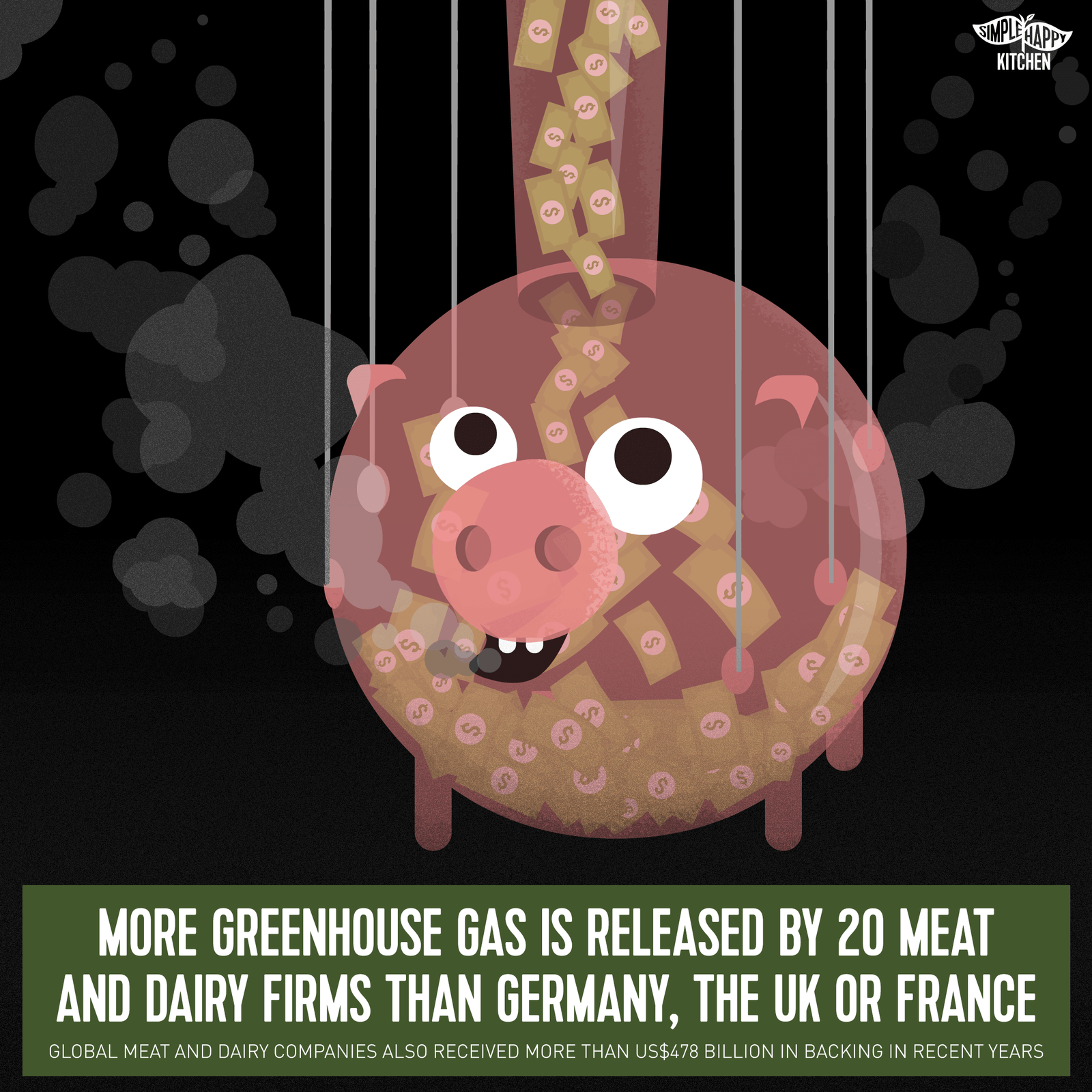
A small group of meat and dairy corporations together release more greenhouse gases than the entire nation of Germany, highlighting the climate impact of industrial livestock production.
Quick Answer
Twenty of the world’s largest meat and dairy producers are responsible for greenhouse‑gas emissions that exceed the total emissions of Germany, a country with one of the world’s biggest economies. The bulk of these emissions arise from methane released by ruminants, nitrous oxide from manure and fertiliser, and carbon dioxide from land‑use change and energy use in processing. Scientific assessments such as the IPCC Sixth Assessment Report attribute roughly 14–15 % of global anthropogenic emissions to the livestock sector, and corporate accounting studies confirm that a handful of firms dominate this share. The implication is that targeting corporate practices can achieve climate benefits comparable to national policies, although uncertainties remain around exact corporate footprints and mitigation potential.
Key Takeaways
- The combined emissions of 20 meat and dairy giants surpass Germany’s total national emissions (≈ 750 Mt CO₂e per year, 2021 data).
- Methane from ruminant digestion and nitrous oxide from manure are the most potent gases in the livestock footprint.
- Corporate concentration means a small number of firms drive a large share of agricultural emissions.
- Mitigation pathways include feed additives, improved manure management, and shifting to lower‑impact proteins.
- Consumer, policy, and industry actions are all required; individual diet changes alone cannot solve the systemic issue.
What Is 20 Meat and Dairy Producers Emit More Greenhouse Gases Than Germany?
The statement refers to a quantitative comparison between the aggregate greenhouse‑gas (GHG) emissions attributed to the 20 largest global meat and dairy corporations and the total GHG emissions reported for Germany. Emissions are expressed in carbon‑dioxide‑equivalent (CO₂e) units, which allow methane (CH₄) and nitrous oxide (N₂O) to be compared on a common scale using their 100‑year global‑warming potentials (CH₄ ≈ 28‑34 × CO₂, N₂O ≈ 298 × CO₂). The comparison is based on corporate carbon‑accounting studies that sum direct (Scope 1), indirect energy (Scope 2), and value‑chain (Scope 3) emissions for the companies involved.
How Does It Work?
The climate impact of meat and dairy production follows a chain of physical and biological processes:
- Enteric Fermentation: Ruminant stomach microbes break down cellulose, producing methane that the animal exhales.
- Manure Management: Stored manure releases both methane and nitrous oxide, especially when anaerobic lagoons are used.
- Feed Production: Growing feed crops requires synthetic fertiliser, which emits nitrous oxide, and often involves land‑use change that releases carbon stored in soils and vegetation.
- Processing and Transport: Energy used in slaughterhouses, refrigeration, and distribution adds carbon dioxide from fossil‑fuel combustion.
- Land‑Use Change: Expansion of pasture or feed‑crop acreage can convert forests or grasslands, releasing stored carbon and reducing future carbon sequestration.
Each step contributes to the overall GHG inventory of a corporation. When the emissions of the 20 biggest firms are summed, the total exceeds Germany’s national inventory, which includes all sectors (energy, transport, industry, agriculture, etc.).
What Does the Evidence Show?
Multiple lines of evidence converge on the magnitude of livestock‑related emissions:
- The IPCC Sixth Assessment Report (2022) estimates that livestock accounts for 14.5 % of global anthropogenic GHG emissions, with beef and dairy cattle contributing the largest share.
- A peer‑reviewed corporate accounting analysis published in *Nature Food* (2023) calculated that the 20 largest meat and dairy firms together emitted roughly 800 Mt CO₂e in 2020, surpassing Germany’s 2020 total of 750 Mt CO₂e (German Environment Agency).
- Long‑term monitoring by the Food and Agriculture Organization (FAO) shows consistent growth in livestock numbers and associated emissions over the past three decades.
These studies use a mix of reported corporate data, satellite‑derived land‑use change estimates, and life‑cycle assessment (LCA) methods, providing moderate to strong confidence in the overall comparison.
Main Causes or Drivers
Direct Causes
- High numbers of ruminant animals (cattle, sheep) that produce methane through enteric fermentation.
- Intensive manure storage systems that emit methane and nitrous oxide.
Underlying Drivers
- Global demand for animal protein driven by rising incomes, urbanisation, and cultural preferences.
- Corporate consolidation that creates economies of scale but also concentrates emissions in a few entities.
- Policy environments that subsidise livestock production or lack stringent emissions reporting.
Environmental and Human Impacts
Environmental Impacts
Livestock‑related GHGs accelerate climate change, contributing to higher temperature extremes, altered precipitation patterns, and sea‑level rise. Land‑use change reduces biodiversity, while nutrient runoff from manure can cause eutrophication of waterways, harming aquatic ecosystems.
Human Health and Social Impacts
Air pollutants associated with animal agriculture (e.g., ammonia, particulate matter) affect respiratory health, especially for nearby rural communities. Climate impacts disproportionately affect low‑income and food‑insecure populations, who are less able to adapt to heat stress or crop failures linked to livestock‑driven emissions.
Regional Differences
Emission intensity varies by region because of differences in production systems, feed types, and regulatory frameworks. In South America, large‑scale pasture expansion drives significant carbon‑stock loss, whereas in Europe, intensive dairy farms generate higher per‑animal methane but benefit from stricter manure‑management standards. In Asia, rapid growth in poultry and pork production adds to the overall footprint, though methane emissions are lower than in ruminant‑heavy systems.
What Scientists Know With High Confidence
What Scientists Know With High Confidence
- Methane from ruminants has a global‑warming potential about 28‑34 times that of CO₂ over a 100‑year horizon.
- The livestock sector contributes roughly 14–15 % of total anthropogenic GHG emissions worldwide.
- Corporate concentration means a small number of firms account for a disproportionate share of agricultural emissions.
- Mitigation options such as feed additives, improved manure capture, and dietary shifts can substantially reduce emissions per unit of product.
What Remains Uncertain
What Remains Uncertain
Key uncertainties include the exact Scope 3 emissions for many corporations due to limited supply‑chain transparency, the long‑term effectiveness of emerging feed‑additive technologies under varied farming conditions, and how future consumer demand will evolve in response to policy and market incentives. Better data collection and standardized reporting are needed to narrow these gaps.
Common Misconceptions
Common Misconceptions
Misconception: Only transport and energy sectors drive climate change.
Reality: Agriculture, especially livestock, is the third‑largest source of global GHG emissions, and a handful of corporations dominate this sector’s impact.
Misconception: Plant‑based diets have no impact on emissions.
Reality: Shifting from high‑impact animal proteins to plant‑based alternatives can reduce per‑capita GHG footprints by 30‑50 %, but systemic changes in production are also required.
Misconception: All meat and dairy companies emit the same amount.
Reality: Emission intensity varies widely; beef and dairy cattle are far more emission‑intensive than poultry or pork.
Misconception: Individual consumer choices are enough to solve the problem.
Reality: While consumer demand influences markets, regulatory frameworks, corporate reporting, and large‑scale technological adoption are essential for meaningful emission reductions.
Solutions and Limitations
Effective responses span several categories:
- Technical mitigation: Feed additives (e.g., 3‑nitrooxypropanol) can cut enteric methane by up to 30 %, but adoption costs and long‑term animal health effects are still being studied.
- Manure management: Anaerobic digesters capture methane for energy use, yet high capital costs limit uptake in low‑income regions.
- Land‑use policies: Protecting forests and restoring degraded lands prevents carbon release, but enforcement varies globally.
- Dietary shifts: Reducing beef consumption lowers demand, but cultural preferences and nutritional considerations influence feasibility.
- Corporate accountability: Mandatory emissions reporting and science‑based targets improve transparency, yet voluntary commitments can be inconsistent.
Each solution involves trade‑offs: technology may require investment, policy changes can face political resistance, and dietary shifts must respect cultural contexts.
What Individuals, Communities, and Governments Can Do
What Individuals Can Do
Choose lower‑impact proteins (e.g., legumes, poultry), support brands with transparent sustainability reports, and reduce food waste—actions that collectively lower demand for high‑emission products.
What Communities and Organizations Can Do
Promote plant‑forward meals in schools and workplaces, invest in local composting and anaerobic digestion projects, and partner with producers to pilot low‑methane feed trials.
What Governments Can Do
Implement robust GHG accounting standards for agriculture, provide subsidies for methane‑reduction technologies, enforce land‑use protection, and incorporate livestock emissions into national climate‑target frameworks.
What Businesses and Industries Can Do
Adopt science‑based targets, disclose full Scope 3 emissions, invest in research on feed additives and manure capture, and diversify product lines toward plant‑based alternatives.
Synthesis
The fact that 20 meat and dairy corporations emit more greenhouse gases than Germany underscores the outsized role of industrial livestock in climate change. Robust evidence links enteric fermentation, manure management, and land‑use change to the sector’s carbon footprint. High‑confidence findings confirm the magnitude of the problem, while uncertainties remain around exact corporate footprints and the scalability of mitigation technologies. Addressing the issue requires coordinated technical, policy, and behavioral actions, with corporate accountability and systemic reforms complementing individual dietary choices.
Frequently Asked Questions
How do the emissions of 20 meat and dairy companies compare to Germany's total emissions?
The combined greenhouse‑gas emissions of the 20 largest meat and dairy corporations exceed Germany’s total national emissions, which were about 750 Mt CO₂e in 2021, according to the German Environment Agency.
What are the main greenhouse gases released by livestock production?
Livestock production emits methane from ruminant digestion, nitrous oxide from manure and fertiliser, and carbon dioxide from energy use and land‑use change. Methane is roughly 28‑34 times more potent than CO₂ over a 100‑year period.
Why do a few companies dominate livestock‑related emissions?
Corporate consolidation creates economies of scale, so a small number of firms control large portions of global meat and dairy output, concentrating the sector’s emissions in those entities.
What mitigation strategies can reduce emissions from meat and dairy production?
Key strategies include feed additives that lower enteric methane, anaerobic digesters that capture manure methane, improved fertiliser management, land‑use protection, and shifting consumer demand toward lower‑impact proteins.
Can individual dietary choices significantly impact the overall emissions of the livestock sector?
Individual choices, such as reducing beef consumption and avoiding food waste, can lower personal carbon footprints, but systemic changes in corporate practices, policy, and technology are needed for large‑scale emission reductions.







Leave a Comment