
Air pollution ranks as the second leading cause of death worldwide, linking millions of premature deaths each year to contaminated outdoor and indoor air.
Quick Answer
Air pollution—primarily fine particulate matter (PM2.5), nitrogen dioxide (NO2), sulfur dioxide (SO2), ozone (O3) and volatile organic compounds—accounts for roughly seven million premature deaths each year, according to the World Health Organization (WHO) 2021 report. The pollutants enter the respiratory tract, trigger inflammation, and can exacerbate cardiovascular and neurological conditions. Evidence from large‑scale epidemiological studies consistently shows a strong association between long‑term exposure and increased mortality, though exact dose‑response curves vary by population and pollutant mixture.
Key Takeaways
- WHO estimates ~7 million premature deaths per year are linked to air pollution, making it the second leading global cause of death.
- Fine particulate matter (PM2.5) is the most harmful component because it penetrates deep into the lungs and bloodstream.
- Health impacts include respiratory disease, heart disease, stroke, lung cancer, and emerging links to dementia.
- Low‑income and densely populated urban areas experience the highest exposure and mortality rates.
- Policy measures—clean energy transition, stricter emission standards, and improved public transport—have demonstrable health benefits.
- Individual actions can reduce personal exposure but must be coupled with systemic change for large‑scale impact.
What Is Air Pollution Ranked Second Leading Cause of Death Worldwide?
Air pollution refers to the mixture of solid particles and gases released into the atmosphere that are harmful to human health and the environment. The ranking as the second leading cause of death comes from comparative analyses of global disease burden, where only cardiovascular disease and cancer together exceed its mortality toll. The term encompasses both outdoor (ambient) pollution—originating from traffic, industry, agriculture, and wildfires—and indoor pollution, such as smoke from cooking fuels. Understanding this ranking requires recognizing that the metric counts premature deaths attributable to long‑term exposure, not immediate fatalities.
How Does It Work?
1. Emission Sources Release Pollutants
Combustion of fossil fuels in vehicles, power plants, and industry emits primary pollutants (e.g., PM, NOx, SO2). Agricultural practices add ammonia, which can form secondary particles. Natural events like wildfires and dust storms also contribute.
2. Chemical Transformation in the Atmosphere
Sunlight drives reactions that convert NOx and volatile organic compounds (VOCs) into ozone (O3). Sulfur dioxide and ammonia undergo oxidation to form sulfate and nitrate particles, enlarging the fine particulate pool.
3. Dispersion and Inhalation
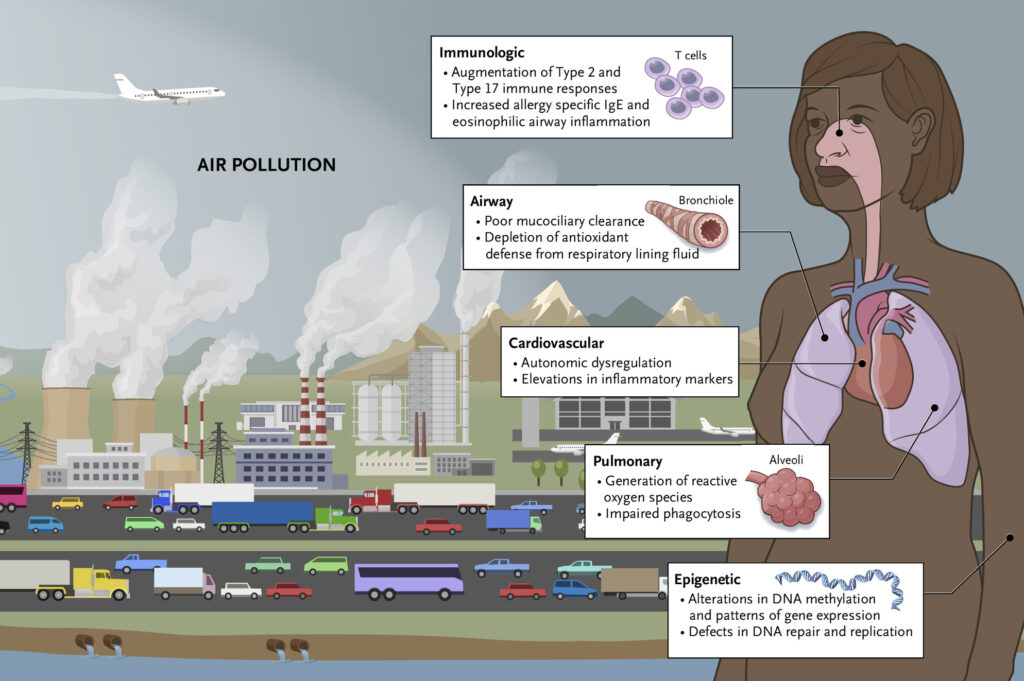
Wind and atmospheric mixing transport pollutants over local to intercontinental scales. When people breathe, inhalable particles (≤2.5 µm) reach the alveoli and may cross into the bloodstream, while gases irritate the airways.
4. Biological Response
Pollutants trigger oxidative stress, inflammation, and endothelial dysfunction. Chronic exposure increases the risk of asthma, chronic obstructive pulmonary disease (COPD), ischemic heart disease, stroke, and lung cancer. Emerging data link long‑term exposure to cognitive decline and adverse birth outcomes.
What Does the Evidence Show?
Multiple lines of evidence converge on the mortality estimate:
- Long‑term cohort studies across North America, Europe, and Asia have documented a dose‑response relationship between annual PM2.5 concentrations and all‑cause mortality (e.g., the American Cancer Society cohort, >500,000 participants).
- Global Burden of Disease (GBD) 2019 analysis, using systematic reviews and exposure‑response functions, attributed 4.2 million deaths to ambient PM2.5 and 2.8 million to indoor air pollution.
- WHO Global Health Estimates 2021 synthesized these findings and reported ~7 million premature deaths, a figure supported by peer‑reviewed meta‑analyses (e.g., Hoek et al., 2013; Cohen et al., 2017).
- Policy impact studies demonstrate that tightening emission standards in the United States (EPA Clean Air Act amendments) and in Europe (EU Air Quality Directive) corresponded with measurable declines in PM2.5 levels and associated mortality reductions.
Overall, the convergence of observational, modeling, and intervention studies provides moderate to strong confidence that air pollution is a major driver of premature mortality.
Main Causes or Drivers
Direct Causes
- Combustion of coal, oil, and gasoline in power generation and transportation.
- Industrial processes such as metal smelting, cement production, and petrochemical manufacturing.
- Agricultural emissions of ammonia and methane.
- Residential burning of biomass and coal for heating and cooking.
Underlying Drivers
- Urbanization and population growth increasing traffic density.
- Economic reliance on fossil‑fuel‑intensive energy systems.
- Insufficient regulatory enforcement in many low‑ and middle‑income countries.
- Climate‑related increases in wildfire frequency, which add episodic spikes of PM2.5.
Environmental and Human Impacts
Environmental Impacts
Air pollutants contribute to acid rain (SO2, NOx), which degrades soils and freshwater bodies, and to ground‑level ozone that damages crops and forests, reducing agricultural yields by up to 10 % in heavily polluted regions (FAO, 2020).
Human Health and Social Impacts
Exposure is linked to:
- Respiratory diseases (asthma, COPD, lung cancer).
- Cardiovascular disease, including heart attacks and strokes.
- Neurological outcomes such as reduced cognitive function and increased dementia risk.
- Adverse birth outcomes (low birth weight, preterm birth).
Vulnerable groups—children, older adults, people with pre‑existing conditions, and low‑income communities located near highways or industrial zones—experience higher exposure and greater health burdens.
Economic and Infrastructure Impacts
The World Bank estimates that air‑pollution‑related health costs amount to roughly 5 % of global GDP, driven by medical expenses and lost productivity. Hospital admissions for respiratory and cardiovascular events rise sharply on days when PM2.5 exceeds WHO guidelines.
Regional Differences
Exposure and mortality vary widely:
- South‑East Asia (India, Bangladesh, Pakistan) records average PM2.5 levels 2–3 times the WHO interim target, accounting for the greatest share of global pollution‑related deaths.
- Sub‑Saharan Africa faces high indoor‑air‑pollution mortality due to widespread use of solid fuels for cooking.
- Western Europe and North America have seen declining trends since the 1990s, yet urban hotspots still exceed WHO limits, especially in disadvantaged neighborhoods.
- Latin America experiences mixed patterns, with improvements in some megacities offset by rising biomass burning emissions in rural areas.
These patterns reflect differences in energy mix, regulatory frameworks, monitoring capacity, and socioeconomic conditions.
What Scientists Know With High Confidence
- Fine particulate matter (PM2.5) is causally linked to increased all‑cause mortality.
- Long‑term exposure to ambient air pollution contributes to cardiovascular disease, respiratory disease, and lung cancer.
- Policy interventions that reduce emissions lead to measurable health benefits within a few years.
- Children and the elderly are more susceptible to adverse health effects.
What Remains Uncertain
Key gaps include precise exposure‑response functions for low‑level concentrations, the health impact of ultrafine particles (<0.1 µm), and the long‑term neurological effects of chronic low‑dose exposure. Additionally, limited monitoring networks in many low‑income regions hinder accurate exposure assessment, creating uncertainty about the true global burden.
Common Misconceptions
Misconception: Only outdoor air matters.
Reality: Indoor air quality can be equally hazardous; WHO estimates that indoor pollution accounts for roughly 3 million of the 7 million deaths.
Misconception: Air pollution is only a problem in developing countries.
Reality: High‑income nations still experience significant health impacts in urban centers, especially among marginalized communities.
Misconception: Wearing a mask eliminates health risks.
Reality: Masks can reduce inhaled particle mass but do not remove all pollutants; systemic emission reductions are required for population‑level health gains.
Solutions and Limitations
Effective strategies span prevention, mitigation, and adaptation:
- Clean energy transition (e.g., phasing out coal) cuts emissions at source, but requires substantial capital investment and grid upgrades.
- Vehicle emission standards (Euro 6, US Tier 3) lower NOx and PM, yet effectiveness depends on enforcement and fleet turnover speed.
- Urban planning that promotes public transit, cycling, and green spaces reduces traffic emissions; however, retrofitting existing cities can be costly and politically challenging.
- Air quality monitoring improves data for policy, yet many regions lack continuous, high‑resolution sensors.
- Public health advisories (e.g., warning days) protect vulnerable groups but do not address root causes.
Each measure has trade‑offs; for instance, biofuel adoption can reduce CO2 but may increase VOC emissions if not managed properly.
What Individuals, Communities, and Governments Can Do
What Individuals Can Do
- Choose low‑emission transport modes (walking, cycling, public transit) when feasible.
- Maintain indoor ventilation while using clean‑fuel stoves or electric cooking appliances.
- Support air‑quality monitoring initiatives and demand transparent reporting.
- Advocate for stricter local emission regulations through community groups.
What Communities and Organizations Can Do
- Implement low‑emission zones or congestion pricing to curb traffic‑related pollutants.
- Develop urban green infrastructure (trees, parks) that can capture particulate matter.
- Partner with schools and workplaces to provide air‑quality alerts and protective equipment on high‑pollution days.
What Governments Can Do
- Adopt and enforce stringent ambient air quality standards aligned with WHO guidelines.
- Provide incentives for renewable energy deployment and phase out coal‑fired power plants.
- Invest in nationwide, high‑resolution monitoring networks to identify hotspots.
- Integrate air‑quality considerations into urban planning, transportation, and climate policies.
What Businesses and Industries Can Do
- Upgrade to best‑available emission control technologies (e.g., scrubbers, catalytic converters).
- Report emissions transparently and set science‑based reduction targets.
- Shift logistics to low‑carbon freight options and optimize supply chains to reduce travel distance.
Closing Synthesis
Air pollution’s ranking as the world’s second leading cause of death reflects a robust body of evidence linking fine particulate matter and gaseous pollutants to a wide range of chronic diseases. The primary drivers—fossil‑fuel combustion, industrial processes, and biomass burning—are amplified by rapid urbanization and insufficient regulation, especially in low‑income regions. High‑confidence findings confirm that reducing emissions yields rapid health benefits, yet uncertainties remain around low‑level exposure effects and data gaps in underserved areas. Systemic solutions—clean energy, stricter standards, and comprehensive monitoring—combined with targeted individual and community actions, offer the most realistic pathway to lower the global mortality burden from polluted air.
Frequently Asked Questions
How is air pollution identified as the second leading cause of death globally?
Air pollution is identified through global disease‑burden analyses that compare mortality attributed to various risk factors. The World Health Organization’s 2021 report estimates roughly 7 million premature deaths each year are linked to ambient and indoor air pollution, placing it behind only cardiovascular disease and cancer combined.
What health problems are most strongly linked to fine particulate matter (PM2.5)?
Fine particulate matter (PM2.5) is strongly associated with increased risk of cardiovascular disease, chronic obstructive pulmonary disease, lung cancer, and premature death. Long‑term cohort studies show a clear dose‑response relationship between annual PM2.5 concentrations and all‑cause mortality.
Which regions experience the highest air‑pollution‑related mortality?
South‑East Asia, particularly India, Bangladesh, and Pakistan, records the highest air‑pollution‑related deaths due to extremely high PM2.5 levels. Sub‑Saharan Africa also faces a large burden from indoor air pollution caused by solid‑fuel cooking, while Western Europe and North America show lower but still significant urban hotspots.
What policies have proven effective in reducing air‑pollution‑related deaths?
Policies such as the U.S. Clean Air Act amendments, the EU Air Quality Directive, and aggressive coal‑phase‑out programs have demonstrably lowered ambient PM2.5 concentrations. Studies show that each 10 µg/m³ reduction in PM2.5 can prevent thousands of premature deaths annually.
How can individuals lower their personal exposure to harmful air pollutants?
Individuals can reduce exposure by using public transit, walking or cycling, improving indoor ventilation, choosing clean‑fuel cooking appliances, and staying informed about air‑quality alerts. While personal actions help, they are most effective when paired with broader community and policy measures.








Leave a Comment