
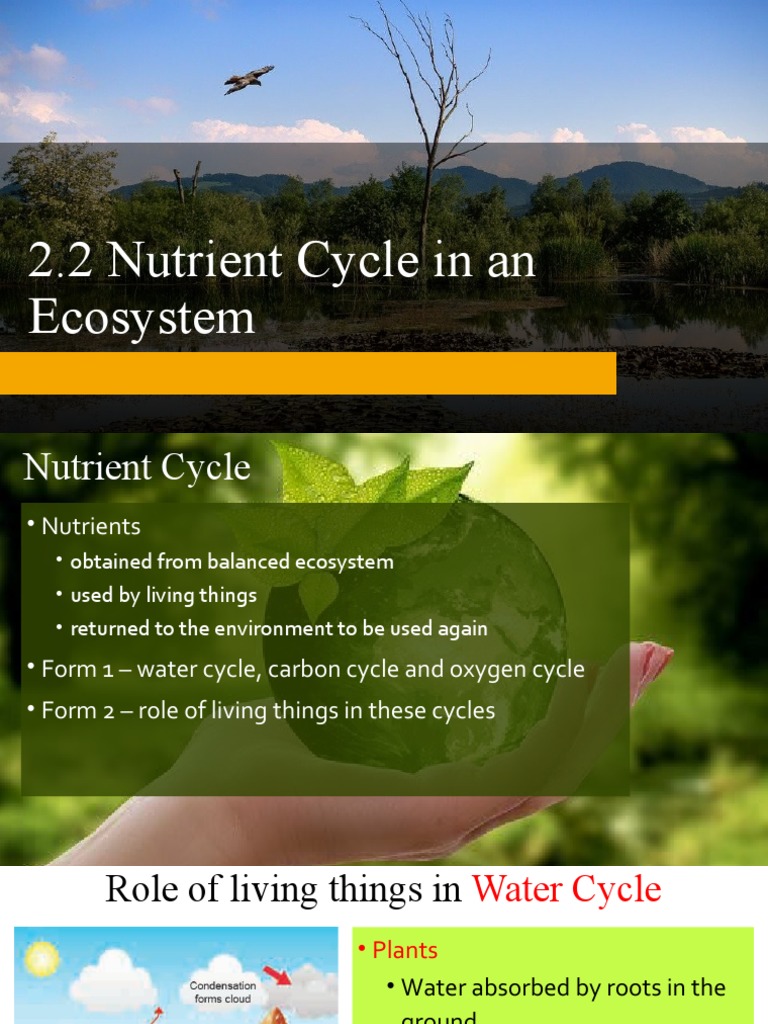
Nutrient cycles continuously recycle essential elements such as carbon, nitrogen, phosphorus, and sulfur, linking soils, water, air, and living organisms to sustain ecosystem health, productivity, and resilience.
Quick Answer
Nutrient cycles are natural biogeochemical pathways that move key elements between the atmosphere, water, soil, and organisms, converting them into biologically usable forms. By linking primary production, decomposition, and atmospheric exchange, these cycles support plant growth, animal nutrition, and microbial activity, which together uphold ecosystem structure and services. Scientific consensus indicates that disrupting any major cycle reduces biodiversity, impairs soil fertility, and can trigger harmful phenomena such as algal blooms, although the exact long‑term thresholds remain uncertain.
Key Takeaways
- Biogeochemical cycles recycle carbon, nitrogen, phosphorus, and sulfur, linking living organisms with the physical environment.
- Intact cycles maintain soil fertility, water quality, and food‑web productivity, enhancing ecosystem resilience.
- Human activities—fertilizer use, fossil‑fuel combustion, and land‑use change—alter the speed and balance of nutrient flows.
- Restoring natural cycling through practices such as cover cropping, wetland protection, and reduced fertilizer application can mitigate many negative impacts.
- High‑confidence science shows that healthy nutrient cycles are essential for climate regulation, clean water, and global food security.
What Is Why Nutrient Cycles Are Essential to Ecosystem Survival?
The phrase refers to the indispensable role that biogeochemical cycles play in keeping ecosystems functional. A nutrient cycle describes the movement of a chemical element from the lithosphere, atmosphere, or hydrosphere into living organisms and back again. The most studied cycles are the carbon, nitrogen, phosphorus, and sulfur cycles. Each follows distinct pathways—photosynthesis, microbial fixation, weathering, or volcanic emissions—but all share the purpose of converting elements into forms that organisms can absorb and later return to the environment. Unlike a one‑way flow, cycles are closed loops that buffer ecosystems against short‑term shortages and recycle waste products, thereby sustaining life over geological timescales.
How Does It Work?
Carbon Cycle
Photosynthetic plants capture atmospheric CO2 and transform it into organic carbon. Herbivores and carnivores ingest this carbon, and respiration releases CO2 back to the air. When organisms die, decomposers break down the organic matter, returning carbon to soils as humus or to the oceans as dissolved inorganic carbon. Long‑term storage occurs in peatlands and permafrost, where low temperatures slow decomposition.
Nitrogen Cycle
Atmospheric N2 is inert for most life. Nitrogen‑fixing bacteria (e.g., Rhizobium) and cyanobacteria convert N2 into ammonia (NH3). Soil microbes oxidize ammonia to nitrate (NO3⁻), which plants absorb. When organisms die, denitrifying bacteria return nitrogen to the atmosphere as N2, completing the loop.
Phosphorus Cycle
Phosphorus resides mainly in rocks. Weathering releases phosphate ions (PO4³⁻) into soils and waterways. Plants take up phosphate, and animals obtain it through consumption. Because phosphorus has no gaseous phase, it returns to sediments when organisms die; geological uplift eventually re‑exposes the mineral source.
Sulfur Cycle
Sulfur enters ecosystems as sulfate (SO4²⁻) from rock weathering or atmospheric deposition. Microbes reduce sulfate to sulfide for incorporation into amino acids. Oxidation of sulfide back to sulfate, aided by oxygenated waters and volcanic emissions, closes the cycle.
What Does the Evidence Show?
Long‑term monitoring by the National Oceanic and Atmospheric Administration (NOAA) documents seasonal carbon fluxes that align with photosynthesis and respiration patterns worldwide. A 2021 systematic review in *Ecology* reported a roughly 30 % decline in nitrogen‑fixation rates in agricultural soils when synthetic fertilizers replace legume rotations, indicating reduced ecosystem nitrogen retention. The Food and Agriculture Organization (FAO) notes that up to 20 % of applied phosphorus is lost via runoff, contributing to eutrophication in freshwater bodies. Across continents, field experiments consistently demonstrate that when nutrient inputs exceed natural processing capacities, biodiversity declines, water quality deteriorates, and soil organic matter is depleted.
Main Causes or Drivers
Direct Human Causes
- Excessive fertilizer application adds nitrogen and phosphorus faster than soils can assimilate them.
- Fossil‑fuel combustion releases large amounts of CO2, altering the carbon balance.
- Deforestation reduces land‑based carbon sinks and disrupts nitrogen fixation by leguminous trees.
Underlying Drivers
- Growing global population increases demand for food, intensifying agricultural inputs.
- Economic incentives favor high‑yield monocultures over diversified cropping systems.
- Urban expansion creates impervious surfaces, accelerating runoff of nutrients into waterways.
Environmental and Human Impacts
Environmental Impacts
When nitrogen or phosphorus loads exceed ecosystem processing capacity, freshwater lakes can experience algal blooms that deplete oxygen, creating hypoxic “dead zones” that kill fish and macrophytes. Soils that lose organic carbon become less able to retain water, increasing erosion risk. Disrupted carbon cycling amplifies atmospheric greenhouse‑gas concentrations, feeding climate change.
Human Health and Social Impacts
Algal toxins from nutrient‑enriched waters can contaminate drinking supplies, posing liver and neurological risks. Declining soil fertility raises food‑price volatility, disproportionately affecting low‑income communities that rely on local agriculture. Loss of fisheries due to dead zones threatens livelihoods in coastal regions worldwide.
Regional Differences
In temperate Europe, intensive livestock production has generated nitrogen surpluses that leach into groundwater, prompting nitrate‑drinking‑water standards. In many tropical regions, heavily weathered soils contain little readily available phosphate, making crops vulnerable to phosphorus deficiency. Arctic tundra ecosystems store vast amounts of carbon in permafrost; warming releases this carbon, altering the global carbon cycle in ways not observed at lower latitudes.
What Scientists Know With High Confidence
- Carbon, nitrogen, and phosphorus cycles are fundamentally linked to ecosystem productivity.
- Human alteration of nutrient inputs can cause measurable water‑quality degradation within decades.
- Soils with active microbial communities retain more carbon and nitrogen than degraded soils.
- Restoration practices such as reforestation, wetland protection, and reduced fertilizer rates improve nutrient balance.
What Remains Uncertain
Key uncertainties include the long‑term fate of excess phosphorus stored in sediments, the precise threshold at which nitrogen deposition shifts from fertilizing to damaging across different biomes, and how climate‑driven changes in precipitation will interact with nutrient transport pathways. Improved global monitoring networks and integrated modeling are needed to narrow these gaps.
Common Misconceptions
Misconception: Nutrient cycles only matter to scientists.
Reality: Cycles affect everyday resources—clean water, fertile soil, and stable food supplies—so understanding them matters to anyone who eats or drinks.
Misconception: Adding more fertilizer always increases crop yields.
Reality: Beyond a certain point, additional nitrogen or phosphorus is not taken up by plants and instead leaches into waterways, causing environmental harm without boosting yields.
Misconception: Carbon sequestration can be achieved solely by planting trees.
Reality: While afforestation captures carbon, the overall carbon balance also depends on soil carbon dynamics, disturbance regimes, and the longevity of the planted forest.
Solutions and Limitations
Effective strategies combine prevention, mitigation, and restoration:
- Precision agriculture: Uses sensor data to apply fertilizers only where needed, reducing excess runoff. Limitation: Requires investment in technology and farmer training.
- Cover cropping and crop rotation: Enhances nitrogen fixation and builds soil organic matter. Limitation: May reduce short‑term cash‑crop area and requires careful management.
- Wetland protection and restoration: Wetlands naturally filter nitrogen and phosphorus before they reach streams. Limitation: Land‑use pressures can conflict with development goals.
- Nutrient trading schemes: Provide economic incentives to limit discharges. Limitation: Effectiveness depends on robust monitoring and enforcement.
What Individuals, Communities, and Governments Can Do
What Individuals Can Do
- Choose food products grown with low‑input or organic practices.
- Reduce food waste to lessen demand for fertilizer‑intensive production.
- Maintain garden soils with compost rather than synthetic fertilizers.
What Communities and Organizations Can Do
- Implement storm‑water green infrastructure (e.g., rain gardens) to capture nutrient runoff.
- Promote local composting programs that recycle organic waste into nutrient‑rich soil amendments.
- Educate farmers about integrated nutrient‑management plans.
What Governments Can Do
- Set science‑based nutrient loading limits for rivers and coastal zones.
- Fund research and monitoring networks that track nutrient fluxes at watershed scales.
- Provide subsidies or tax incentives for adoption of precision‑agriculture tools and cover‑crop seeds.
Closing Synthesis
Nutrient cycles are the lifeblood of ecosystems, continuously recycling the elements that sustain plants, animals, and humans. Robust scientific evidence shows that intact cycles underpin soil health, water quality, and climate regulation, while human‑induced disruptions generate measurable environmental and social harms. Although core mechanisms are well understood, uncertainties remain about long‑term thresholds and climate interactions. Evidence‑based solutions—such as smarter fertilizer use, wetland protection, and policy incentives—offer the most reliable path forward, but they must be implemented alongside equitable actions that respect regional realities and socioeconomic constraints.
Frequently Asked Questions
What are nutrient cycles and why are they important for ecosystems?
Nutrient cycles are natural pathways that move elements like carbon, nitrogen, phosphorus, and sulfur between the atmosphere, water, soil, and living organisms. They convert these elements into forms that plants and animals can use, supporting growth, decomposition, and overall ecosystem productivity.
How do the carbon, nitrogen, and phosphorus cycles differ from each other?
The carbon cycle relies on photosynthesis and respiration to exchange CO₂ between air, plants and soils. The nitrogen cycle involves microbial fixation of atmospheric N₂ into ammonia, nitrification, plant uptake, and denitrification back to N₂. The phosphorus cycle depends on rock weathering to release phosphate, with no gaseous phase, and returns to sediments when organisms die.
Which human activities most strongly disrupt nutrient cycles?
Excessive fertilizer use adds nitrogen and phosphorus faster than soils can absorb them, fossil‑fuel combustion releases large amounts of CO₂, and deforestation removes trees that fix nitrogen and store carbon. These actions alter the speed and balance of nutrient flows, leading to imbalances.
In what ways can restoring wetlands improve nutrient cycling?
Wetlands act as natural filters, allowing microbes to convert excess nitrate and phosphate into less harmful forms before they reach streams. Restoring wetlands therefore reduces nutrient runoff, improves water quality, and helps re‑establish balanced nitrogen and phosphorus cycles.
What practical steps can individuals take to support healthy nutrient cycles?
Individuals can choose foods grown with low‑input or organic methods, reduce food waste to lower fertilizer demand, and use compost instead of synthetic fertilizers in home gardens. These actions help keep nutrient inputs aligned with natural cycling capacities.







Leave a Comment