
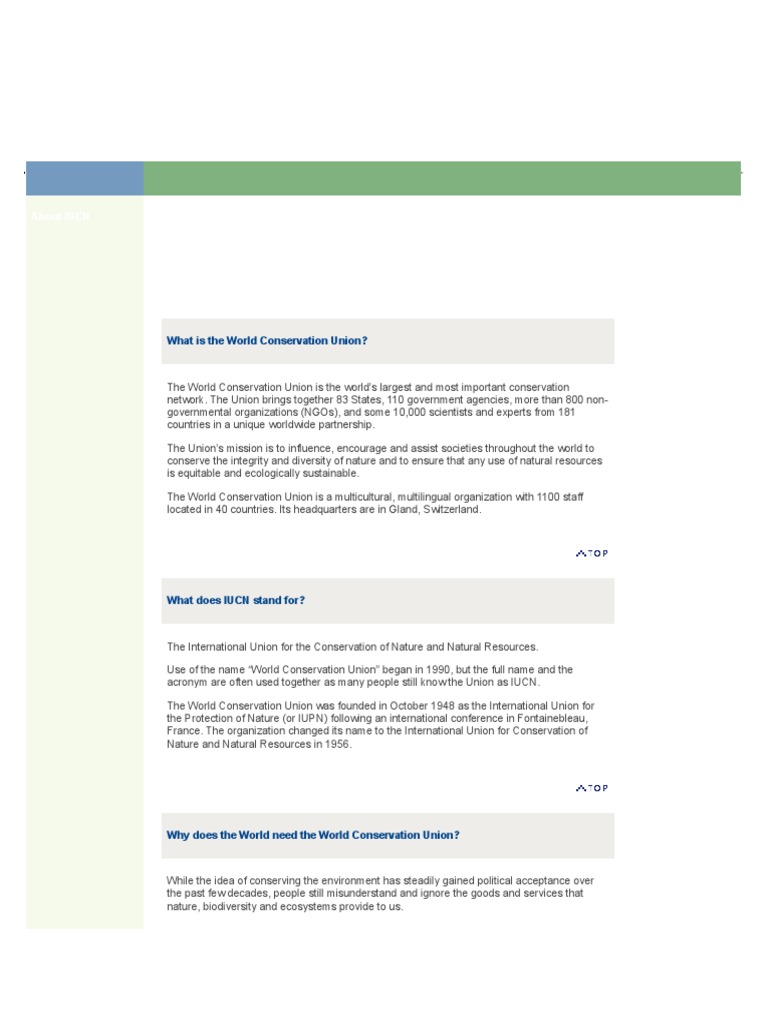
The International Union for Conservation of Nature (IUCN) is a global network of governments, NGOs and experts that assesses species risk, advises policy and supports on‑the‑ground conservation to safeguard biodiversity.
Quick Answer
The IUCN is an intergovernmental organization founded in 1948 that brings together more than 1,400 member groups to generate scientific knowledge, set conservation standards and influence international agreements. Its most visible tool is the Red List of Threatened Species, which ranks species by extinction risk using rigorous criteria. By providing data, guidelines and capacity‑building, the IUCN helps governments and practitioners prioritize actions, design protected areas and negotiate treaties such as the Convention on Biological Diversity. While its influence is strong, outcomes depend on political will and funding, creating some uncertainty about long‑term impact.
Key Takeaways
- The IUCN coordinates science, policy and on‑the‑ground action for global biodiversity conservation.
- The Red List is the world’s most comprehensive assessment of species extinction risk.
- The organization shapes major treaties (CBD, CITES) and supports the creation of protected areas worldwide.
- Capacity‑building and local community engagement are core to the IUCN’s strategy.
- Effectiveness hinges on member commitment, funding streams and political context.
What Is the IUCN and What Does It Actually Do?
The International Union for Conservation of Nature (IUCN) is a membership‑driven union of governments, non‑governmental organizations, indigenous peoples and scientific experts. Its charter defines a mission to “influence, encourage and assist societies to conserve the integrity and diversity of nature.” Established in 1948, the IUCN now has more than 1,400 members and operates from its headquarters in Gland, Switzerland. Unlike a single‑purpose NGO, the IUCN functions as a platform for collaborative research, policy advice and practical implementation across all ecosystems.
How Does It Work?
The IUCN’s work follows a structured cycle that links data, assessment, policy and implementation.
1. Data Collection and Scientific Assessment
Member experts conduct field surveys, compile monitoring data and publish peer‑reviewed analyses. These inputs feed into standardized assessment tools such as the Red List criteria, the Global Species Programme and the World Commission on Protected Areas (WCPA) guidelines.
2. Synthesis and Publication
Assessments are reviewed by independent panels, then published in open‑access databases. The Red List, for example, classifies species into categories ranging from “Least Concern” to “Critically Endangered” using quantitative thresholds for population size, decline rate and geographic range.
3. Policy Advice and International Negotiation
The IUCN Secretariat provides scientific briefings to United Nations conventions, regional bodies and national governments. Its experts sit on negotiating tables for the Convention on Biological Diversity (CBD) and the Convention on International Trade in Endangered Species (CITES), translating scientific evidence into treaty language.
4. Capacity Building and On‑the‑Ground Support
Through regional workshops, training programs and grant mechanisms, the IUCN builds local expertise. It helps design protected‑area networks, develop species recovery plans and implement community‑based monitoring.
What Does the Evidence Show?
Multiple lines of evidence confirm the IUCN’s central role in biodiversity governance. The Intergovernmental Science‑Policy Platform on Biodiversity and Ecosystem Services (IPBES) cites the Red List as a “critical baseline” for global biodiversity assessments. Systematic reviews of conservation outcomes (e.g., a 2019 meta‑analysis in *Conservation Biology*) find that projects informed by IUCN guidelines achieve higher species‑recovery rates than those lacking such standards. Moreover, a 2022 assessment by the United Nations Environment Programme reported that over 70 % of newly designated protected areas incorporated IUCN WCPA criteria, indicating broad institutional uptake.
Main Causes or Drivers of Conservation Challenges
Direct Human Pressures
- Habitat loss from agriculture, urban expansion and infrastructure.
- Unsustainable harvesting of wildlife and plants.
- Pollution and invasive species that alter ecosystem function.
Underlying Socio‑Economic Drivers
- Population growth and rising demand for natural resources.
- Economic incentives that favor short‑term extraction over long‑term stewardship.
- Weak governance and limited enforcement of environmental laws.
Environmental and Human Impacts
Environmental Impacts
When species decline, ecosystem services such as pollination, water filtration and carbon storage are compromised. A 2020 World Bank report links reduced forest biodiversity to lower watershed stability, increasing flood risk for downstream communities.
Human Health and Social Impacts
Loss of biodiversity can amplify disease emergence; the World Health Organization notes that disturbed ecosystems raise the probability of zoonotic spillover. Additionally, many Indigenous and rural peoples depend on local species for food, medicine and cultural identity, making biodiversity loss a direct threat to livelihoods.
Regional Differences
Implementation of IUCN tools varies by region. In tropical Africa, limited funding constrains Red List assessments, resulting in data‑deficient classifications for many amphibians. Conversely, Europe has a long history of protected‑area planning, and most national parks follow WCPA standards. In the Pacific Islands, community‑led marine protected areas often integrate traditional knowledge alongside IUCN guidelines, illustrating a hybrid governance model.
What Scientists Know With High Confidence
- The Red List provides the most comprehensive, peer‑reviewed inventory of global extinction risk.
- Protected‑area networks that adhere to IUCN criteria consistently show higher biodiversity retention than unmanaged lands.
- Science‑policy interfaces led by the IUCN improve the alignment of national biodiversity strategies with international targets.
What Remains Uncertain
Key gaps include the completeness of species assessments in understudied taxa (e.g., invertebrates), the long‑term socio‑economic outcomes of community‑based conservation, and the degree to which IUCN‑informed policies translate into on‑the‑ground enforcement in regions with weak governance. Improved monitoring and longitudinal studies are needed to close these gaps.
Common Misconceptions
Misconception: The IUCN is a single conservation NGO.
Reality: The IUCN is a union of governments, NGOs, Indigenous groups and scientific bodies, operating as a collaborative platform rather than a single‑purpose charity.
Misconception: The Red List decides which species receive funding.
Reality: The Red List provides risk assessments; funding decisions are made by donors and governments, although the List is a key reference for prioritization.
Misconception: IUCN policies guarantee species recovery.
Reality: Policies set standards and provide guidance, but successful recovery also depends on local implementation, financing and political stability.
Solutions and Limitations
The IUCN promotes a suite of strategies that together address biodiversity loss.
- Protected‑area expansion: Effective when sites are ecologically representative and socially inclusive, but can conflict with land‑use rights if not properly negotiated.
- Species recovery plans: Targeted actions (captive breeding, habitat restoration) improve status for many taxa, yet success rates vary and require long‑term funding.
- Policy integration: Embedding IUCN guidelines into national legislation aligns development with conservation, but enforcement gaps often limit impact.
- Capacity building: Training local practitioners increases stewardship, though scaling up remains constrained by resource availability.
What Individuals, Communities, and Governments Can Do
What Individuals Can Do
- Support organizations that fund IUCN assessments and field projects.
- Choose sustainably sourced products that reduce habitat pressure.
- Participate in citizen‑science programs that contribute data to IUCN databases.
What Communities and Organizations Can Do
- Adopt IUCN‑based monitoring protocols for local wildlife.
- Engage in co‑management of protected areas, integrating traditional knowledge with scientific guidelines.
- Apply for IUCN grant schemes that support habitat restoration.
What Governments Can Do
- Incorporate Red List data into national biodiversity strategies and land‑use planning.
- Allocate budget lines for long‑term protected‑area management following WCPA standards.
- Facilitate transparent reporting to IUCN mechanisms, enhancing global data completeness.
Closing Synthesis
The IUCN serves as the world’s principal hub for biodiversity knowledge, standards and policy advice. Its evidence‑based tools—most notably the Red List and protected‑area guidelines—help align global conservation effort with scientific understanding. While high‑confidence findings underscore the value of these tools, uncertainties remain around assessment coverage and implementation effectiveness. By strengthening data gaps, securing financing, and ensuring inclusive governance, the IUCN’s framework can continue to steer humanity toward a more resilient and biodiverse future.
Frequently Asked Questions
What is the primary purpose of the IUCN?
The IUCN’s primary purpose is to influence, encourage and assist societies in conserving the integrity and diversity of nature through science, policy advice and on‑the‑ground action.
How does the IUCN Red List determine a species’ risk category?
The Red List uses quantitative criteria such as population size, rate of decline, geographic range and degree of fragmentation to assign species to categories from Least Concern to Critically Endangered.
In what ways does the IUCN influence international environmental agreements?
The IUCN provides scientific briefings, expert panels and policy recommendations that shape the language and implementation of treaties like the Convention on Biological Diversity and CITES.
What are some limitations of IUCN‑guided conservation strategies?
Limitations include uneven data coverage for many taxa, reliance on political will for enforcement, funding constraints, and potential conflicts with local land‑use rights if not properly managed.
How can ordinary citizens support the work of the IUCN?
Individuals can support IUCN by donating to its programs, choosing sustainably sourced products, and participating in citizen‑science projects that contribute observations to IUCN databases.








Leave a Comment