
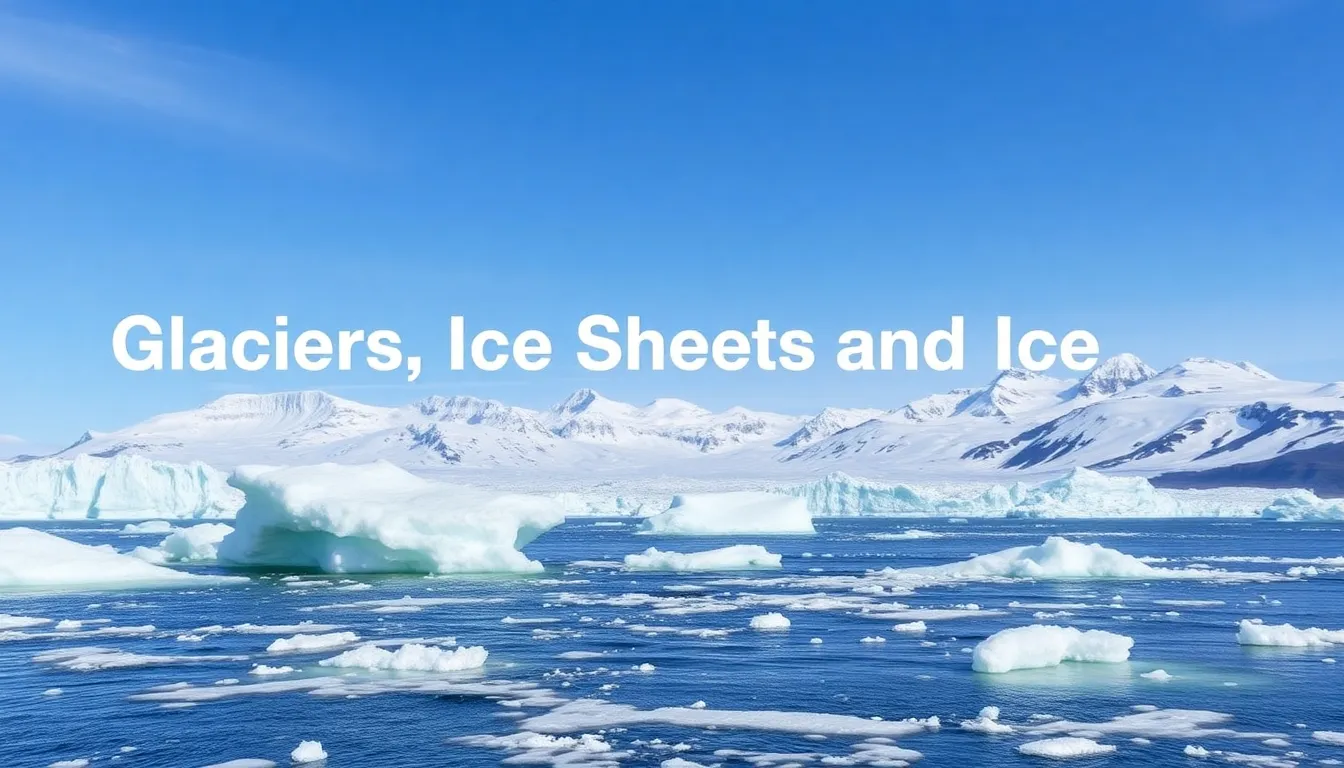
Understanding the Three Cryospheric Components
Glaciers
Glaciers are flowing masses of ice that form in mountainous regions and high‑latitude plateaus. They accumulate snow in winter, compress it into ice, and slowly move downhill under gravity. Though smaller than ice sheets, glaciers store about 10 percent of the world’s freshwater and are highly sensitive to temperature shifts. For detailed regional information, see our glaciers collection.
Ice Sheets
Ice sheets are continent‑scale ice bodies that cover more than 50,000 square kilometers. The two present‑day ice sheets—Antarctica and Greenland—contain roughly 99 percent of Earth’s freshwater ice. Their sheer size gives them a long‑term influence on sea level, and subtle changes can translate into meters of global rise over centuries. Explore further at ice sheets.
Sea Ice
Sea ice forms when ocean water freezes at the surface in polar regions. Unlike glaciers and ice sheets, sea ice is already floating, so its melt does not directly raise sea level. However, it regulates heat exchange, influences ocean circulation, and provides habitat for a wide range of wildlife. Our dedicated section on sea ice offers more depth.
Why Melting Matters: Climate, Sea Level, and Ecosystems
Melting in any of the three components triggers a cascade of effects:
- Sea‑level rise: Water released from glaciers and ice sheets adds to the ocean, threatening low‑lying coasts and island nations.
- Albedo feedback: Ice reflects sunlight. When it disappears, darker ocean or land surfaces absorb more heat, accelerating warming.
- Ocean circulation: Freshwater influx can alter the density‑driven currents that transport heat around the globe, potentially reshaping climate patterns.
- Marine ecosystems: Changes in sea‑ice extent affect species such as krill, seals, and polar bears, with knock‑on effects up the food chain.
Collectively, these impacts intersect with topics like sea level rise, ocean warming and ocean acidification.
How Melting Happens: Physical Processes
Melting is driven by a combination of atmospheric and oceanic forces:
- Surface melt: Rising air temperatures melt the exposed surface of ice. Meltwater can percolate down, lubricating the base of glaciers and ice sheets and increasing flow speed.
- Basal melt: Warmer ocean currents erode the underside of marine‑terminating glaciers and ice shelves, thinning them from below.
- Calving: Large chunks of ice break off from the edge of a glacier or ice sheet and become icebergs. Calving accelerates mass loss when the glacier retreats faster than it can replenish.
- Sub‑seasonal variability: Weather patterns such as heatwaves, foehn winds, or oceanic heat spikes can cause rapid, short‑term melt episodes.
These mechanisms interact, making predictions complex but critical for planning.
Key Indicators and Measurement Techniques
Scientists monitor melt through several complementary methods:
- Satellite remote sensing: Instruments like NASA’s GRACE and ESA’s CryoSat track changes in ice mass, thickness, and extent.
- Airborne laser altimetry: Flights over polar regions measure surface elevation changes with centimeter precision.
- Ground‑based GPS and stake networks: Fixed points record vertical motion and horizontal flow rates on glaciers.
- Ocean temperature profiling: Moorings and autonomous floats detect warm water intrusions that drive basal melt.
Data from these sources feed into the sea‑level rise projections used by policymakers worldwide.
Impacts on Coastal Communities and Adaptation Strategies
Rising seas threaten infrastructure, freshwater supplies, and livelihoods. In many regions, even a few centimeters of additional water can increase flooding frequency, erode shorelines, and contaminate groundwater. Communities are responding through:
- Coastal adaptation: Elevating buildings, constructing seawalls, and restoring natural buffers such as mangroves. See coastal adaptation for case studies.
- Managed retreat: Relocating vulnerable populations and abandoning high‑risk zones.
- Early‑warning systems: Integrating tide‑gauge data with climate forecasts to give residents more preparation time.
Effective adaptation hinges on accurate, localized projections of ice‑mass loss and sea‑level rise.
Implications for Marine Life and Coral Reefs
The loss of sea ice reshapes habitats for species that rely on ice cover for breeding or feeding. For example, reduced Arctic sea‑ice limits the hunting grounds of polar bears and alters the distribution of phytoplankton, the base of the marine food web. Warmer, fresher water entering the ocean can also stress coral reefs by increasing temperatures and promoting algal blooms. Learn more about these connections at marine ecosystems and coral reefs.
Connections to Ocean Warming and Acidification
Ice melt does not occur in isolation. Warmer atmospheric temperatures accelerate surface melt, while ocean warming intensifies basal melt. In addition, the influx of freshwater can modify the carbonate chemistry of seawater, influencing acidification rates. These linked processes create feedback loops that amplify climate impacts across the cryosphere and the oceans.
Future Projections and Uncertainties
Climate models project a wide range of outcomes depending on greenhouse‑gas emissions pathways:
- Low‑emission scenarios (RCP2.6): Global mean temperature rise limited to ~1.5 °C, resulting in slower ice loss and sea‑level rise under 0.5 m by 2100.
- High‑emission scenarios (RCP8.5): Temperatures could exceed 4 °C, potentially triggering rapid Greenland ice‑sheet destabilization and sea‑level rise exceeding 1 m by century’s end.
Uncertainties stem from complex ice dynamics, such as the potential for marine‑based ice‑sheet collapse, and from regional climate variability. Continuous observation and model refinement are essential.
Common Misconceptions
Addressing myths helps the public grasp the seriousness of melt:
- “Sea ice melt raises sea level” – Because sea ice is already floating, its melt does not directly add volume to the ocean, though indirect effects exist.
- “All ice is melting at the same rate” – Glaciers, ice sheets, and sea ice respond differently to temperature, ocean currents, and local geography.
- “Melting is inevitable and irreversible” – While some loss is locked in for centuries, reducing emissions can slow or even halt further rapid melt.
What You Can Do: From Awareness to Action
Individuals, communities, and governments can contribute to slowing melt and preparing for its impacts:
- Reduce carbon footprint: Energy efficiency, renewable electricity, and sustainable transportation lower the temperature drivers of melt.
- Support climate‑resilient policies: Advocate for robust coastal‑flooding mitigation plans and funding for scientific monitoring.
- Stay informed: Follow updates from reputable sources, including our own series on oceans and ice.
- Engage in local adaptation: Participate in community planning for sea‑level rise, support habitat restoration, and encourage resilient building practices.
Collective effort can preserve the cryosphere and the myriad systems it supports.
Related Topics to Explore
Our pillar article serves as a hub for deeper dives into specific areas:
- Coastal flooding dynamics
- Ocean warming mechanisms
- Ocean acidification impacts
- Marine ecosystem responses
Frequently Asked Questions
What is the difference between glaciers, ice sheets and sea ice?
Glaciers are mountain‑valley ice flows, ice sheets are continent‑scale ice masses covering Antarctica and Greenland, and sea ice is frozen ocean water that floats on the sea surface.
How does melting ice contribute to sea‑level rise?
When land‑based ice (glaciers and ice sheets) melts, the water flows into the oceans, adding volume and raising sea level. Sea‑ice melt itself does not directly raise sea level because it is already floating.
Why is sea‑ice loss important if it doesn’t raise sea level?
Sea‑ice loss reduces the Earth’s albedo, allowing more solar energy to be absorbed, which accelerates warming. It also disrupts habitats for species like polar bears and krill, affecting the entire marine food web.
Can the melting of Greenland’s ice sheet be stopped?
While some melt is already committed, reducing global greenhouse‑gas emissions can limit further temperature rise, slowing the rate of Greenland ice‑sheet loss and preventing the most extreme scenarios.
What role do humans play in accelerating ice melt?
Human activities that increase atmospheric CO₂ and other greenhouse gases raise global temperatures, intensifying surface and basal melt processes across all three ice types.
Conclusion
Melting glaciers, ice sheets and sea ice is a clear signal of a warming planet, with profound consequences for sea level, weather patterns, and marine life. By understanding the processes, recognizing the risks, and taking coordinated mitigation and adaptation actions, societies can reduce future impacts and protect vulnerable coastal and polar regions.
Frequently Asked Questions
What is the difference between glaciers, ice sheets and sea ice?
Glaciers are mountain‑valley ice flows, ice sheets are continent‑scale ice masses covering Antarctica and Greenland, and sea ice is frozen ocean water that floats on the sea surface.
How does melting ice contribute to sea‑level rise?
When land‑based ice (glaciers and ice sheets) melts, the water flows into the oceans, adding volume and raising sea level. Sea‑ice melt itself does not directly raise sea level because it is already floating.
Why is sea‑ice loss important if it doesn’t raise sea level?
Sea‑ice loss reduces the Earth’s albedo, allowing more solar energy to be absorbed, which accelerates warming. It also disrupts habitats for species like polar bears and krill, affecting the entire marine food web.
Can the melting of Greenland’s ice sheet be stopped?
While some melt is already committed, reducing global greenhouse‑gas emissions can limit further temperature rise, slowing the rate of Greenland ice‑sheet loss and preventing the most extreme scenarios.
What role do humans play in accelerating ice melt?
Human activities that increase atmospheric CO₂ and other greenhouse gases raise global temperatures, intensifying surface and basal melt processes across all three ice types.





Leave a Comment