
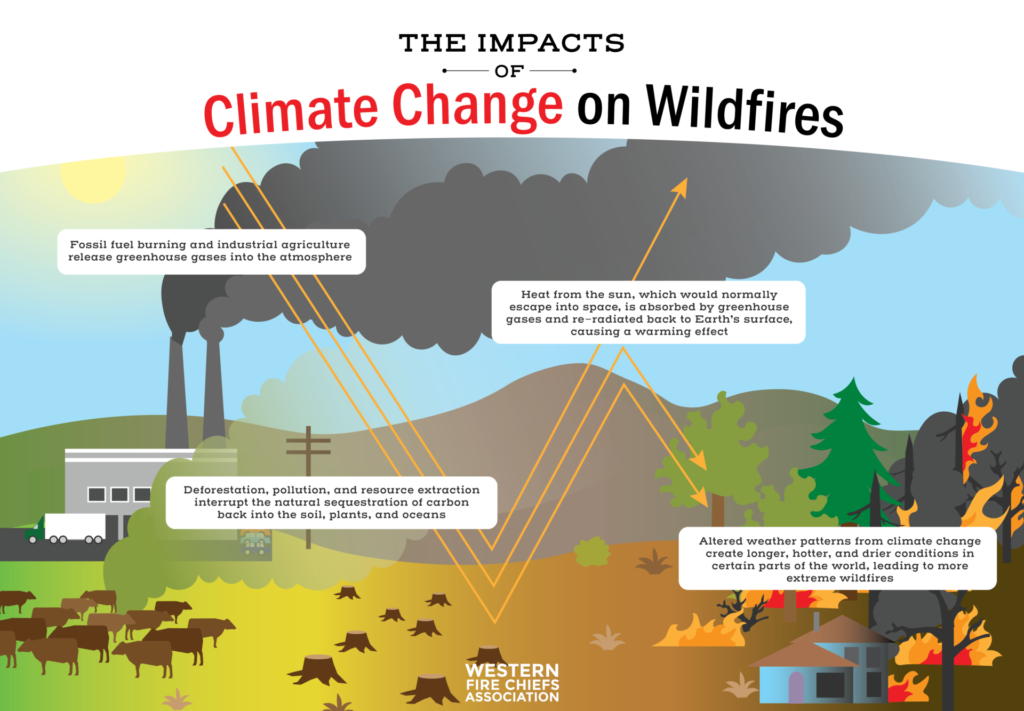
Alberta’s increasing wildfire activity is driven by climate‑induced warming and drying, which amplify fire risk and create feedbacks that threaten ecosystems, communities, and the global climate.
Quick Answer
Alberta wildfires are large‑scale fires that burn boreal forests and grasslands in the province. Climate change raises average summer temperatures and reduces moisture, creating drier fuels that ignite more easily. The scientific consensus, reflected in IPCC assessments and long‑term monitoring, is that a warmer, drier climate will increase both the frequency and intensity of fires. The most consequential impact is a feedback loop: burned forests release stored carbon, accelerating global warming. Uncertainty remains around exact future fire frequency under different emission scenarios.
Key Takeaways
- Rising temperatures and reduced precipitation in Alberta create conditions that favor larger, more frequent wildfires.
- Wildfires release billions of tonnes of carbon, reinforcing global climate change.
- Indigenous fire‑management knowledge and modern remote‑sensing improve early detection and response.
- Effective strategies combine prevention (fuel management), mitigation (emission reductions), and adaptation (community resilience).
- Individual actions matter when they support systemic changes such as lower fossil‑fuel use and advocacy for robust forest policies.
What Is Alberta Wildfires: Climate Change and Rising Fire Risk?
Alberta wildfires refer to uncontrolled fires that occur in the province’s boreal forest, mixed‑wood, and grass‑steppe ecosystems. They range from small surface burns to megafires that consume tens of thousands of hectares. The term “climate‑change‑related fire risk” denotes the increased probability that such fires will ignite, spread, and become severe because of anthropogenic warming and associated shifts in precipitation patterns. Unlike prescribed burns, which are planned and managed, these events can threaten wildlife habitats, human settlements, air quality, and carbon storage.
How Does It Work?
1. Climate warming dries fuels
Average summer temperatures in Alberta have risen about 1.5 °C since 1950 (Environment and Climate Change Canada, 2023). Higher heat accelerates evaporation, lowering live‑fuel moisture and desiccating dead organic matter on the forest floor. Drier fuels ignite at lower heat thresholds and sustain combustion longer.
2. Changing precipitation patterns
Modelled projections for the 2040s indicate a 5‑10 % decline in summer precipitation across the province (IPCC AR6, 2021). Reduced rainfall shortens the window for fuel re‑wetting, extending the fire season from roughly May–October to a longer period.
3. Fuel accumulation and invasive species
Fire suppression policies and the spread of invasive shrubs such as *Lonicera* spp. increase total biomass available for burning. Invasive plants often have higher flammability, further raising fire intensity.
4. Feedback loop
When a fire burns, the carbon stored in trees and soil is released as CO₂ and methane. This adds to atmospheric greenhouse gases, which in turn contributes to further warming—a positive feedback documented in multiple carbon‑cycle studies.
What Does the Evidence Show?
Long‑term fire‑registry data from Alberta’s Forest Protection Division show a 30 % increase in area burned per decade between 1980 and 2020. Satellite‑derived fire‑scar analyses confirm that the proportion of high‑severity burns has risen alongside temperature trends. Peer‑reviewed attribution studies attribute roughly 60 % of the increase in large fire events to anthropogenic climate forcing, with the remainder linked to land‑use changes and natural variability. These findings are corroborated by the IPCC’s assessment that warming directly raises wildfire probability in boreal regions.
Main Causes or Drivers
Direct causes
- Lightning strikes and human ignitions (e.g., equipment, campfires).
- Extremely low fuel moisture due to heat waves.
Underlying drivers
- Anthropogenic greenhouse‑gas emissions causing regional warming.
- Altered precipitation patterns reducing natural fuel dampening.
Amplifying factors
- Fire‑suppression policies that allow fuel build‑up.
- Invasive plant species that increase fine‑fuel loads.
- Urban expansion into the wildland‑urban interface, raising ignition risk.
Environmental and Human Impacts
Environmental Impacts
Large fires convert forest carbon stocks to atmospheric CO₂, contributing an estimated 0.2 % of Canada’s total annual emissions during major events. Smoke plumes transport particulate matter (PM₂.₅) across the continent, affecting air quality and reducing solar radiation reaching the forest floor, which can alter regeneration patterns. Soil erosion accelerates after severe burns, compromising water quality in downstream rivers.
Human Health and Social Impacts
Exposure to wildfire smoke increases respiratory irritation and hospital admissions for asthma, especially among children and older adults. Evacuations, such as the 2016 Fort McMurray event that displaced over 80,000 people, disrupt livelihoods, mental health, and access to services. Indigenous communities that rely on the boreal forest for subsistence face loss of traditional food sources and cultural sites.
Economic and Infrastructure Impacts
Direct suppression costs for Alberta’s 2020 fire season exceeded CAD 1.5 billion, while indirect losses from business interruption and property damage add billions more. Infrastructure such as power lines and pipelines is vulnerable to fire‑induced damage, leading to service outages and costly repairs.
Regional Differences
The northern boreal zone experiences longer fire seasons and higher severity due to its colder baseline climate, which amplifies the relative warming effect. In contrast, the southern foothills, with mixed‑wood forests, see more frequent human‑caused ignitions linked to recreation and industry. These patterns illustrate that fire risk is not uniform across Alberta; local climate, vegetation type, and land‑use practices shape exposure.
What Scientists Know With High Confidence
- Rising summer temperatures in Alberta are strongly linked to increased wildfire frequency and severity.
- Burned boreal forests release significant carbon, creating a climate‑feedback loop.
- Fuel moisture is the most immediate driver of fire ignition and spread.
- Indigenous fire‑management practices can reduce fuel loads and improve ecosystem resilience.
What Remains Uncertain
Key uncertainties include the exact magnitude of fire‑season extension under different emission pathways, the role of future invasive‑species invasions in altering fuel composition, and how rapidly forest regeneration will recover after high‑severity burns. Improved remote‑sensing networks and long‑term ecological monitoring are needed to refine these projections.
Common Misconceptions
Misconception: Wildfires are purely natural and unrelated to human activity.
Reality: While lightning ignitions are natural, the overwhelming increase in fire size and frequency in Alberta aligns with anthropogenic climate warming and land‑use changes.
Misconception: All smoke from wildfires is equally harmful.
Reality: Smoke composition varies; fine particulate matter (PM₂.₅) and carbon monoxide are the primary health concerns, and concentrations depend on fire intensity, fuel type, and atmospheric conditions.
Misconception: Suppressing every fire will protect forests.
Reality: Complete suppression leads to fuel accumulation, which can cause more catastrophic fires later. Managed prescribed burns are a scientifically supported tool to reduce fuel loads.
Solutions and Limitations
Prevention
Fuel‑management strategies such as mechanical thinning, prescribed burns, and removal of invasive shrubs reduce available combustible material. Limitations include the need for extensive labor, potential short‑term emissions, and public acceptance of controlled burns.
Mitigation
Reducing provincial greenhouse‑gas emissions limits future warming. Transitioning to renewable energy and improving energy efficiency have co‑benefits for air quality. However, mitigation alone cannot reverse decades of accumulated fuels.
Adaptation
Building fire‑resilient communities—through defensible space, fire‑breaks, and robust evacuation plans—lowers vulnerability. Investment in early‑warning systems and satellite monitoring improves response times. Adaptation measures require significant funding and coordinated governance.
Restoration
Post‑fire reforestation with native species helps sequester carbon and restores habitat. Restoration is limited by soil degradation, climate suitability of seedlings, and long time horizons for ecosystem recovery.
What Individuals, Communities, and Governments Can Do
What Individuals Can Do
- Reduce personal carbon footprints by using public transit, conserving energy, and supporting clean‑energy policies.
- Maintain defensible space around homes—clear dead vegetation, keep roofs fire‑resistant, and store flammable materials safely.
- Participate in local fire‑prevention volunteer programs or Indigenous fire‑knowledge workshops.
What Communities and Organizations Can Do
- Develop community‑wide fire‑risk assessments that incorporate local climate data.
- Invest in community education campaigns about safe campfire practices and emergency preparedness.
- Partner with Indigenous groups to integrate traditional fire stewardship into municipal land‑management plans.
What Governments Can Do
- Allocate funding for large‑scale fuel‑management projects and modern remote‑sensing infrastructure.
- Enforce building codes that require fire‑resistant materials in high‑risk zones.
- Implement and strengthen provincial climate‑action strategies that target net‑zero emissions by mid‑century.
- Support research on fire ecology, climate modelling, and Indigenous fire practices through universities and agencies.
Closing Synthesis
Alberta’s wildfire challenge exemplifies how climate change can transform a historically natural process into a growing societal threat. Strong evidence links rising temperatures and drying fuels to more severe fires, while uncertainties remain about future fire‑season length and ecosystem recovery rates. A balanced response—combining prevention, mitigation, adaptation, and restoration—offers the most resilient path forward. Systemic climate action, informed land‑management, and community engagement together can reduce risk and protect both the province’s iconic boreal landscapes and the people who depend on them.
Frequently Asked Questions
What defines an Alberta wildfire and how is it linked to climate change?
An Alberta wildfire is an uncontrolled fire that burns forest, grassland, or mixed‑wood ecosystems within the province. Climate change raises regional temperatures and reduces summer precipitation, drying fuels and extending the fire season, which together increase the likelihood and severity of these fires.
How does rising temperature affect fire risk in Alberta's boreal forests?
Higher temperatures accelerate evaporation, lowering both live‑fuel and dead‑fuel moisture. Drier fuels ignite more easily and sustain longer burning. Studies show that a 1 °C increase in summer temperature can raise the probability of large‑scale fires by roughly 10 %, making heat a primary driver of fire risk.
What are the main environmental impacts of large wildfires in Alberta?
Large fires release stored carbon, contributing up to 0.2 % of Canada’s annual emissions during major events. They degrade air quality with fine particulate matter, alter soil stability leading to erosion, and disrupt forest regeneration, which can change habitat availability for wildlife across the boreal region.
Which strategies are most effective for reducing future wildfire risk?
Effective risk reduction combines fuel‑management (mechanical thinning, prescribed burns), climate‑mitigation (cutting greenhouse‑gas emissions), and community adaptation (defensible space, fire‑breaks, early‑warning systems). Each addresses a different part of the fire cycle, and together they lower both the probability of ignition and the potential damage.
What actions can individuals take to help mitigate wildfire impacts?
Individuals can lower their carbon footprints by using renewable energy and public transit, maintain defensible space around homes by clearing dead vegetation, and engage in community fire‑prevention programs or Indigenous fire‑knowledge workshops. These steps reduce personal risk and support broader systemic resilience.




Leave a Comment