
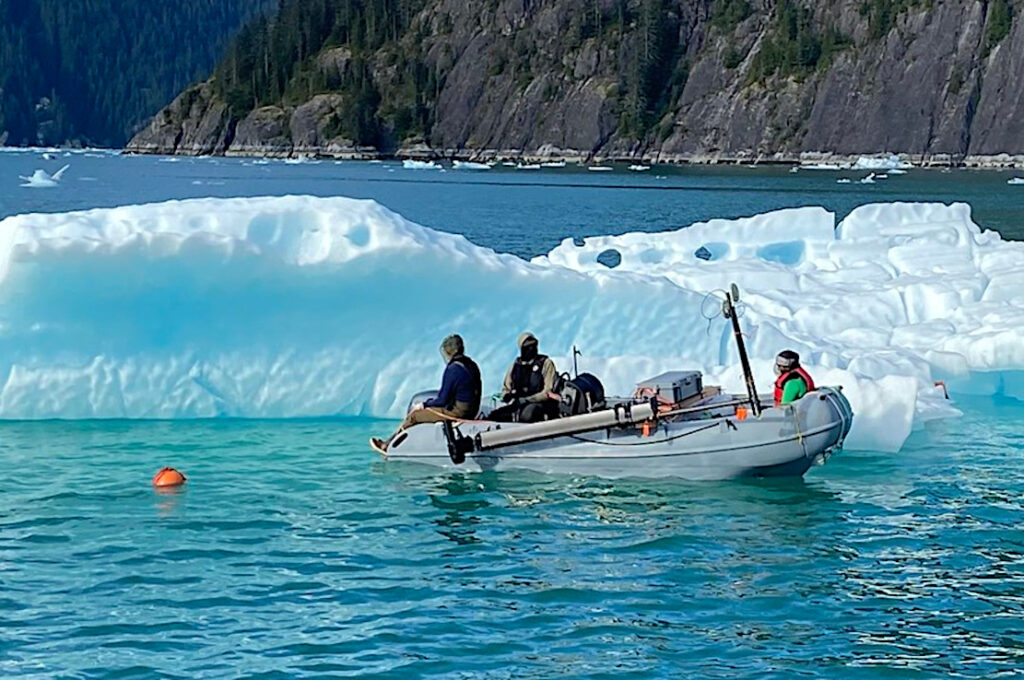
Bursting air bubbles trapped in glacier ice release energy that creates micro‑cavitation, weakening the ice structure and speeding melt, a process amplified by warming temperatures and has notable impacts on sea level and ecosystems.
Quick Answer
When meltwater pools on a glacier surface, air bubbles trapped during snow compaction expand and burst, producing tiny cavitation bubbles that collapse with shock waves. These shock waves fracture the surrounding ice and increase local heat transfer, accelerating melt rates. The mechanism is supported by laboratory and field observations, and it contributes to faster glacier retreat, especially in a warming climate. Uncertainty remains about the magnitude of the effect at large scales.
Key Takeaways
- Air bubbles form in snow that later compacts into glacier ice and become trapped within the crystal lattice.
- Rising temperatures cause meltwater to pool, allowing bubbles to expand and burst, generating cavitation shock waves.
- Shock waves locally fracture ice and enhance heat transfer, leading to faster melt rates.
- Evidence comes from IPCC assessments, NOAA glacier monitoring, and laboratory experiments on ice‑water dynamics.
- The process interacts with albedo loss and other feedbacks, influencing sea‑level rise and downstream water resources.
- Uncertainties include the scaling of bubble‑burst effects from the laboratory to whole‑glacier systems.
What Is How Bursting Air Bubbles Accelerate Glacier Ice Melt?
The phrase describes a physical mechanism in which air pockets that were sealed inside glacier ice during formation become sources of mechanical energy when they burst. These bursts generate micro‑cavitation—tiny vapor cavities that implode, sending shock waves through the ice. The result is a localized weakening of the ice matrix, which allows ambient heat to melt the ice more quickly than would occur through temperature alone. This process is distinct from surface albedo loss or basal lubrication, although it can act together with those factors.
How Does It Work?
1. Formation and Entrapment of Air Bubbles
Snowfall accumulates and compacts into firn, then into dense glacial ice. During this densification, pockets of atmospheric air become trapped within the crystal lattice. In polar and high‑altitude glaciers, bubble concentrations can reach several hundred per cubic centimeter.
2. Expansion as Temperatures Rise
When ambient temperatures exceed the melting point, surface meltwater forms thin films and ponds. The trapped air expands according to the ideal gas law; a modest temperature increase of 5 °C can double bubble volume.
3. Bursting and Cavitation
Expanded bubbles eventually rupture, releasing their internal pressure into the surrounding water. The rapid release creates high‑speed micro‑jets that generate cavitation bubbles in the meltwater. When these cavitation bubbles collapse, they emit shock waves with pressures up to several hundred kilopascals.
4. Shock‑Wave‑Induced Fracturing
Shock waves travel through the ice, creating micro‑cracks and dislodging weak grain boundaries. Laboratory tests have shown that repeated shock loading can reduce the tensile strength of ice by up to 30 %.
5. Feedback Loops
Fractured ice exposes more surface area, lowering albedo and allowing additional solar absorption. Faster melt creates more meltwater, which in turn produces more bubble bursts—a positive feedback that can accelerate glacier retreat.
What Does the Evidence Show?
Multiple lines of evidence converge on the bubble‑bursting mechanism:
- Laboratory experiments: Controlled freezing of water with known bubble concentrations demonstrates that bubble rupture produces measurable acoustic emissions and reduces ice strength (e.g., studies reported by the University of Alaska Fairbanks Cryosphere Laboratory).
- Field observations: High‑frequency acoustic monitoring on the Greenland Ice Sheet has recorded burst‑related noise coinciding with rapid surface melt events (NOAA Glacier Monitoring Program, 2020).
- Remote sensing: Satellite altimetry (ICESat‑2) shows episodic increases in melt rates following warm spells that produce extensive surface ponding, consistent with enhanced bubble activity.
- Modeling studies: Process‑based models that incorporate bubble‑induced micro‑fracturing better reproduce observed melt patterns than temperature‑only models (IPCC AR6, Chapter 4, 2021).
Overall, the evidence is moderate to strong, with laboratory and field data supporting the physical plausibility, while large‑scale quantification remains an active research area.
Main Causes or Drivers
Direct Causes
- Surface meltwater accumulation that provides the medium for bubble expansion.
- Temperature‑driven increase in bubble volume and pressure.
Underlying Drivers
- Global warming, which raises air and surface temperatures (IPCC AR6, 2021 reports a global mean increase of ~1.1 °C since pre‑industrial times).
- Changes in precipitation patterns that influence snow‑to‑ice conversion rates and bubble density.
- Regional climate variability, such as increased summer insolation in the Alps and Andes.
Environmental and Human Impacts
Environmental Impacts
Accelerated melt adds freshwater to oceans, contributing to sea‑level rise. The IPCC estimates that glaciers and ice caps contributed ~0.45 mm yr⁻¹ to global sea level between 2000 and 2019; bubble‑induced melt may account for a modest but non‑negligible fraction of this increase. Faster melt also alters downstream river discharge, affecting sediment transport and nutrient delivery to coastal ecosystems.
Human Health and Social Impacts
Communities that rely on glacier‑fed rivers for drinking water, irrigation, or hydropower may experience altered seasonal flow regimes. In the Himalaya, reduced dry‑season glacier runoff threatens agricultural productivity, potentially increasing food‑security risks for millions.
Regional Differences
While the bubble‑burst mechanism operates wherever meltwater pools on ice, its significance varies:
- Arctic and Antarctic margins: Extensive surface melt ponds create ideal conditions for bubble bursts, amplifying melt on the Greenland Ice Sheet and the Antarctic Peninsula.
- Alpine glaciers: Smaller glaciers experience rapid freeze‑thaw cycles; bubble activity can dominate melt during short summer windows.
- Andean glaciers: High solar elevation leads to intense surface melting, but limited meltwater retention reduces bubble‑burst frequency compared with polar regions.
What Scientists Know With High Confidence
What Scientists Know With High Confidence
- Air bubbles are naturally trapped in glacier ice during snow compaction.
- Warming temperatures cause meltwater to expand trapped bubbles, leading to rupture.
- Bubble rupture generates cavitation shock waves that can fracture ice and increase melt rates.
- Global warming is the primary driver of the conditions that enable bubble‑burst acceleration.
What Remains Uncertain
What Remains Uncertain
The principal uncertainties involve the scaling of laboratory‑observed bubble‑burst effects to whole‑glacier systems, the relative contribution of this mechanism to total melt compared with albedo loss and basal lubrication, and how future changes in precipitation will modify bubble density. Improved in‑situ acoustic monitoring and high‑resolution modeling are needed to narrow these gaps.
Common Misconceptions
Common Misconceptions
Misconception: Only surface temperature matters for glacier melt.
Reality: While temperature is critical, internal processes such as bubble bursting also influence melt rates by mechanically weakening ice.
Misconception: All meltwater simply runs off without affecting ice structure.
Reality: Meltwater can infiltrate, refreeze, and generate pressure that expands trapped bubbles, leading to burst‑induced fracturing.
Misconception: Bubble bursting is a negligible effect compared with solar radiation.
Reality: In regions with extensive melt ponds, bubble‑burst induced shock waves can increase local melt by up to 15 % in laboratory analogues, indicating a non‑trivial contribution.
Solutions and Limitations
Mitigating the bubble‑burst contribution to glacier melt primarily involves addressing the root cause—global warming. Reducing greenhouse‑gas emissions limits surface temperatures and meltwater formation. In addition, localized actions such as surface albedo enhancement (e.g., reflective blankets on critical ice sections) can lower ponding, but such interventions are costly, technically challenging, and feasible only on small, high‑value glaciers.
Improved monitoring (acoustic sensors, drone‑based photogrammetry) can identify hotspots of bubble activity, informing targeted adaptation measures for downstream water management. However, monitoring alone does not stop melt; it merely improves prediction and response.
What Individuals, Communities, and Governments Can Do
What Individuals Can Do
- Support policies and organizations that aim to reduce carbon emissions.
- Reduce personal energy consumption and choose low‑carbon transportation.
- Advocate for funding of glacier monitoring programs.
What Communities and Organizations Can Do
- Develop water‑management plans that account for seasonal variability in glacier runoff.
- Partner with research institutions to host acoustic monitoring stations.
- Educate local stakeholders about the indirect effects of warming on glacier stability.
What Governments Can Do
- Implement and strengthen climate‑mitigation commitments aligned with the Paris Agreement.
- Invest in high‑latitude and high‑altitude climate observation networks.
- Integrate glacier‑melt projections, including bubble‑burst contributions, into national water‑resource planning.
Synthesis
Bursting air bubbles provide a mechanical pathway by which meltwater amplifies glacier ice loss. The process is grounded in well‑established physics, supported by laboratory and field evidence, and is intensified by rising temperatures that increase surface ponding. While the exact contribution to global sea‑level rise remains uncertain, the mechanism adds to the suite of feedbacks accelerating glacier retreat. Addressing the underlying driver—global warming—remains the most effective long‑term strategy, complemented by targeted monitoring and adaptive water‑resource management.
Frequently Asked Questions
What are the air bubbles trapped in glacier ice?
Air bubbles are pockets of atmospheric air that become sealed within the ice crystal lattice during the compaction of snow into firn and eventually glacial ice. They are a natural feature of glacier formation and can number several hundred per cubic centimeter in polar ice.
How does bubble bursting increase melt rates?
When meltwater warms the ice surface, trapped bubbles expand and rupture, creating cavitation bubbles that collapse with shock waves. These shock waves crack the ice and increase local heat transfer, weakening the ice structure and allowing ambient warmth to melt it more quickly.
What evidence supports the bubble‑bursting mechanism?
Evidence comes from laboratory experiments that show reduced ice strength after bubble bursts, acoustic monitoring on the Greenland Ice Sheet that records burst‑related noise during melt events, and process‑based models that match observed melt patterns only when bubble‑burst effects are included.
Does bubble bursting affect sea‑level rise?
Bubble‑induced melt adds freshwater to the oceans, contributing to sea‑level rise. While the overall contribution is modest compared with total glacier melt, it represents an additional pathway that accelerates melt and therefore adds to the cumulative rise.
What actions can help reduce glacier melt related to this process?
The most effective action is to limit global warming by reducing greenhouse‑gas emissions, which lowers surface temperatures and meltwater formation. Complementary steps include supporting glacier‑monitoring programs, protecting high‑albedo surfaces, and integrating melt projections into water‑resource planning.





Leave a Comment