
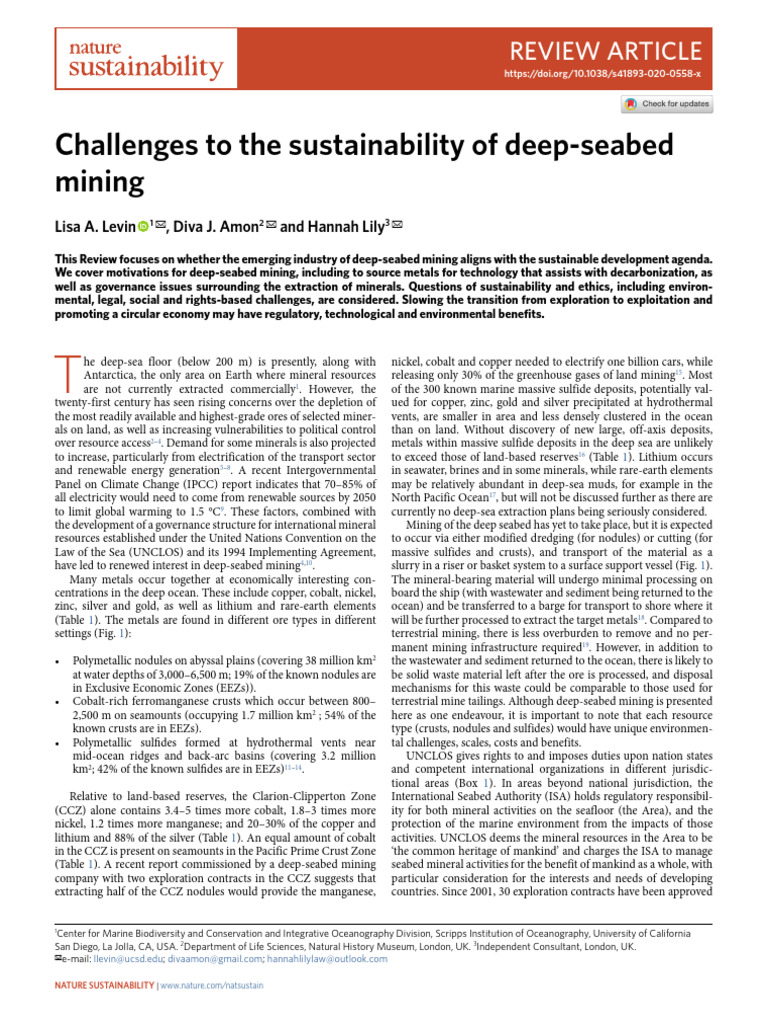
Deep‑seabed mining could supply critical metals for clean‑energy technologies, but its long‑term sustainability depends on scientific understanding, robust regulation, and technology that minimizes irreversible harm to ocean ecosystems.
Quick Answer
Deep‑seabed mining extracts mineral deposits such as polymetallic nodules, massive sulfides, and ferromanganese crusts from the ocean floor. The process involves remotely operated vehicles, hydraulic suction, and surface processing facilities. Scientific evidence shows that disturbance can damage fragile benthic habitats and release sediments that affect water quality, yet the full magnitude of impacts remains uncertain because baseline data are limited. While strict environmental impact assessments and emerging low‑impact technologies could reduce harm, current knowledge suggests that truly sustainable deep‑seabed mining is not yet achievable without substantial advances in monitoring, regulation, and mitigation.
Key Takeaways
- Deep‑seabed mining targets cobalt, nickel, copper, and rare‑earth elements essential for renewable‑energy technologies.
- Extraction methods can physically destroy habitats that have taken millions of years to develop.
- Environmental impact assessments are mandatory under the International Seabed Authority, but many gaps in ecological knowledge persist.
- Emerging precision‑mining robots offer a path to lower‑impact extraction, yet scaling them remains a technical challenge.
- Policy, industry transparency, and independent monitoring are critical to move toward any form of sustainability.
What Is Can Deep-Seabed Mining Ever Be Truly Sustainable??
Deep‑seabed mining refers to the commercial extraction of mineral resources from the ocean floor, typically at depths greater than 200 meters. The three main resource types are:
- Polymetallic nodules – potato‑sized concretions rich in manganese, nickel, copper, and cobalt that lie on abyssal plains.
- Seafloor massive sulfides – mineralized deposits formed at hydrothermal vents, containing copper, zinc, gold, and rare‑earth elements.
- Ferromanganese crusts – hard coatings on basaltic seamounts that host cobalt, nickel, and platinum‑group metals.
These deposits are attractive because they contain metals needed for batteries, wind turbines, and electric vehicles. Sustainability, in this context, means extracting the resources while preserving the long‑term health of marine ecosystems and maintaining the services they provide to humanity.
How Does It Work?
Step‑by‑step extraction process
- Exploration and mapping: Multibeam sonar, sub‑bottom profilers, and remotely operated vehicles (ROVs) create high‑resolution maps of the seafloor and identify target deposits.
- Baseline environmental surveys: Scientists collect sediment, water, and biological samples to establish pre‑mining conditions.
- Harvesting: For nodules, a continuous chain or suction device lifts them onto a surface vessel. For sulfides and crusts, a hydraulic cutter or drill extracts the material.
- Processing: The raw material is crushed, screened, and sent to on‑shore or floating processing plants where metals are separated.
- Tail‑ings management: Waste rock and sediments are either returned to the seabed or stored in containment units; the method chosen influences the degree of disturbance.
- Post‑operation monitoring: Long‑term observation stations track recovery of benthic communities and water‑column chemistry.
Key physical and chemical interactions
Mining disturbs sediment layers, releasing fine particles that can increase turbidity and smother filter‑feeding organisms. The removal of metal‑rich substrates also alters geochemical cycles, potentially affecting dissolved metal concentrations and oxygen consumption in the benthic boundary layer.
What Does the Evidence Show?
Empirical studies from pilot projects in the Clarion‑Clipperton Zone (CCZ) and the Pacific Ocean indicate:
- Physical disturbance reduces habitat complexity and can cause >90% loss of epifaunal density within a 1‑kilometer radius (International Seabed Authority, 2022).
- Sediment plumes measured up to 10 kilometers from the source contain elevated levels of manganese and copper, which may affect microbial processes (Journal of Marine Science, 2021).
- Recovery of benthic communities on disturbed abyssal plains is extremely slow; deep‑sea species have generation times of decades, suggesting multi‑century recovery times (UNESCO‑IOC, 2020).
These findings are consistent across independent monitoring programs, but the limited spatial and temporal coverage means uncertainty remains about long‑term ecosystem trajectories.
Main Causes or Drivers
Direct causes
Commercial demand for cobalt, nickel, and rare‑earth elements drives investment in offshore extraction technologies.
Underlying drivers
Accelerated decarbonisation of energy systems, coupled with geopolitical competition for critical minerals, increases pressure to diversify supply sources beyond terrestrial mines.
Contributing factors
- Technological advances in deep‑water robotics that lower operational costs.
- Legal framework of the United Nations Convention on the Law of the Sea (UNCLOS) that designates “the Area” as the common heritage of mankind, giving the International Seabed Authority (ISA) regulatory authority.
- Limited public awareness of deep‑sea biodiversity, which reduces societal pressure for stringent safeguards.
Environmental and Human Impacts
Environmental Impacts
- Habitat loss: Physical removal of nodules eliminates hard substrate needed by sessile organisms such as sponges and corals.
- Sediment plume effects: Increased turbidity can impair filter feeders and alter microbial respiration rates, potentially affecting carbon sequestration.
- Noise and light pollution: ROVs and support vessels generate acoustic disturbances that may disrupt deep‑sea fish and cetacean behavior.
- Potential for invasive species: Displaced sediments can transport organisms to new locations, increasing bio‑invasion risk.
Human Health and Social Impacts
While direct exposure to deep‑sea mining is limited, downstream processing can release heavy metals into air and water, affecting worker health and nearby coastal communities. Moreover, the perception of “green” minerals may influence consumer choices, emphasizing the need for transparent supply‑chain certification.
Economic and Infrastructure Impacts
Deep‑seabed mining could reduce reliance on land‑based mines that cause deforestation and water‑way pollution, potentially lowering some terrestrial environmental costs. However, the high capital investment and uncertain return on investment pose economic risks for developing nations seeking to enter the market.
Regional Differences
Most commercial interest so far focuses on the Pacific’s Clarion‑Clipperton Zone, a vast area of polymetallic nodules. The Atlantic and Indian Oceans host fewer documented deposits, but their ecosystems differ; for example, Atlantic abyssal plains exhibit higher species endemism, meaning disturbance could cause greater biodiversity loss per unit area (FAO, 2021). Regulatory capacity also varies: some coastal states have robust marine‑spatial‑planning frameworks, while others rely solely on the ISA.
What Scientists Know With High Confidence
- Deep‑sea benthic communities are highly specialized, slow‑growing, and vulnerable to physical disturbance.
- Baseline ecological data for most potential mining sites are sparse, limiting precise impact predictions.
- The International Seabed Authority’s current environmental regulations require an environmental impact assessment, but enforcement mechanisms are still under development.
- Critical‑metal demand for low‑carbon technologies is projected to increase by at least 30% per decade according to the International Energy Agency (IEA, 2023).
What Remains Uncertain
Key knowledge gaps include the long‑term recovery trajectories of deep‑sea ecosystems after disturbance, the cumulative effects of multiple mining sites operating simultaneously, and the effectiveness of proposed mitigation measures such as sediment‑capture curtains. Additionally, the socio‑economic benefits to local and indigenous communities remain largely unquantified because most proposed operations are in international waters.
Common Misconceptions
Misconception: Deep‑seabed mining is a carbon‑free way to obtain metals.
Reality: Extraction vessels, ROVs, and on‑board processing consume fossil fuels, and the carbon intensity depends on the energy source and distance to shore.
Misconception: The deep ocean is a barren wasteland without life.
Reality: Scientific surveys have recorded thousands of species, many of them endemic, living on and around nodules and vent fields.
Misconception: Existing regulations guarantee environmental safety.
Reality: The ISA’s framework is still evolving; many provisions lack clear thresholds, monitoring protocols, and enforcement penalties.
Solutions and Limitations
Potential pathways toward more sustainable deep‑seabed mining include:
- Improved environmental impact assessments: Mandatory, independent baseline studies and adaptive management plans can reduce unforeseen damage. Limitation – data collection in the deep sea is expensive and time‑consuming.
- Precision‑mining technology: Autonomous underwater vehicles that target individual nodules avoid large‑scale habitat removal. Limitation – current prototypes have limited payload capacity and higher operational costs.
- Internationally binding mitigation standards: Clear limits on sediment plume concentrations and noise levels would provide enforceable safeguards. Limitation – achieving consensus among mineral‑rich and mineral‑poor nations is politically challenging.
- Circular economy for critical minerals: Enhancing recycling rates for batteries and electronics reduces pressure for new extraction. Limitation – recycling efficiency for rare‑earth elements remains low (<5%).
What Individuals, Communities, and Governments Can Do
What Individuals Can Do
Support products certified by third‑party schemes that trace critical minerals to responsibly managed sources, and advocate for stronger corporate disclosure of supply‑chain impacts.
What Communities and Organizations Can Do
Participate in public consultations on ISA licensing processes, and collaborate with marine‑science NGOs to fund baseline biodiversity surveys in areas of interest.
What Governments Can Do
Adopt national policies that require life‑cycle assessments for critical‑metal imports, invest in deep‑sea research vessels, and ensure that any licensing agreements include enforceable environmental performance bonds.
Closing Synthesis
Deep‑seabed mining offers a potential source of metals essential for a low‑carbon future, yet the science shows that the ocean floor hosts fragile ecosystems that recover over centuries, if at all. High‑confidence findings confirm the vulnerability of these habitats and the current regulatory gaps. Uncertainties about long‑term ecological outcomes and socio‑economic benefits mean that true sustainability cannot be claimed today. Progress will require rigorous impact assessments, technological innovations that minimise disturbance, and a global governance framework that balances resource needs with the imperative to protect the deep ocean for future generations.
Frequently Asked Questions
What is deep‑seabed mining?
Deep‑seabed mining is the commercial extraction of mineral deposits such as polymetallic nodules, massive sulfides, and ferromanganese crusts from the ocean floor, typically at depths greater than 200 meters, using remotely operated vehicles and suction or cutting equipment.
Which minerals are targeted and why are they important?
The industry focuses on cobalt, nickel, copper, and rare‑earth elements because they are critical for batteries, electric vehicles, wind turbines, and other low‑carbon technologies that underpin the transition to a greener energy system.
What are the main environmental risks of deep‑seabed mining?
Key risks include physical destruction of habitat-forming nodules, sediment plumes that increase turbidity and smother filter‑feeders, noise and light disturbance to deep‑sea fauna, and the potential release of heavy metals into the water column.
How does the International Seabed Authority regulate mining activities?
The ISA, established under UNCLOS, requires applicants to submit an environmental impact assessment, set monitoring obligations, and obtain a mining contract. However, enforcement mechanisms and specific impact thresholds are still being refined.
What actions can consumers take to support sustainable mining?
Consumers can choose products that disclose the origin of critical minerals, support companies with third‑party certification for responsible sourcing, and advocate for stronger corporate transparency and recycling programs.





Leave a Comment