
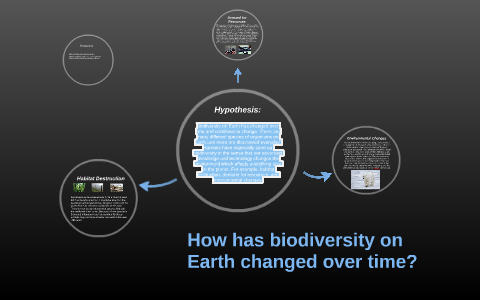
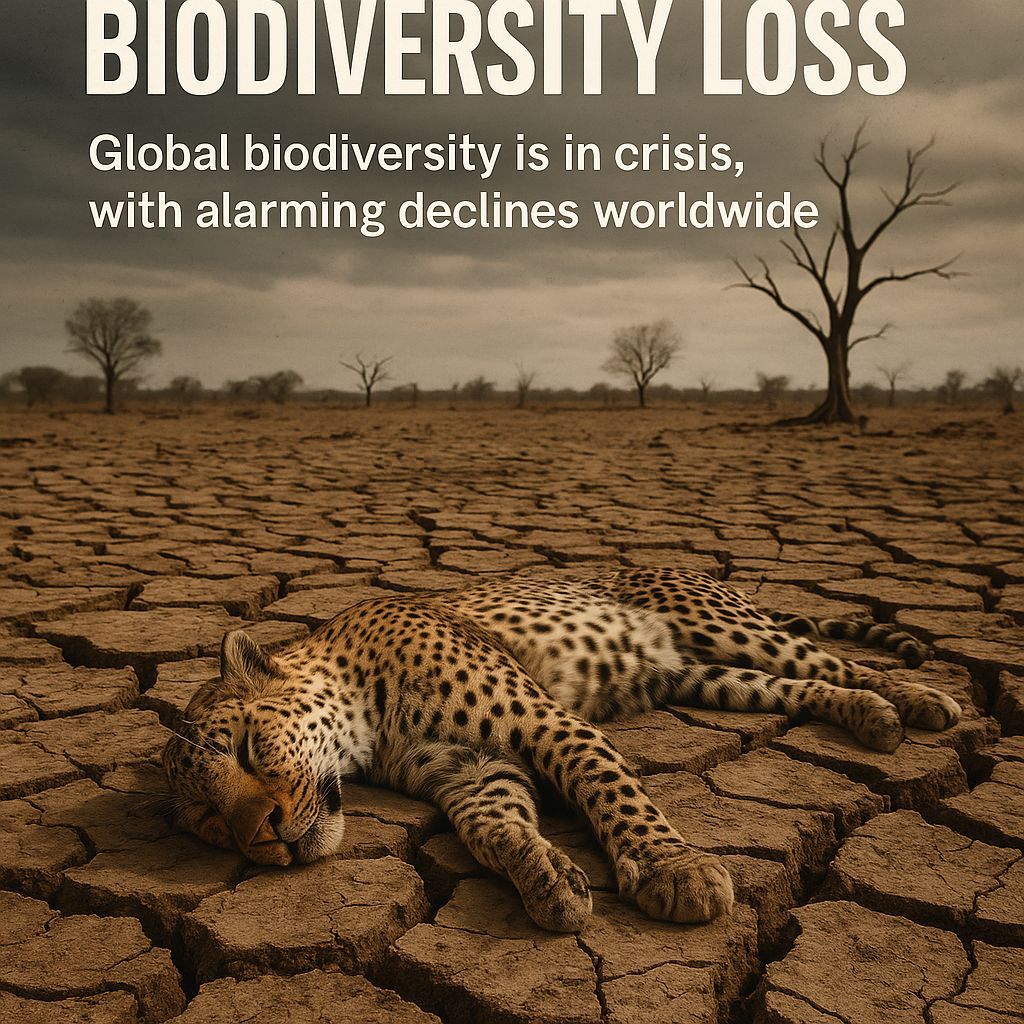
Biodiversity, the variety of life from genes to ecosystems, has risen over billions of years, been reshaped by five major mass‑extinction events, and is now declining at rates far faster than the natural background because of human‑driven habitat loss, climate change, pollution and overexploitation.
Quick Answer
Biodiversity refers to the genetic, species and ecosystem variation that sustains planetary life. Over geological time it expanded through evolution, punctuated by five mass‑extinction pulses, and today faces an unprecedented decline driven primarily by habitat conversion, climate warming, chemical pollution and unsustainable harvest. The most significant implication is the erosion of ecosystem services—food, water regulation, disease control and cultural benefits—that underpin human well‑being. While the direction of loss is clear, exact extinction timelines for many poorly studied taxa remain uncertain.
Key Takeaways
- Life began ~3.5 billion years ago and diversified dramatically during the Cambrian Explosion (~541 Ma).
- Five recognized mass‑extinction events removed up to 96% of marine species, resetting evolutionary pathways.
- Since the mid‑18th century, human activities have accelerated species loss to 100–1,000 times the background rate.
- Habitat loss is the single largest driver, followed by climate change, pollution and overexploitation.
- Protected‑area expansion, sustainable land use and ecosystem restoration are the most effective mitigation strategies.
- Key uncertainties involve extinction probabilities for invertebrates and microbes, and how multiple stressors will interact under future climate scenarios.
What Is What Has Happened to Biodiversity Over Time??
The phrase asks us to trace the amount and distribution of life from deep time to the present, linking evolutionary dynamics, ancient extinction events and modern anthropogenic pressures. Biodiversity includes three nested levels: genetic diversity within populations, species diversity across taxa, and ecosystem diversity that shapes the functioning of forests, reefs, grasslands and wetlands. Understanding its trajectory matters because the stability of ecosystem services—pollination, carbon storage, water purification—depends on this variety.
How Does It Work?
Evolutionary Diversification
Natural selection, genetic drift and speciation gradually fill ecological niches. The Cambrian Explosion produced most animal phyla within a relatively short window, establishing the basic architecture of modern ecosystems.
Mass‑Extinction Pulses
Five major events—End‑Ordovician, Late Devonian, End‑Permian, End‑Triassic and End‑Cretaceous—rapidly removed large fractions of species. The End‑Permian (≈252 Ma) eliminated ~96% of marine and ~70% of terrestrial species, illustrating how rapid environmental change can reset biodiversity.
Human‑Driven Drivers Since the Industrial Revolution
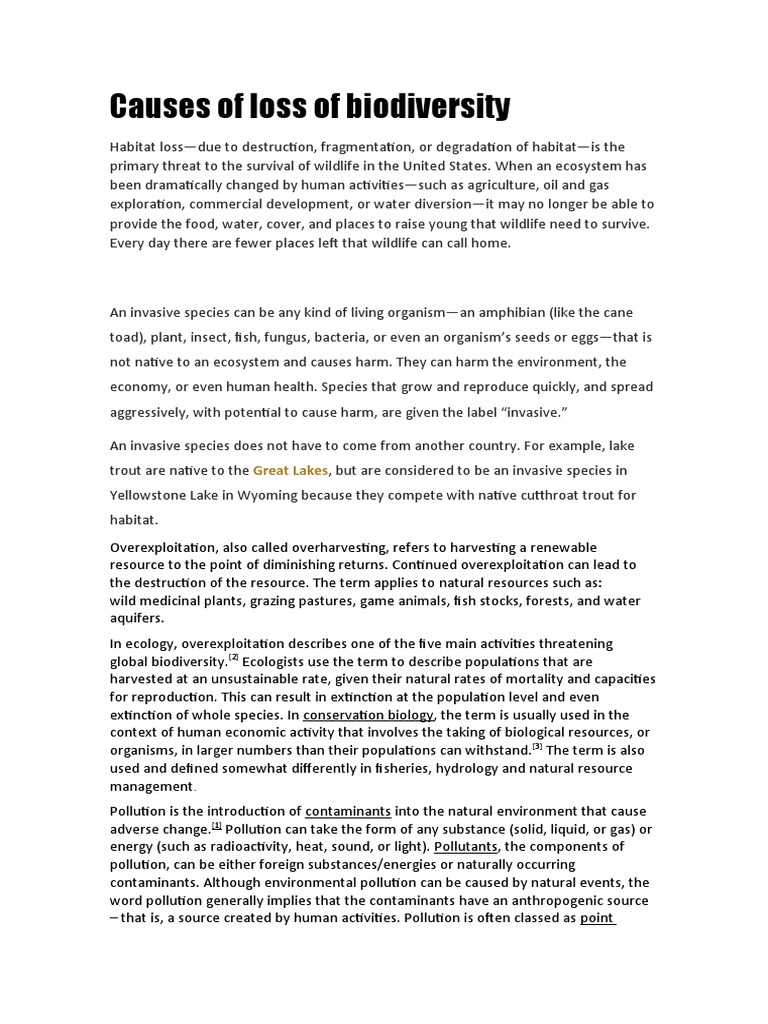
- Habitat alteration: Deforestation, urban expansion and conversion of natural lands fragment or destroy habitats.
- Climate change: Rising temperatures and shifting precipitation move species’ climatic envelopes.
- Pollution: Plastics, nutrients, heavy metals and pesticides degrade soil, water and air quality.
- Overexploitation: Unsustainable fishing, hunting and wildlife trade reduce populations faster than they can recover.
What Does the Evidence Show?
Long‑term monitoring by the Global Biodiversity Information Facility and the Living Planet Index indicates an average 68% decline in vertebrate population sizes between 1970 and 2014 (World Wildlife Fund, 2020). The 2019 Intergovernmental Science‑Policy Platform on Biodiversity and Ecosystem Services (IPBES) assessment, synthesising >15,000 peer‑reviewed sources, concluded that roughly 1 million species—about 27% of those assessed—face heightened extinction risk. Fossil records confirm the magnitude of past mass extinctions, while satellite‑derived forest‑cover maps show a loss of ~10 million ha of primary forest per year (FAO, 2020). Together these independent lines of evidence point to a clear, accelerating downward trend in global biodiversity.
Main Causes or Drivers
Natural Drivers
Volcanic eruptions, asteroid impacts and natural climate oscillations have historically triggered mass extinctions, but their occurrence rates are orders of magnitude slower than current anthropogenic pressures.
Anthropogenic Drivers
- Land‑use change accounts for ~23% of global biodiversity loss (IPBES, 2019).
- Climate change contributes ~7% directly, with indirect effects that amplify other drivers.
- Pollution and overexploitation together add another 10–15% of the impact.
These drivers often interact synergistically; for example, climate‑induced range shifts can expose species to novel pathogens that thrive in fragmented habitats.
Environmental and Human Impacts
Environmental Impacts
Reduced species richness weakens pollination, seed dispersal and nutrient cycling. Coral‑reef bleaching, driven by ocean warming and acidification, has cut reef cover by roughly 50% since the 1980s, threatening marine biodiversity and fisheries.
Human Health and Social Impacts
Loss of predator diversity can increase disease‑carrying rodent populations, raising zoonotic risk. Declines in pollinators jeopardise crops that provide 35% of global food production (FAO, 2021), affecting food security especially in low‑income regions.
Economic and Infrastructure Impacts
Ecosystem services are valued at US$125 trillion per year (Costanza et al., 2014). Wetland loss—over 35% globally since 1970—reduces natural flood mitigation, leading to billions in disaster costs.
Regional Differences
Temperate Europe benefits from dense protected‑area networks but still suffers from habitat fragmentation. Tropical hotspots such as the Amazon and Congo basins experience rapid deforestation—over 17 million ha lost in the Amazon between 2000 and 2020—resulting in higher species‑level risk. Island ecosystems (e.g., Madagascar, New Zealand) show disproportionate extinction rates because many species have tiny ranges and limited dispersal ability.
What Scientists Know With High Confidence
- Current extinction rates are 100–1,000 times higher than the background rate inferred from the fossil record.
- Habitat loss is the most significant driver of global biodiversity decline.
- Well‑managed protected areas covering at least 30% of land and 10% of oceans can substantially curb species loss.
- Climate change is already shifting many species toward higher latitudes and elevations.
What Remains Uncertain
Key gaps include precise extinction probabilities for poorly documented invertebrates and microorganisms, the long‑term resilience of ecosystems under combined stressors, and how future socioeconomic pathways will shape land‑use patterns. These uncertainties do not overturn the overall conclusion of rapid biodiversity loss, but they limit our ability to predict exact timelines for many taxa.
Common Misconceptions
Misconception: Biodiversity loss is a recent phenomenon.
Reality: Extinction is a natural part of Earth’s history, yet the current rate exceeds background levels by two to three orders of magnitude because of human activities.
Misconception: Only charismatic megafauna matter.
Reality: Ecosystem functions rely on the full spectrum of life, including microbes, insects and plants; their loss can undermine services such as soil formation and pollination.
Misconception: Individual lifestyle choices alone can solve biodiversity loss.
Reality: Personal actions matter, but systemic change—policy, corporate practices and large‑scale land‑use planning—is essential to address the dominant drivers.
Solutions and Limitations
Effective responses combine prevention, protection, restoration and regulation.
- Protected‑area expansion: Increases habitat security but may conflict with indigenous land rights if not co‑designed.
- Sustainable agriculture and forestry: Reduces habitat conversion, yet may require higher yields or dietary shifts to meet food demand.
- Restoration ecology: Reforestation and coral‑reef rehabilitation rebuild services, but success depends on species selection, climate suitability and long‑term funding.
- Policy instruments: International frameworks such as the Convention on Biological Diversity provide coordination, but national implementation varies widely.
- Technology: Satellite monitoring improves enforcement; eDNA surveys accelerate species detection, yet technology cannot replace the need for intact habitats.
What Individuals, Communities, and Governments Can Do
What Individuals Can Do
Choose sustainably sourced products, reduce food waste, support organizations that protect habitats, and participate in citizen‑science projects that contribute data to biodiversity databases.
What Communities and Organizations Can Do
Develop local habitat corridors, adopt regenerative farming practices, and create education programs that highlight native species and the services they provide.
What Governments Can Do
Enact and enforce land‑use regulations, increase funding for protected‑area management, integrate biodiversity considerations into climate‑policy planning, and fulfill commitments under the Convention on Biological Diversity.
Closing Synthesis
Biodiversity has risen through billions of years of evolution, been reshaped by cataclysmic mass‑extinction events, and is now being compressed by human‑driven habitat loss, climate change, pollution and overexploitation. Robust evidence shows that these drivers are accelerating species declines and eroding ecosystem services vital to human societies. High‑confidence findings highlight protected‑area networks, sustainable land use and restoration as effective levers, while uncertainties remain about many understudied taxa and the combined effects of multiple stressors. Addressing biodiversity loss requires coordinated action across scales—individual choices, community initiatives and strong governmental policies—supported by continuous scientific monitoring and adaptive management.
Frequently Asked Questions
What is the definition of biodiversity?
Biodiversity is the variety of life on Earth, encompassing genetic differences within species, the variety of species themselves, and the range of ecosystems that support them.
How many major mass‑extinction events have occurred in Earth’s history?
Scientists recognize five major mass‑extinction events: End‑Ordovician, Late Devonian, End‑Permian, End‑Triassic and End‑Cretaceous, each causing massive losses of species.
Which human activity is the leading driver of current biodiversity loss?
Habitat loss from land‑use change, such as deforestation and urban expansion, is the single largest driver, accounting for roughly 23% of global biodiversity decline.
What are some ecosystem services affected by biodiversity loss?
Key services include pollination of crops, water purification, carbon storage, flood mitigation, and disease regulation, all of which rely on diverse species and functional ecosystems.
What actions can governments take to curb biodiversity decline?
Governments can expand and effectively manage protected areas, enforce land‑use regulations, fund restoration projects, and integrate biodiversity goals into climate and development policies.





Leave a Comment