
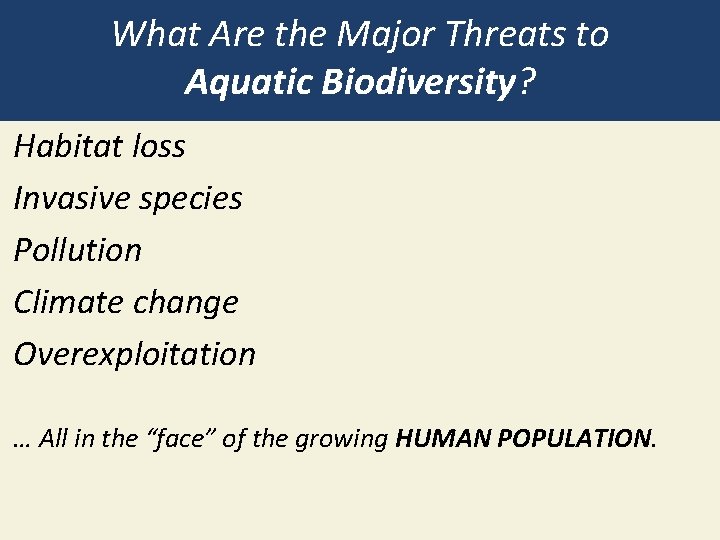
Aquatic biodiversity is under severe pressure from a suite of interlinked threats—including climate change, habitat loss, pollution, overfishing, invasive species, and ocean acidification—requiring coordinated science‑based action.
Quick Answer
Aquatic biodiversity faces six primary, largely human‑driven threats: rising temperatures and altered precipitation (climate change), loss of wetlands, rivers and coastal habitats, chemical and plastic pollution, unsustainable fishing practices, invasive non‑native species, and the lowering of ocean pH (acidification). These stressors reduce species abundance, disrupt food webs, and diminish ecosystem services such as water purification and carbon storage. While the direction of impact is clear, uncertainties remain about exact thresholds for collapse in many systems.
Key Takeaways
- Climate change drives warmer waters, altered flow regimes, and ocean acidification, threatening temperature‑sensitive and calcifying organisms.
- Habitat degradation—from wetland drainage to mangrove clearing—removes critical breeding and feeding grounds.
- Pollution, especially nutrients, heavy metals, and microplastics, creates toxic conditions and bio‑accumulative hazards.
- Overfishing and destructive gear reduce population resilience and damage seabed habitats.
- Invasive species can outcompete natives, altering food‑web dynamics and nutrient cycles.
- Effective solutions combine protection, restoration, sustainable management, and pollution control, but each has trade‑offs.
What Is The Major Threats Facing Aquatic Biodiversity Today?
Aquatic biodiversity encompasses the variety of life found in freshwater (rivers, lakes, wetlands) and marine (coasts, open ocean) ecosystems. The term “major threats” refers to the most widespread, scientifically documented drivers that cause measurable declines in species abundance, distribution, or ecosystem function. These threats differ from natural disturbances (e.g., seasonal floods) because they are amplified by human activities and persist beyond the capacity of many species to adapt.
How Does It Work?
1. Climate Change
Increased greenhouse‑gas concentrations raise global average temperatures. Warmer air heats surface waters, while altered precipitation changes river discharge and lake levels. Warmer water reduces dissolved oxygen, stresses cold‑water species, and expands the range of heat‑tolerant invaders. Ocean acidification occurs when seawater absorbs CO₂, forming carbonic acid and lowering pH, which impairs calcium carbonate formation in corals, mollusks, and some plankton.
2. Habitat Loss and Degradation
Urban expansion, agriculture, and infrastructure convert or fragment wetlands, floodplains, and mangroves. Dams and water withdrawals modify flow regimes, preventing fish migration and altering sediment transport. The loss of structural complexity reduces shelter and spawning sites, leading to population declines.
3. Pollution
Runoff from fertilized fields adds nitrogen and phosphorus, causing eutrophication and hypoxic “dead zones.” Pesticides and industrial chemicals introduce toxic compounds that can cause mortality or sub‑lethal reproductive effects. Heavy metals accumulate in tissues, while plastics—especially micro‑plastics—are ingested, interfering with feeding and growth.
4. Unsustainable Fishing
Targeted overharvest removes large fractions of biomass, often before species can replace lost individuals. Bottom trawling scrapes seabed habitats, destroying benthic communities. Bycatch unintentionally captures non‑target species such as turtles, sharks, and seabirds, adding further pressure.
5. Invasive Species
Non‑native organisms introduced through ballast water, aquaculture, or the pet trade can outcompete native species for food or habitat. Some invaders, like the zebra mussel, alter nutrient cycling and increase water clarity, which reshapes algal communities.
6. Ocean Acidification (Separate from Climate Change)
Although driven by the same CO₂ emissions, acidification has distinct biological impacts. Reduced saturation states of aragonite and calcite limit shell formation in organisms such as pteropods, which are a key food source for many fish.
What Does the Evidence Show?
Long‑term monitoring by the Intergovernmental Panel on Climate Change (IPCC, 2021) documents a global average sea‑surface temperature rise of ~0.13°C per decade since 1970, correlating with shifts in species ranges. The United Nations Environment Programme (UNEP, 2020) reports that 30 % of the world’s wetlands have been lost since 1900, with remaining wetlands supporting disproportionate biodiversity. A systematic review of 150 peer‑reviewed studies (e.g., Halpern et al., 2019, *Science*) confirms that overfishing reduces biomass by an average of 50 % in heavily exploited regions. Meta‑analyses of plastic ingestion (Rochman et al., 2021) find micro‑plastics in >80 % of examined marine organisms. Collectively, these independent lines of evidence indicate that each threat contributes to measurable declines, and their co‑occurrence often produces synergistic effects.
Main Causes or Drivers
Direct Human Activities
Fossil‑fuel combustion, deforestation, and intensive agriculture release greenhouse gases and pollutants that directly alter water temperature, chemistry, and quality.
Economic and Policy Drivers
Market demand for seafood fuels overcapacity in fisheries; subsidies for high‑impact gear (e.g., bottom trawls) encourage unsustainable harvests. Weak regulatory enforcement permits illegal discharge of industrial waste.
Technological and Infrastructure Factors
Dams, levees, and land‑reclamation projects fragment habitats and disrupt natural hydrological cycles.
Global Trade and Transportation
Ballast‑water discharge and ornamental‑aquarium trade are primary pathways for invasive aquatic species.
Environmental and Human Impacts
Environmental Impacts
Reduced species diversity weakens food‑web stability, leading to regime shifts such as algal blooms that further depress oxygen levels. Loss of coral reefs eliminates habitat for an estimated 25 % of marine species. Diminished wetlands lower natural carbon sequestration, exacerbating climate change.
Human Health and Social Impacts
Contaminated fish can transmit toxins (e.g., mercury, PCBs) to consumers, increasing risks of neurological and developmental disorders. Declining fisheries threaten food security for coastal communities that rely on fish for protein—over 3 billion people are affected globally, according to the Food and Agriculture Organization (FAO, 2022).
Economic and Infrastructure Impacts
Degraded fisheries cost the global economy an estimated US$83 billion per year in lost revenue (World Bank, 2020). Flood protection provided by wetlands is valued at US$15 billion annually; their loss increases vulnerability to storm surges and costly infrastructure repairs.
Regional Differences
In the tropics, coral bleaching driven by warming waters is most acute; the 2016–2017 El Niño event caused >30 % mortality of corals in the Great Barrier Reef (Australian Institute of Marine Science, 2018). Temperate regions experience pronounced freshwater stress; the North American Great Lakes have seen record low ice cover and rising invasive species like the sea lamprey. In arid zones, water extraction for irrigation lowers river flows, endangering species such as the Mekong giant catfish. Each region’s exposure reflects local climate trends, land‑use patterns, and governance capacity.
What Scientists Know With High Confidence
- Greenhouse‑gas emissions are the primary driver of global ocean warming and acidification (IPCC, 2021).
- Habitat loss is the leading cause of freshwater species decline (IUCN Red List, 2020).
- Overfishing has reduced global fish biomass by roughly half in heavily fished stocks (FAO, 2022).
- Micro‑plastic ingestion is widespread across taxonomic groups and habitats (Rochman et al., 2021).
- Invasive species are a major driver of local extinctions in both freshwater and marine systems (Mack et al., 2000).
What Remains Uncertain
Key knowledge gaps include the precise temperature thresholds that trigger irreversible coral collapse, the long‑term ecological consequences of chronic micro‑plastic exposure, and the effectiveness of emerging marine protected area networks under climate change. Limited monitoring in many low‑income coastal nations hampers global assessments of species trends, making it difficult to predict regional tipping points.
Common Misconceptions
Misconception: “Plastic pollution only harms sea turtles.”
Reality: Plastic debris is ingested by a wide range of organisms—from plankton to large fish—causing physical blockages, reduced feeding efficiency, and chemical exposure across the food web.
Misconception: “Ocean acidification only affects corals.”
Reality: Acidification reduces the ability of many calcifying organisms, including shellfish, pteropods, and some plankton, which in turn impacts species that depend on them for food.
Misconception: “Protected areas automatically stop biodiversity loss.”
Reality: Protection is effective only when enforcement is strong, when areas are ecologically representative, and when climate‑change impacts are integrated into management plans.
Solutions and Limitations
Effective responses combine prevention, mitigation, adaptation, and restoration. Climate mitigation—rapid reduction of CO₂ emissions—is essential but requires decades to translate into detectable water‑temperature benefits. Habitat restoration (e.g., mangrove replanting) can sequester carbon and improve coastal resilience, yet success depends on site selection, local community involvement, and long‑term funding. Pollution control through stricter effluent standards reduces nutrient loads, but legacy contamination in sediments may persist for centuries. Sustainable fisheries management—quota systems, gear restrictions, and marine protected areas—can rebuild stocks, yet illegal, unreported, and unregulated (IUU) fishing undermines progress. Invasive‑species management (early detection, rapid response) is cost‑effective early on but becomes increasingly expensive and less successful once populations are established.
What Individuals, Communities, and Governments Can Do
What Individuals Can Do
Choose sustainably sourced seafood (e.g., MSC‑certified), reduce use of single‑use plastics, support policies that fund water‑quality monitoring, and advocate for climate‑action at local elections.
What Communities and Organizations Can Do
Implement watershed restoration projects, establish citizen‑science water‑quality monitoring, and develop local bans on micro‑plastic beads and harmful pesticides.
What Governments Can Do
Enforce strict discharge limits, phase out harmful subsidies for destructive fishing gear, expand and adequately fund marine and freshwater protected area networks, and integrate climate‑resilient water management into national planning.
Closing Synthesis
The major threats to aquatic biodiversity—climate change, habitat loss, pollution, overfishing, invasive species, and ocean acidification—are interconnected and driven largely by human activity. High‑confidence research confirms their detrimental impacts on species and ecosystem services, while uncertainties remain around thresholds and long‑term outcomes. Solutions exist, but each carries trade‑offs and requires coordinated action across scales. By aligning science, policy, and community effort, societies can safeguard the water‑borne web of life that underpins food security, health, and climate stability.
Frequently Asked Questions
What are the six primary threats to aquatic biodiversity?
The six primary threats are climate change (warming and altered precipitation), habitat loss and degradation, pollution (nutrient, chemical, and plastic), unsustainable fishing, invasive species, and ocean acidification.
How does ocean acidification affect marine life?
Ocean acidification lowers seawater pH, reducing carbonate ion availability needed by calcifying organisms such as corals, mollusks, and some plankton to build shells and skeletons, which can disrupt entire food webs.
Why is habitat loss especially harmful to freshwater species?
Habitat loss removes essential wetlands, floodplains, and riverine areas that provide breeding, feeding, and refuge spaces; without these habitats many freshwater species cannot complete their life cycles, leading to population declines.
What evidence shows that overfishing has reduced global fish biomass?
A synthesis of over 150 studies reported by the FAO and published in Science found that heavily fished stocks have lost about 50 % of their original biomass, indicating widespread overexploitation.
What actions can individuals take to protect aquatic biodiversity?
Individuals can choose sustainably sourced seafood, reduce single‑use plastic consumption, support water‑quality monitoring initiatives, and vote for policies that address climate change and pollution.






Leave a Comment