
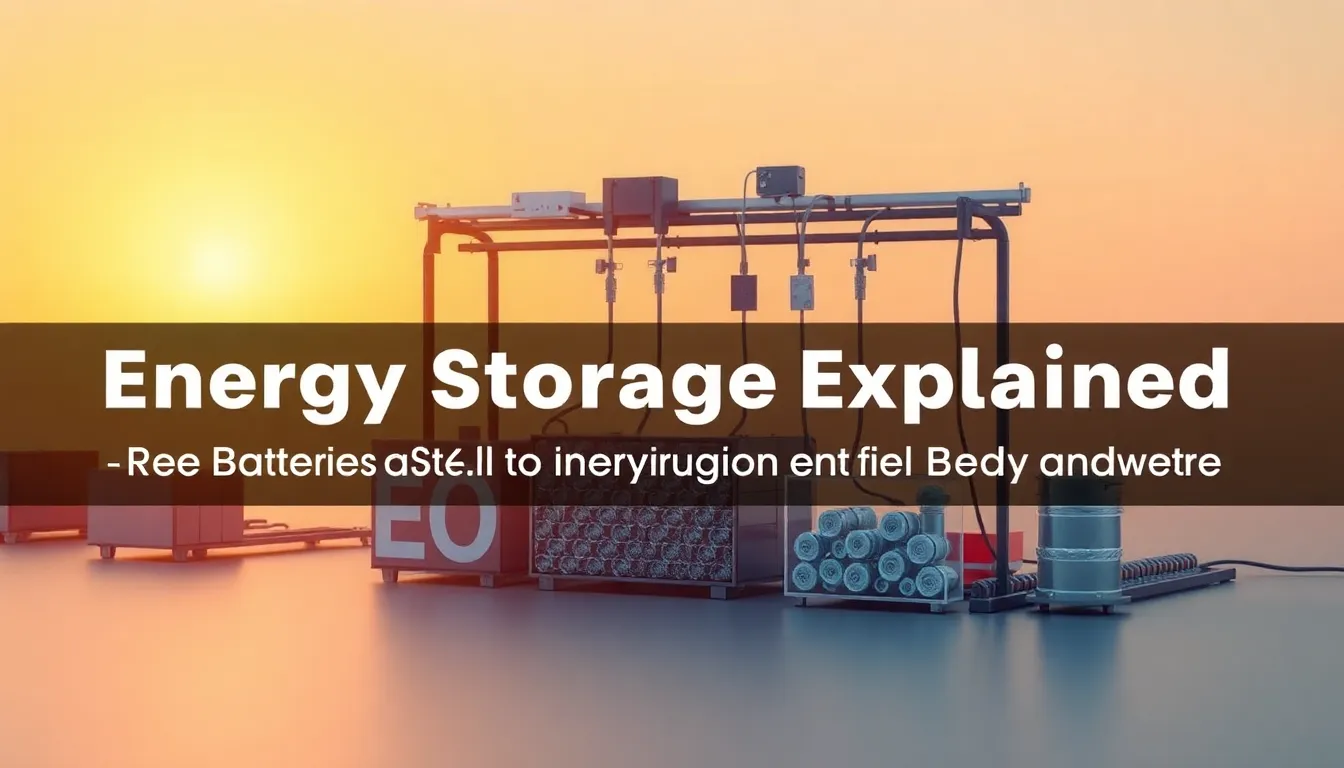
What Is Energy Storage and Why It Matters
Energy storage refers to the capture of energy produced at one time for use at a later time. In the context of a low‑carbon future, it is the bridge that turns intermittent renewable power—such as solar energy and wind energy—into reliable, dispatchable electricity for homes, industry, and transport. Without adequate storage, excess generation would be wasted and grid stability would suffer, limiting the scale‑up of clean power.
Key Technologies for Storing Energy
Battery Storage
Battery systems convert electrical energy into chemical energy and back again. The most common chemistries today are lithium‑ion, which dominate residential and utility‑scale installations, and emerging alternatives such as sodium‑ion, solid‑state, and flow batteries. Batteries excel at short‑to‑medium duration storage (minutes to a few hours), making them ideal for smoothing solar peaks, providing frequency regulation, and supporting electric vehicle charging infrastructure.
Hydrogen Power
Hydrogen stores energy in a gaseous or liquid form after electricity splits water molecules in a process called electrolysis. The resulting hydrogen can be stored for months or even years and later reconverted to electricity via fuel cells or combustion turbines. Hydrogen is especially attractive for long‑duration, high‑capacity needs such as seasonal storage, heavy‑duty transport, and industrial heat.
Emerging Solutions Beyond Batteries and Hydrogen
Several innovative approaches are moving from laboratory to pilot stage:
- Thermal storage captures heat in molten salts or concrete, then releases it to generate steam for turbines.
- Mechanical storage includes pumped‑hydro (using two reservoirs) and advanced compressed‑air systems that store energy as pressurized air underground.
- Gravity‑based systems lift heavy blocks or use rail‑based elevators, releasing the weight to drive generators when needed.
- Electro‑chemical flow batteries separate power and energy components, allowing storage capacity to be scaled independently of power output.
How Energy Storage Supports Renewable Sources
Renewable generation is variable: solar peaks at midday, wind can surge or lull without warning. Energy storage mitigates this mismatch in three ways:
- Time shifting: Store daytime solar output for evening use.
- Peak shaving: Release stored power during high‑demand periods, reducing strain on the grid.
- Grid services: Provide frequency and voltage regulation, reserve capacity, and black‑start capability.
By integrating storage, utilities can defer expensive transmission upgrades and maintain reliability while increasing the share of renewable energy in the mix.
Benefits and Challenges of Different Storage Options
- Batteries
- Fast response (milliseconds), high round‑trip efficiency (80‑95%).
- Scalable from kilowatt‑hour home units to gigawatt‑hour utility farms.
- Challenges: material sourcing (lithium, cobalt), degradation over cycles, and relatively high upfront cost.
- Hydrogen
- Very high energy density, suitable for long‑duration and transport applications.
- Can be produced using excess renewable electricity (green hydrogen).
- Challenges: electrolysis efficiency (≈70 %), storage pressure or liquefaction costs, and limited fueling infrastructure.
- Pumped‑hydro
- Proven technology with lifetimes exceeding 50 years and low operating cost.
- Provides multi‑hour to multi‑day storage.
- Challenges: geographic dependence, high capital expense, and environmental permitting.
- Thermal & Mechanical
- Low material cost, can be paired with concentrated solar or waste heat.
- Efficiency varies (50‑80 %) and conversion steps add complexity.
- Best suited for specific industrial or district‑heating contexts.
Practical Considerations for Choosing a Storage System
- Duration needed: Short bursts (seconds‑minutes) favor batteries; daily to weekly shifts may use pumped‑hydro or flow batteries; seasonal storage points to hydrogen.
- Location and space: Urban sites often rely on modular battery racks, while rural or mountainous areas can host pumped‑hydro reservoirs.
- Cost per kilowatt‑hour: Compare capital expense, operation & maintenance, and expected lifetime.
- Battery costs have fallen below $120/kWh in many markets.
- Hydrogen production cost depends on electricity price; green hydrogen is competitive when electricity < $30/MWh.
- Grid services required: Frequency regulation needs fast‑responding assets; capacity firming may accept slower technologies.
- Regulatory and policy environment: Incentives for clean storage, carbon pricing, and interconnection rules can tilt the economics toward one technology.
Future Trends and What to Watch Next
Several developments are likely to reshape the storage landscape over the next decade:
- Second‑generation batteries: Solid‑state electrolytes promise higher energy density and improved safety.
- Hybrid systems: Combining batteries with hydrogen or thermal storage to capture the strengths of each.
- Digital optimisation: AI‑driven dispatch algorithms that maximize revenue from multiple grid services.
- Policy momentum: Growing climate policy, such as net‑zero targets, is encouraging governments to fund large‑scale storage projects.
Related Topics to Explore
Understanding energy storage opens doors to many other climate solutions. Readers may also be interested in:
- Electricity Grids – how modern grids integrate storage and renewables.
- Clean Transportation – the role of batteries and hydrogen in electric vehicles and fuel‑cell trucks.
- Energy Efficiency – reducing demand before storage is needed.
- Sustainable Buildings – on‑site battery systems and thermal storage for net‑zero homes.
- Carbon Removal – how excess renewable power can be directed to direct‑air capture or bioenergy with carbon capture.
Conclusion
Energy storage is the keystone of a resilient, low‑carbon energy system. Batteries provide rapid, high‑efficiency response for daily fluctuations, while hydrogen and other emerging technologies address long‑duration and sector‑coupling challenges. By matching technology to duration, location, and grid needs, societies can unlock the full potential of renewable power, support clean transportation, and move toward climate‑stable economies.
Frequently Asked Questions
What is the difference between battery storage and hydrogen storage?
Battery storage converts electricity to chemical energy and back within a sealed cell, offering fast response and high efficiency for short‑term needs. Hydrogen storage uses electrolysis to split water, storing the resulting gas for months or years, making it suitable for long‑duration and heavy‑duty applications, though with lower round‑trip efficiency.
How does energy storage help integrate solar and wind power into the grid?
Storage shifts excess solar generation from midday to evening, smooths wind variability, and provides grid services like frequency regulation. By storing surplus renewable electricity, it reduces curtailment, balances supply and demand, and allows utilities to defer expensive transmission upgrades.
What are the main challenges of using hydrogen as an energy carrier?
Key challenges include the cost and efficiency of electrolysis, the need for high‑pressure or cryogenic storage infrastructure, limited fueling stations, and material durability in fuel cells. Overcoming these hurdles requires cheaper renewable electricity and supportive policy incentives.
Which storage technology is best for short‑term grid stabilization?
Lithium‑ion batteries are currently the best choice for short‑term stabilization because they can respond in milliseconds, have high round‑trip efficiency, and are easily scalable from residential to utility‑scale installations.
Can emerging storage solutions like pumped‑hydro or thermal storage replace batteries?
Emerging solutions complement rather than replace batteries. Pumped‑hydro provides large, multi‑day capacity where geography allows, while thermal storage works well for heat‑intensive processes. Batteries remain essential for fast, high‑efficiency response, so a hybrid approach often delivers the most resilient system.








Leave a Comment