
Human actions have pushed millions of species toward extinction, but scientific evidence shows that coordinated conservation, restoration, and policy measures can still halt and even reverse biodiversity loss.
Quick Answer
Biodiversity loss is driven by habitat destruction, climate change, overexploitation, pollution, and invasive species. The consensus of major assessments (IPBES 2019, IUCN Red List) is that the trajectory can be altered if societies implement large‑scale habitat protection, ecosystem restoration, and climate‑compatible policies. Evidence suggests that such actions can stabilize or increase populations for many threatened groups, though uncertainty remains about the speed of recovery and the capacity to rescue species with very small populations.
Key Takeaways
- About 1 million species face extinction risk, but many can recover with effective protection.
- Habitat loss is the primary driver; protecting and restoring ecosystems yields the greatest biodiversity gains.
- Climate change amplifies threats, making climate‑smart conservation essential.
- Policy tools such as protected‑area networks, payments for ecosystem services, and stricter trade regulations are proven to work when adequately funded.
- Individual actions matter when they support systemic change, for example by choosing sustainable products and advocating for strong environmental laws.
What Is Can Humans Still Fix the Biodiversity Crisis??
The phrase asks whether humanity can stop and reverse the current loss of biological variety – the diversity of species, genetic traits, and ecosystems that sustain life on Earth. It encompasses global extinction risk, regional habitat degradation, and the erosion of ecosystem services. Unlike a simple “conservation” label, the question emphasizes feasibility: are the scientific, technological, and socio‑economic tools sufficient to turn the tide?
How Does It Work?
1. Species and Habitat Interdependence
Every species depends on a network of ecological interactions – pollination, predation, nutrient cycling – that maintain ecosystem stability. When a habitat is removed, these networks collapse, leading to population declines and possible extinctions.
2. Feedback Loops with Climate
Deforestation reduces carbon sequestration, accelerating climate change, which in turn stresses species through temperature shifts and altered precipitation. This positive feedback can push ecosystems past tipping points.
3. Restoration Processes
Ecological restoration reinstates native vegetation, reconnects fragmented habitats, and re‑establishes natural disturbance regimes (e.g., fire, flood). Over time, restored areas can regain species richness and provide climate mitigation benefits.
4. Governance and Funding Mechanisms
Effective policies create protected‑area networks, regulate trade, and allocate financial incentives (e.g., biodiversity credits). These mechanisms translate scientific knowledge into on‑the‑ground actions.
What Does the Evidence Show?
Long‑term monitoring by the International Union for Conservation of Nature (IUCN) and the Intergovernmental Science‑Policy Platform on Biodiversity and Ecosystem Services (IPBES) indicates that species loss has accelerated over the past half‑century. The 2020 World Wildlife Fund Living Planet Report recorded a 68 % average decline in vertebrate population abundance since 1970. However, meta‑analyses of protected‑area effectiveness (e.g., by the UNEP World Conservation Monitoring Centre) show that well‑managed reserves can increase species richness by 20–30 % compared with unprotected lands.
Restoration case studies, such as the Atlantic Forest reforestation in Brazil, have demonstrated that native tree planting can raise bird diversity to 80 % of original levels within 20 years (peer‑reviewed study, 2021). Climate‑smart conservation pilots in East Africa report increased resilience of savanna ecosystems when grazing is managed alongside carbon‑sequestration projects.
Main Causes or Drivers
Direct Causes
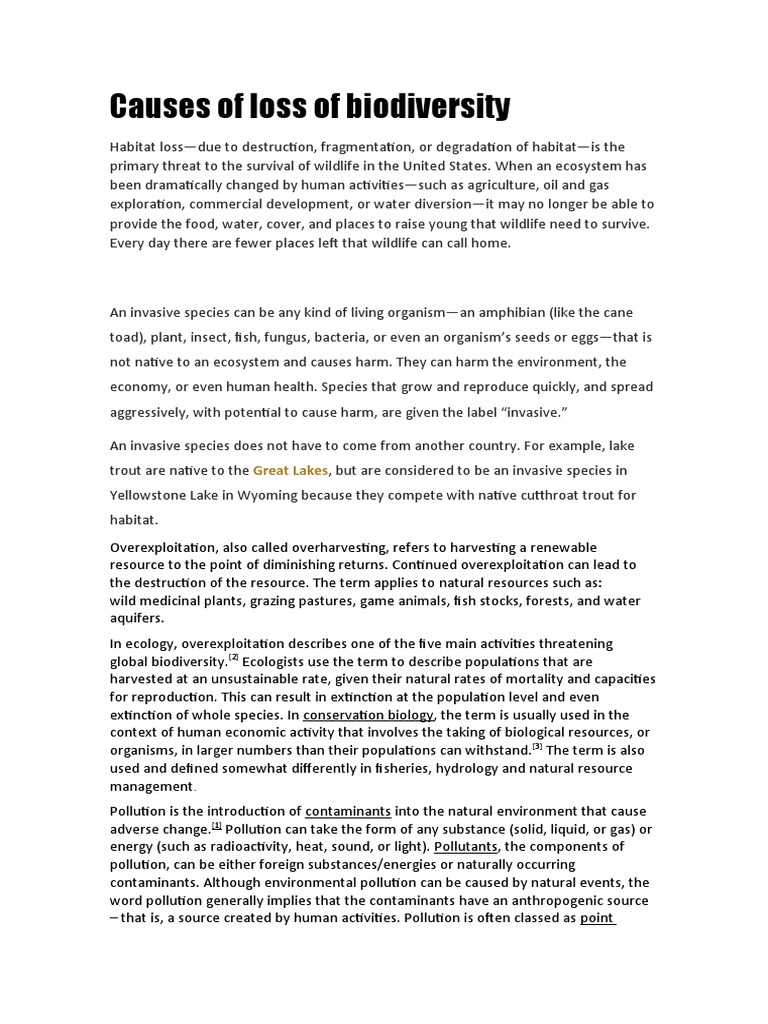
- Habitat loss and fragmentation – primarily from agriculture, urban expansion, and infrastructure.
- Overexploitation – unsustainable fishing, hunting, and timber harvest.
- Pollution – nutrient runoff, plastic debris, and chemical contaminants.
- Invasive species – non‑native organisms outcompeting or predating native species.
Underlying Drivers
- Economic incentives that prioritize short‑term profit over long‑term ecosystem health.
- Population growth and rising consumption patterns, especially in high‑income regions.
- Climate change – altering temperature and precipitation regimes worldwide.
- Policy gaps – insufficient enforcement of environmental regulations.
Environmental and Human Impacts
Environmental Impacts
Loss of pollinators reduces crop yields, while declining fish stocks threaten marine food webs. Wetland degradation diminishes water purification and flood regulation, increasing the likelihood of extreme flooding events.
Human Health and Social Impacts
Reduced biodiversity can amplify disease transmission; the dilution effect suggests that diverse ecosystems lower the risk of zoonotic spillover. Indigenous peoples and rural communities, who depend directly on natural resources, face food insecurity and loss of cultural heritage.
Economic and Infrastructure Impacts
The World Bank estimates that ecosystem services contribute roughly 14 % of global GDP. Declines in these services can raise costs for water treatment, disaster mitigation, and agricultural inputs.
Regional Differences
In tropical regions such as the Congo Basin, deforestation rates exceed 0.5 % yr⁻¹, driving rapid loss of primate species. Conversely, parts of Europe have seen modest biodiversity gains due to intensive habitat restoration under the EU Biodiversity Strategy 2030. In the Arctic, climate‑induced habitat shift threatens cold‑adapted flora, while the impact on species is still being quantified.
What Scientists Know With High Confidence
- Habitat destruction is the leading cause of global species decline (IPBES 2019).
- Protected areas that are adequately funded and managed reduce local extinction risk.
- Climate change interacts synergistically with other drivers, accelerating biodiversity loss.
- Ecosystem restoration can recover functional biodiversity within decades, given appropriate species pools and management.
What Remains Uncertain
Key uncertainties include the exact thresholds at which ecosystem tipping points become irreversible, the long‑term viability of small, isolated populations, and how rapid climate change will reshape species’ geographic ranges. Improved global monitoring networks and longitudinal studies are needed to refine these estimates.
Common Misconceptions
Misconception: Biodiversity loss is inevitable and cannot be stopped.
Reality: While many trends are severe, evidence from protected‑area successes and restoration projects shows that targeted actions can halt and reverse declines for numerous species.
Misconception: Planting trees alone solves the biodiversity crisis.
Reality: Tree planting helps carbon sequestration, but biodiversity benefits depend on using native species, restoring ecological processes, and connecting habitats.
Misconception: Only wealthy nations can afford effective conservation.
Reality: Community‑based conservation in low‑income regions has demonstrated cost‑effective outcomes, especially when supported by international finance mechanisms.
Solutions and Limitations
Effective responses combine prevention, mitigation, adaptation, and restoration:
- Protected‑area expansion – offers high biodiversity gains but requires sustainable financing and enforcement.
- Payments for ecosystem services – incentivize landowners, yet scaling up depends on reliable valuation methods.
- Climate‑smart agriculture – reduces habitat conversion, though adoption can be limited by market access.
- Genetic rescue and assisted migration – emerging tools with promising case studies, yet carry ecological risk and ethical debate.
- Policy reforms – such as stricter trade regulations for wildlife, which can be politically contested.
What Individuals, Communities, and Governments Can Do
What Individuals Can Do
- Choose certified sustainable seafood and timber.
- Support organizations that fund protected‑area management.
- Advocate for strong biodiversity legislation through voting and public comment.
What Communities and Organizations Can Do
- Implement local habitat restoration projects using native species.
- Develop community‑managed conservation areas that share benefits with residents.
- Integrate biodiversity criteria into corporate supply‑chain decisions.
What Governments Can Do
- Meet and exceed the post‑2020 Global Biodiversity Framework targets.
- Allocate at least 10 % of national budgets to protected‑area management, as recommended by the Convention on Biological Diversity.
- Create and enforce regulations that curb illegal wildlife trade and overfishing.
- Incentivize climate‑compatible land‑use practices through tax credits or subsidy reforms.
Synthesis
The biodiversity crisis is a complex, multi‑driver challenge, but the scientific consensus affirms that humanity possesses the knowledge and tools to reverse many of its worst effects. High‑confidence findings highlight habitat protection, climate‑aware restoration, and robust policy as the most effective levers. Uncertainties remain around thresholds and long‑term outcomes, underscoring the need for continued monitoring. By aligning individual choices, community initiatives, and governmental policies with evidence‑based strategies, a resilient and diverse planet is within reach.
Frequently Asked Questions
What does the term ‘biodiversity crisis’ refer to?
The biodiversity crisis describes the rapid loss of species, genetic variation, and ecosystem diversity caused mainly by habitat destruction, climate change, overexploitation, pollution, and invasive species.
How many species are currently at risk of extinction?
The Intergovernmental Science‑Policy Platform on Biodiversity and Ecosystem Services (IPBES) estimates that roughly one million species worldwide are threatened with extinction, based on assessments up to 2019.
Can protected areas actually stop species loss?
Yes. Peer‑reviewed studies show that well‑managed protected areas increase local species richness by 20–30 % and lower extinction risk, especially when they are adequately funded and connected to other habitats.
What role does climate change play in the biodiversity crisis?
Climate change amplifies other drivers by shifting temperature and precipitation patterns, which can push species beyond their tolerance limits and interact with habitat loss to increase overall extinction risk.
What actions can individuals take to help restore biodiversity?
Individuals can choose sustainably sourced products, support organizations that fund conservation, and advocate for strong environmental policies through voting, petitions, and public commentary.






Leave a Comment