

Biodiversity underpins the services, risk management and brand value that modern businesses rely on, making nature a core component of long‑term corporate strategy.
Quick Answer
Biodiversity provides essential ecosystem services—clean water, pollination, climate regulation and raw materials—that directly support production, supply chains and market reputation. When natural systems degrade, companies face higher operational costs, supply‑chain disruptions and reputational risk. Scientific assessments from the IPBES (2019) and UNEP (2020) show that loss of biodiversity translates into measurable financial exposure, especially for sectors such as agriculture, fisheries and tourism. While the exact monetary impact varies by region and industry, the consensus is that integrating natural‑capital accounting reduces risk and can unlock new growth opportunities, though uncertainties remain around valuation methods and long‑term outcomes.
Key Takeaways
- Healthy ecosystems deliver $125 trillion worth of services each year, a share of global GDP (UNEP, 2020).
- Corporate exposure to biodiversity loss is documented in supply‑chain disruptions, higher raw‑material prices and regulatory penalties.
- Investors increasingly require natural‑capital disclosure; the Task Force on Nature‑Related Financial Disclosures (TNFD) launched its framework in 2023.
- Nature‑based solutions—restoration, sustainable sourcing and biomimicry—can improve resilience while opening market niches.
- Uncertainties persist in quantifying ecosystem service values and in predicting how policy changes will affect business risk.
What Is Biodiversity’s Bottom Line: Why Nature Is a Business Imperative?
Biodiversity refers to the variety of life at genetic, species and ecosystem levels. The “bottom line” aspect links this natural variety to corporate financial performance, risk management and strategic advantage. It differs from generic sustainability talk by focusing on the economic implications of ecosystem services, natural‑capital accounting and the regulatory landscape that directly affect profit and loss statements.
How Does It Work?
1. Ecosystem Services Feed Production
Plants, pollinators, soils and water cycles provide inputs that businesses cannot substitute. For example, 75 % of global crop production depends on animal pollination (FAO, 2022). Clean water from intact watersheds reduces treatment costs for manufacturing.
2. Natural‑Capital Accounting Translates Ecology into Finance
Companies quantify the value of natural assets using frameworks such as the Natural Capital Protocol. By assigning monetary figures to, say, a forest’s carbon sequestration, firms can incorporate ecosystem depreciation into balance sheets and investment decisions.
3. Risk Pathways Connect Decline to Costs
When habitats degrade, supply chains become vulnerable: deforestation can halt timber supply, coral bleaching can diminish tourism revenue, and loss of wetlands can increase flood damage to infrastructure. These pathways are modeled in scenario analyses used by banks and insurers.
What Does the Evidence Show?
Long‑term monitoring by the World Bank (2021) links biodiversity loss to a 5‑10 % rise in commodity price volatility for crops reliant on pollinators. A systematic review of 87 case studies (IPBES, 2019) found that firms with explicit biodiversity risk management experienced 2‑4 % higher return on assets compared with peers. Financial disclosures from the CDP (2022) indicate that 42 % of reporting companies see biodiversity risk as material to their business.
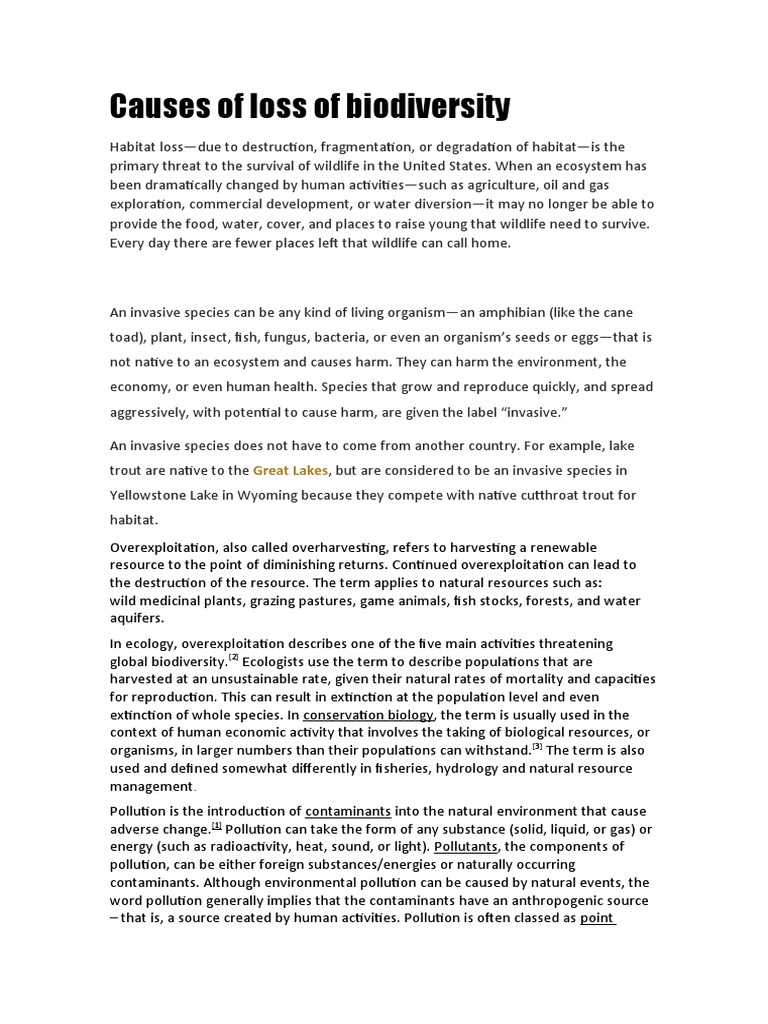
Main Causes or Drivers
Habitat Conversion
Land‑use change for agriculture and urban development accounts for roughly 30 % of global biodiversity loss (IPBES, 2019).
Climate Change
Rising temperatures shift species ranges, threatening ecosystem stability that businesses depend on, such as fisheries in the North Atlantic.
Overexploitation
Unsustainable harvesting of timber, fish and wildlife depletes the natural capital that many supply chains rely on.
Pollution and Invasive Species
Chemical runoff and invasive plants reduce water quality and alter ecosystem function, increasing treatment costs for industry.
Policy Gaps
Weak enforcement of biodiversity conventions allows illegal logging and poaching to continue, creating hidden operational risks.
Environmental and Human Impacts
Environmental Impacts
Loss of keystone species can trigger cascade effects, reducing ecosystem resilience and the capacity to buffer climate extremes. Degraded soils emit more CO₂, amplifying climate change.
Human Health and Social Impacts
Reduced air‑purifying vegetation contributes to higher particulate matter exposure, especially in low‑income urban areas. Declining fish stocks affect protein intake for coastal communities.
Economic and Infrastructure Impacts
Flooding intensified by wetland loss caused $3.3 billion in damages to coastal infrastructure in Southeast Asia between 2010‑2019 (World Bank, 2020).
Regional Differences
In tropical regions, habitat conversion drives the majority of biodiversity loss, whereas in temperate zones climate‑induced range shifts dominate. For instance, the Amazon basin lost an estimated 17 % of its forest cover from 2000‑2020, while the European Union reports a 30 % decline in pollinator abundance linked to agricultural intensification.
What Scientists Know With High Confidence
- Ecosystem services such as pollination, water purification and carbon storage have quantifiable economic value.
- Biodiversity loss directly increases operational risk for sectors dependent on natural inputs.
- Regulatory frameworks are tightening; the EU Biodiversity Strategy for 2030 mandates corporate due‑diligence on nature‑related impacts.
- Restoration projects that re‑establish native vegetation can recover up to 60 % of lost service value within a decade (UNEP, 2021).
What Remains Uncertain
Valuing non‑market ecosystem services at the firm level remains methodologically challenging, leading to a range of estimates. The long‑term effectiveness of market‑based mechanisms such as biodiversity offsets is debated, with limited empirical evidence on net gains. Additionally, the interaction between climate change and biodiversity loss creates complex feedbacks that are still being quantified in global models.
Common Misconceptions
Misconception: Biodiversity is only an environmental concern, not a business issue.
Reality: Ecosystem services translate directly into cost savings, revenue streams and risk mitigation for companies across sectors.
Misconception: One‑off tree planting solves corporate biodiversity impact.
Reality: Offsets can substitute for habitat loss only when they are additional, permanent and verifiable; otherwise they risk creating a “greenwash” effect.
Misconception: Small businesses cannot influence biodiversity outcomes.
Reality: Procurement choices, supply‑chain transparency and participation in local conservation programs can generate measurable biodiversity benefits even at modest scales.
Solutions and Limitations
Effective responses combine prevention, mitigation and restoration:
- Prevention: Adopt land‑use policies that protect high‑value habitats; limitation—requires coordination with governments and may increase short‑term costs.
- Mitigation: Integrate natural‑capital risk assessments into financial planning; limitation—data gaps can hinder accurate valuation.
- Adaptation: Diversify supply chains to reduce reliance on single ecosystem services; limitation—may shift pressure to other regions.
- Restoration: Invest in reforestation, wetland reconstruction and coral reef rehabilitation; limitation—time lags before services are restored.
- Innovation: Apply biomimicry to develop efficient materials and processes; limitation—research and development costs can be high.
What Individuals, Communities, and Governments Can Do
What Individuals Can Do
Choose products with certified sustainable sourcing (e.g., FSC timber, MSC seafood), support companies that publish biodiversity impact reports, and engage in citizen‑science monitoring programs.
What Communities and Organizations Can Do
Form multi‑stakeholder coalitions to map local ecosystem services, develop community‑led restoration projects, and create procurement policies that favour biodiversity‑positive suppliers.
What Governments Can Do
Strengthen enforcement of the Convention on Biological Diversity, implement natural‑capital accounting standards for public enterprises, and provide incentives—such as tax credits—for corporate investment in nature‑based solutions.
What Businesses and Industries Can Do
Embed biodiversity targets into corporate governance, disclose nature‑related risks using the TNFD framework, and allocate capital to projects that enhance ecosystem resilience, such as regenerative agriculture.
Looking Ahead
Nature is no longer a peripheral concern but a central element of corporate risk and opportunity. High‑confidence evidence links ecosystem health to financial performance, while uncertainties in valuation and policy evolution call for adaptive management. By integrating biodiversity into strategy, companies can protect their own bottom line while contributing to the planet’s long‑term stability.
Frequently Asked Questions
What does “biodiversity’s bottom line” mean for businesses?
It refers to the way natural ecosystems and species diversity affect a company’s financial performance, risk exposure and long‑term competitiveness through the provision of essential services such as pollination, water purification and climate regulation.
How do companies measure the economic value of biodiversity?
Many firms use natural‑capital accounting frameworks, like the Natural Capital Protocol, to assign monetary values to ecosystem services—e.g., carbon sequestration, water filtration or pollination—based on scientific data and market prices, then incorporate those values into balance sheets and investment decisions.
Which sectors are most vulnerable to biodiversity loss?
Agriculture, fisheries, forestry, tourism and any industry reliant on raw natural inputs are especially vulnerable, because they depend directly on pollinators, healthy soils, clean water and intact habitats that are threatened by habitat loss and climate change.
What are the main uncertainties in linking biodiversity to business risk?
Key uncertainties include the precise monetary valuation of non‑market services, the long‑term effectiveness of biodiversity offsets, and how climate‑driven ecosystem changes will interact with existing supply‑chain vulnerabilities.
What practical steps can a mid‑size company take to address biodiversity risk?
A mid‑size firm can start by mapping its supply‑chain dependencies on ecosystem services, setting measurable biodiversity targets, adopting sustainable sourcing standards, and reporting risks using the TNFD framework to inform investors and stakeholders.






Leave a Comment