
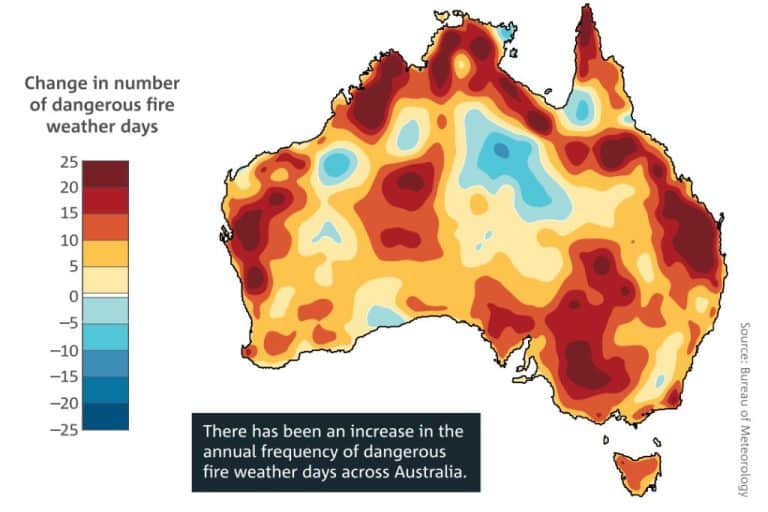
Southeast Australia faces heightened fire danger as an intense heatwave drives drought‑stressed vegetation toward extreme bushfire risk, a pattern linked to climate change and land‑management practices.
Quick Answer
The southeast of Australia is experiencing an extreme fire risk because a prolonged heatwave raises temperatures above 40 °C, dries out fuels, and coincides with long‑term drought conditions. Scientific assessments show that rising average temperatures and reduced rainfall, both driven by climate change, increase the likelihood of large, fast‑moving bushfires. The most immediate impact is heightened danger to communities, ecosystems, and infrastructure, while uncertainty remains around exact fire‑season length under future climate scenarios.
Key Takeaways
- Heatwaves above 40 °C combined with multi‑year drought create the fuel conditions for extreme bushfires in southeast Australia.
- Climate‑change attribution studies link rising fire danger to higher mean summer temperatures and more erratic rainfall.
- Indigenous cultural burning can reduce fuel loads, but modern fire‑management often overlooks these practices.
- High‑confidence findings include the link between temperature, fuel moisture, and fire spread; uncertainties involve future fire‑season timing.
- Effective responses require integrated approaches: community preparedness, policy support for research, and incorporation of traditional knowledge.
What Is Australia’s Southeast Braces for Extreme Fire Risk Amid Intense Heatwave?
The phrase describes a situation in which the states of New South Wales and Victoria, together with the Australian Capital Territory, face a markedly elevated probability of large bushfires because an intense, prolonged heatwave pushes temperatures well above seasonal averages. This risk is not a single event but a systemic condition defined by three interacting elements: (1) extreme atmospheric heat, (2) dried vegetation that acts as combustible fuel, and (3) landscape and human factors that influence fire ignition and spread. It differs from ordinary fire danger ratings by its combination of meteorological severity and long‑term climatic trends.
How Does It Work?
1. Atmospheric Heating
During a heatwave, high‑pressure systems suppress cloud formation, allowing solar radiation to heat the ground continuously. In southeast Australia, recorded heatwave peaks have exceeded 45 °C, raising ambient temperature and reducing relative humidity to below 10 % (Bureau of Meteorology, 2023).
2. Fuel Desiccation
Prolonged heat and low rainfall cause live and dead vegetation to lose moisture. Fuel moisture content below 5 % is a threshold at which fire ignitions become more likely and flame heights increase dramatically (CSIRO, 2022).
3. Fire Ignition Sources
Human activities (e.g., campfires, machinery) and natural sources (lightning) provide ignition points. During heatwaves, the probability of accidental ignition rises because people are more likely to be outdoors and equipment may overheat.
4. Rapid Fire Spread
Dry fuels, steep terrain, and strong winds combine to produce high fire‑spread rates—often >20 km h⁻¹. The interaction of wind and topography can create fire “storms” that jump firebreaks.
5. Feedback Loops
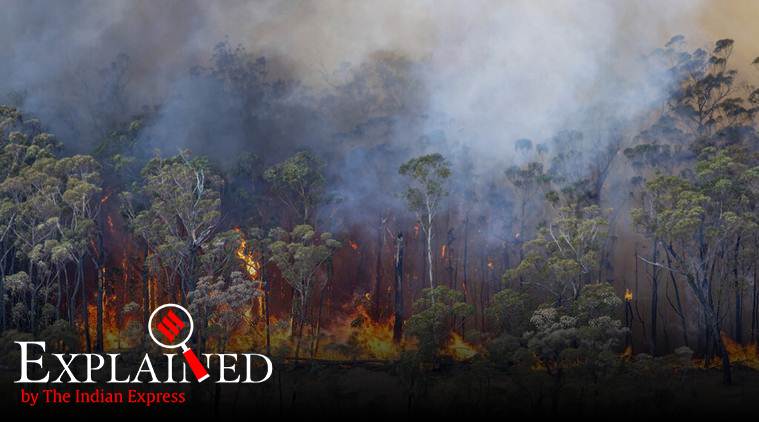
Large fires generate their own weather, producing pyrocumulus clouds that can intensify wind and further dry surrounding fuels, a self‑reinforcing cycle documented in the 2019–2020 “Black Summer” fires.
What Does the Evidence Show?
Long‑term monitoring by the Australian Bureau of Meteorology indicates that the number of days with maximum temperature above 35 °C in the southeast has increased by roughly 15 % per decade since the 1970s. A systematic review published in *Nature Climate Change* (2021) found a strong statistical association between rising summer temperatures and the frequency of megafires (>10,000 ha) across Australia. Climate‑model ensembles from the IPCC AR6 project project further temperature increases of 1.5–2 °C by 2050 under moderate emission pathways, which would extend the fire‑danger season by up to six weeks.
Field studies in the Victorian alpine region show that fire‑prone fuel loads have doubled over the past 30 years due to reduced fire frequency, a consequence of fire suppression policies that limit low‑intensity burns. Indigenous land‑management research demonstrates that cultural burning, conducted in winter and early spring, can reduce fine‑fuel accumulation by 30–40 % without harming biodiversity (Australian Institute of Aboriginal and Torres Strait Islander Studies, 2020).
Main Causes or Drivers
Direct Causes
- Extreme temperature spikes (>40 °C) during heatwaves.
- Extremely low fuel moisture from multi‑year drought.
- Human ignition sources amplified by outdoor activity.
Underlying Drivers
- Anthropogenic climate change increasing baseline summer heat.
- Land‑use change that fragments habitats and creates edge effects.
- Fire‑suppression policies that have reduced the frequency of low‑intensity burns.
Amplifying Factors
- Urban expansion into fire‑prone bushland (the “wildland‑urban interface”).
- Inadequate integration of Indigenous fire‑management knowledge.
- Economic pressures that limit resources for fire‑fighter training and equipment.
Environmental and Human Impacts
Environmental Impacts
Large bushfires release up to 600 Mt of CO₂ per event, contributing to atmospheric greenhouse gas concentrations. They also destroy habitat for endemic species such as the Leadbeater’s possum, whose population declined by an estimated 40 % after the 2019–2020 fires. Soil erosion increases as vegetation cover is lost, leading to sedimentation of waterways and reduced water quality.
Human Health and Social Impacts
Smoke exposure during severe fire events raises fine‑particulate (PM₂.₅) levels to hazardous concentrations, associated with increased emergency‑room visits for respiratory and cardiovascular conditions. Communities in the fire‑prone zones experience heightened anxiety, displacement, and loss of cultural sites, particularly for Aboriginal peoples whose connection to land is integral to identity.
Economic and Infrastructure Impacts
Direct costs of wildfire suppression and property loss in southeast Australia averaged AU$1.2 billion per major season between 2010 and 2020 (National Bushfire Centre). Power outages, road closures, and loss of tourism revenue further strain regional economies.
Regional Differences
Within the southeast, fire risk varies with topography and climate. Coastal New South Wales, with higher humidity, experiences shorter fire‑danger periods than the inland alpine zones of Victoria, where low humidity and steep slopes accelerate fire spread. The Australian Capital Territory, though smaller, faces intense risk because of dense urban development adjacent to eucalypt forests. These variations demand region‑specific preparedness plans.
What Scientists Know With High Confidence
- Higher ambient temperatures and lower fuel moisture substantially increase fire ignition probability and rate of spread.
- Climate change has already shifted temperature distributions upward, lengthening the fire‑danger season in southeast Australia.
- Indigenous cultural burning can effectively reduce fine‑fuel loads without compromising biodiversity.
- Large bushfires generate significant carbon emissions that feed back into the climate system.
What Remains Uncertain
Key uncertainties include the precise timing and magnitude of future fire‑season extensions under different emission scenarios, and how changing vegetation types (e.g., encroachment of invasive grasses) will alter fuel characteristics. Additionally, the social‑acceptability and scalability of integrating cultural burning into contemporary fire‑management frameworks remain under‑explored, requiring further interdisciplinary research.
Common Misconceptions
Misconception: “All Australian bushfires are caused by climate change.”
Reality: Climate change amplifies the conditions that favor large fires, but ignition can also stem from human activities, lightning, or prescribed burns. The relationship is one of increased risk, not sole causation.
Misconception: “Prescribed burns eliminate fire risk completely.”
Reality: Controlled burns reduce fine‑fuel loads and can lower fire intensity, but they do not prevent fire entirely, especially under extreme heatwave conditions that can override the benefits of prior burning.
Misconception: “Indigenous fire practices are outdated and unsafe.”
Reality: Scientific studies show that cultural burning, when applied seasonally and strategically, lowers fuel accumulation and supports biodiversity, offering a complementary tool to modern fire‑management.
Solutions and Limitations
Effective fire‑risk mitigation in southeast Australia requires a portfolio of actions:
- Pre‑emptive fuel management: Combining modern prescribed burns with Indigenous cultural burns can reduce fuel loads, but limited weather windows and resource constraints restrict the scale of operations.
- Improved forecasting: High‑resolution fire‑danger modelling enhances early warnings, yet predictive accuracy diminishes under unprecedented heatwave intensity.
- Community education and preparedness: Programs that teach residents how to create defensible space and respond to alerts are low‑cost, but success depends on sustained engagement and socioeconomic equity.
- Greenhouse‑gas mitigation: Reducing emissions addresses the root cause of rising temperatures, yet policy implementation is politically complex and requires long‑term commitment.
- Infrastructure hardening: Designing power lines and buildings to withstand fire exposure reduces damage, but retrofitting existing structures involves high expense.
What Individuals, Communities, and Governments Can Do
What Individuals Can Do
Maintain a cleared perimeter of at least 30 m around homes, use fire‑resistant building materials, and stay informed through local fire‑danger ratings. Reducing personal carbon footprints—e.g., by using public transport—contributes marginally to the broader climate mitigation effort.
What Communities and Organizations Can Do
Organize neighborhood fire‑ready groups, conduct regular drills, and collaborate with Indigenous elders to incorporate cultural burning knowledge. Local councils can allocate funding for community fire‑breaks and support volunteer fire brigades.
What Governments Can Do
Invest in research for fire‑resistant vegetation, expand funding for Indigenous fire‑management programs, and enforce building codes that require fire‑resilient designs in high‑risk zones. Policy frameworks should align emissions‑reduction targets with land‑management strategies.
Closing Synthesis
Southeast Australia’s heightened fire risk during intense heatwaves reflects a convergence of climate‑driven warming, prolonged drought, and land‑management choices. Strong evidence links rising temperatures to fuel dryness and faster fire spread, while uncertainties persist around future fire‑season dynamics and the integration of traditional burning practices. By combining scientific forecasting, community preparedness, policy support for emissions reductions, and Indigenous knowledge, the region can build resilience against the growing threat of extreme bushfires.
Frequently Asked Questions
What defines extreme fire risk in southeast Australia?
Extreme fire risk in southeast Australia is defined by a combination of unusually high temperatures (often above 40 °C), extremely low fuel moisture from prolonged drought, and heightened ignition probability, creating conditions where large bushfires can ignite and spread rapidly.
How does an intense heatwave increase bushfire danger?
An intense heatwave raises ambient temperature, reduces relative humidity, and dries vegetation, lowering fuel moisture below critical thresholds. These conditions make ignition easier and fire spread faster, especially when accompanied by strong winds.
What evidence links climate change to the rising fire danger in southeast Australia?
Long‑term climate records show a 15 % per decade rise in days above 35 °C, and systematic reviews have found a strong statistical link between higher summer temperatures and increased megafire frequency. Climate models also project further temperature rises that would extend the fire‑danger season.
Can Indigenous cultural burning reduce the risk of extreme bushfires?
Yes. Research shows that seasonal cultural burns reduce fine‑fuel loads by 30–40 %, lowering fire intensity and spread. When integrated with modern fire‑management, cultural burning can improve landscape resilience while supporting biodiversity, though scaling the practice requires community collaboration and policy support.
What practical steps can homeowners take to protect their property during fire season?
Homeowners should create a defensible space by clearing vegetation at least 30 m from structures, use fire‑resistant building materials, maintain roof and gutter clearance, and stay updated with local fire‑danger ratings. These measures reduce ignition risk and improve the chances of surviving a bushfire.




Leave a Comment