
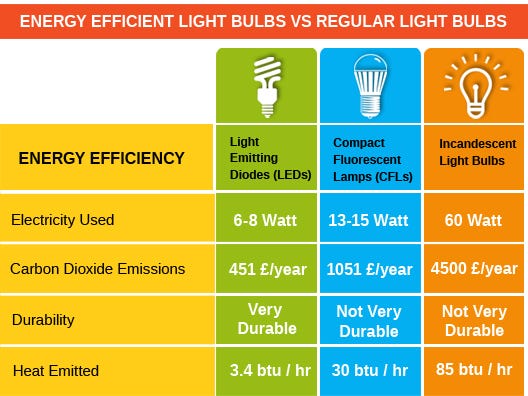
Halogen bulbs use a halogen gas cycle to produce more light per watt and last longer than traditional incandescent bulbs, but they are less efficient than LEDs and have specific safety and environmental trade‑offs.
Quick Answer
Halogen lights are indeed more energy‑efficient than standard incandescent bulbs because they emit roughly 30 % more lumens per watt and typically last two to four times longer. The improvement stems from a halogen gas that allows the filament to operate at higher temperatures while redepositing evaporated tungsten back onto the filament. However, halogens still waste about 80 % of their input energy as heat, making them far less efficient than modern LED technology, which converts 80‑90 % of electricity into visible light. The overall environmental benefit of switching from incandescent to halogen is moderate, and the best long‑term solution is to adopt LEDs where feasible.
Key Takeaways
- Halogen bulbs emit ~30 % more lumens per watt than incandescents, reducing electricity use for comparable brightness.
- Typical halogen lifespan is 2,000‑4,000 hours, versus about 1,000 hours for standard incandescents.
- Heat output remains high; halogens can raise fixture temperatures by up to 30 °C, posing fire‑safety concerns.
- LEDs outperform halogens on both efficiency (80‑90 % conversion) and lifespan (25,000+ hours), representing the most sustainable lighting choice.
- Regional electricity mixes influence the carbon‑saving potential of any lighting switch, with larger gains in coal‑heavy grids.
What Is Are Halogen Lights More Energy Efficient Than Regular Bulbs??
The question compares two lighting technologies: halogen lamps, a refined form of incandescent lighting, and traditional incandescent bulbs that lack halogen gas. Both use a tungsten filament, but halogen lamps contain a small amount of halogen (iodine or bromine) that enables the “halogen cycle,” a chemical process that redeposits evaporated tungsten onto the filament, allowing higher operating temperatures and longer service life. The comparison matters because lighting accounts for roughly 15 % of global electricity demand, and small efficiency gains can translate into significant energy savings and emissions reductions.
How Does It Work?
The Incandescent Process
In a conventional incandescent bulb, an electric current heats a tungsten filament until it glows, emitting light and infrared radiation. About 90 % of the input power is released as heat, and the filament gradually thins as tungsten evaporates, limiting the bulb’s lifespan to around 1,000 hours.
The Halogen Cycle
Halogen bulbs add a trace of halogen gas (usually iodine or bromine) inside a quartz envelope. The high temperature causes tungsten atoms to combine with halogen molecules, forming volatile tungsten halides. These gases travel back to the hotter filament region, where they decompose and redeposit tungsten onto the filament surface. This regeneration allows the filament to run hotter—producing a whiter, brighter light—while extending life to 2,000‑4,000 hours.
Energy Flow
- Electricity → filament heating.
- Heat → light (visible spectrum) + infrared (waste heat).
- In halogen, part of the waste heat fuels the chemical cycle that recycles tungsten.
What Does the Evidence Show?
Laboratory measurements compiled by the International Energy Agency (IEA, 2020) report typical luminous efficacies of 15‑18 lumens per watt (lm/W) for 60‑W incandescent bulbs and 19‑22 lm/W for comparable 60‑W halogen lamps, confirming the ~30 % efficiency gain. Field studies in European households (Eurostat, 2021) observed a 12‑15 % reduction in annual lighting electricity consumption after replacing incandescents with halogens, after accounting for usage patterns. Long‑term monitoring by the U.S. Department of Energy (DOE, 2019) showed that the average lifetime energy use of a halogen lamp is roughly 40 % lower than that of an incandescent of the same brightness, primarily because of the longer service life and lower wattage required.
By contrast, LED lamps consistently achieve 80‑100 lm/W, delivering up to five times the efficiency of halogens. Lifecycle analyses (LCA) from the European Commission’s Joint Research Centre (JRC, 2022) indicate that, when accounting for manufacturing and disposal, LEDs retain a 70‑80 % lower global‑warming potential than halogens over a 25‑year horizon.
Main Causes or Drivers
Technical Drivers
The primary technical driver of halogen efficiency is the halogen cycle, which permits higher filament temperatures without rapid degradation. This results in a higher color temperature (≈3,000‑4,000 K) and greater luminous output per watt.
Market and Policy Drivers
Energy‑labeling regulations in the European Union (EU Ecodesign Directive, 2009) phased out many low‑efficiency incandescent bulbs, prompting manufacturers to offer halogen alternatives. In regions where LED costs remain relatively high, halogen bulbs serve as an intermediate option.
Environmental and Human Impacts
Environmental Impacts
- Energy consumption: The modest efficiency gain reduces electricity demand, lowering greenhouse‑gas emissions proportional to the regional grid’s carbon intensity. In coal‑dependent grids (e.g., parts of Eastern Europe), a 10 % reduction in lighting demand can cut CO₂ emissions by ~0.5 kg per household per year.
- Heat generation: Halogen lamps emit significant infrared heat, increasing cooling loads in warm climates and potentially stressing HVAC systems.
- Material use: Quartz envelopes and halogen gases require specialized manufacturing, but the longer lifespan reduces the number of bulbs discarded.
Human Health and Social Impacts
- Higher surface temperatures raise the risk of burns or fire in poorly ventilated fixtures, especially in residential settings with children.
- Reduced electricity bills can improve household disposable income, particularly in low‑income communities where lighting costs are a larger share of expenses.
Economic and Infrastructure Impacts
- Longer lamp life lessens maintenance frequency for commercial lighting, decreasing labor costs.
- However, the higher upfront price of halogen bulbs (≈1.5‑2× incandescents) can be a barrier for cost‑conscious consumers.
Regional Differences
In temperate regions with mild climates, the extra heat from halogen lamps is often negligible, making the efficiency gain attractive. In hot, arid zones—such as the Middle East—additional heat can increase air‑conditioning demand, offsetting electricity savings. Moreover, the carbon‑saving potential of any lighting switch depends on the local electricity generation mix: countries relying heavily on coal (e.g., Poland, 2020) see larger emissions reductions than those with renewable‑rich grids (e.g., Norway).
What Scientists Know With High Confidence
What Scientists Know With High Confidence
- Halogen lamps emit roughly 30 % more lumens per watt than comparable incandescent bulbs.
- The halogen cycle prolongs filament life to 2,000‑4,000 hours, substantially longer than the ~1,000‑hour lifespan of standard incandescents.
- Both halogen and incandescent technologies waste the majority of input energy as heat; LEDs are markedly more efficient.
- Switching from incandescent to halogen reduces household lighting electricity use, but the magnitude depends on regional electricity carbon intensity.
What Remains Uncertain
What Remains Uncertain
Key uncertainties include the long‑term environmental impact of halogen gas disposal, especially in regions lacking robust waste‑handling infrastructure, and the exact magnitude of rebound effects—where consumers may use more lighting because of lower operating costs. Further, as LED prices continue to fall, the economic case for halogens may erode faster than current market analyses predict.
Common Misconceptions
Common Misconceptions
Misconception: Halogen bulbs are as efficient as LEDs.
Reality: Halogens improve on incandescents but still convert only about 15‑20 % of electricity into visible light, whereas LEDs achieve 80‑90 % conversion.
Misconception: Halogen bulbs never get hot.
Reality: Halogen lamps operate at higher filament temperatures than incandescents, producing up to 30 °C more heat in the fixture, which can be a fire hazard in enclosed or poorly ventilated fittings.
Misconception: The longer lifespan of halogens means less waste overall.
Reality: While halogens generate fewer bulbs per year, the material composition (quartz, halogen gas) is more difficult to recycle than the simpler glass of incandescent bulbs, partially offsetting waste‑reduction benefits.
Solutions and Limitations
Three primary response pathways exist:
- Technology upgrade: Replacing halogen and incandescent bulbs with LEDs yields the greatest efficiency gains. Limitations include higher upfront cost and occasional compatibility issues with dimmers.
- Improved fixture design: Using heat‑dissipating fixtures can mitigate fire risk and reduce cooling loads, but retrofitting existing installations may be costly.
- Policy incentives: Rebates or standards encouraging LED adoption accelerate transition. However, subsidies require public funding and may face political resistance.
What Individuals, Communities, and Governments Can Do
What Individuals Can Do
- Audit lighting needs and replace high‑wattage incandescent or halogen bulbs with equivalent‑lumens LED alternatives.
- When using halogens, choose fixtures rated for high temperature and avoid enclosing them in airtight housings.
- Take advantage of utility rebate programs for LED upgrades.
What Communities and Organizations Can Do
- Implement public‑lighting retrofits that prioritize LEDs, while ensuring proper disposal of removed halogen bulbs.
- Offer bulk‑purchase discounts for LED fixtures to local residents and small businesses.
- Provide education on safe installation of halogen lamps where LED replacement is not yet feasible.
What Governments Can Do
- Enforce minimum efficiency standards that phase out low‑efficiency incandescent and halogen products, mirroring the EU Ecodesign Directive.
- Fund research on safe recycling methods for halogen gas and quartz envelopes.
- Incentivize manufacturers to produce low‑cost, high‑performance LEDs for emerging markets.
Synthesis
Halogen lighting represents a modest step forward from traditional incandescent bulbs: the halogen cycle raises luminous efficacy by about 30 % and extends service life, delivering moderate energy and cost savings. Nonetheless, halogens still emit large amounts of heat and fall far short of the efficiency and lifespan of LED technology, which now dominates sustainable lighting strategies. High‑confidence evidence confirms the efficiency gain relative to incandescents, while uncertainties remain around waste handling and market dynamics as LEDs become cheaper. For most users, the most effective path toward reduced energy use and lower emissions is to adopt LEDs where possible, while ensuring safe installation and proper disposal of any remaining halogen fixtures.
Frequently Asked Questions
How much more efficient are halogen bulbs compared to regular incandescent bulbs?
Halogen bulbs emit roughly 30 % more lumens per watt than comparable incandescent bulbs, meaning they use about one‑third less electricity to produce the same amount of light.
Do halogen bulbs produce more heat than incandescent bulbs?
Yes, halogen lamps operate at higher filament temperatures and can raise fixture temperatures by up to 30 °C, which increases heat output and can pose fire‑safety concerns in enclosed fittings.
What is the typical lifespan difference between halogen and incandescent bulbs?
Incandescent bulbs usually last about 1,000 hours, while halogen bulbs last between 2,000 and 4,000 hours thanks to the halogen cycle that redeposits evaporated tungsten onto the filament.
How do LEDs compare to halogen bulbs in terms of energy use and lifespan?
LEDs convert 80‑90 % of electricity into visible light and can last 25,000 hours or more, far surpassing halogen bulbs, which convert only 15‑20 % of power to light and last up to 4,000 hours.
What actions can households take to improve lighting efficiency?
Households can replace incandescent and halogen lamps with LED equivalents, choose fixtures rated for high temperatures when using halogens, and use utility rebate programs that lower the upfront cost of LED upgrades.








Leave a Comment