

The greenhouse effect is a natural atmospheric process that traps solar heat, making Earth habitable, but human‑driven increases in greenhouse gases amplify this warming, driving climate change.
Quick Answer
The greenhouse effect is the warming of Earth’s surface caused by atmospheric gases—principally carbon dioxide, methane, nitrous oxide, and water vapor—that let sunlight in but absorb and re‑emit infrared radiation. This natural mechanism keeps the average global temperature around 15 °C (59 °F) instead of the –18 °C (0 °F) it would be without it. Scientific assessments, such as the IPCC Sixth Assessment Report (2021), show that human activities have increased concentrations of these gases by roughly 50 % since pre‑industrial times, leading to a measurable rise in global average temperature of about 1.1 °C. The most important implication is that the enhanced greenhouse effect underlies the ongoing trend of global warming, with associated risks to ecosystems, water resources, and human societies. Uncertainty remains about the exact magnitude of future warming under different emission pathways, but the direction of change is clear.
Key Takeaways
- The greenhouse effect is essential for life, but its intensification by humans causes global warming.
- Carbon dioxide, methane, nitrous oxide, and water vapor are the primary greenhouse gases.
- Multiple lines of evidence—instrumental records, satellite observations, and climate models—confirm the warming trend.
- Impacts include sea‑level rise, extreme weather, ecosystem disruption, and public‑health challenges.
- Mitigation requires rapid emissions reductions, renewable energy, and ecosystem protection, while adaptation addresses unavoidable changes.
What Is the Greenhouse Effect and Why It Matters?
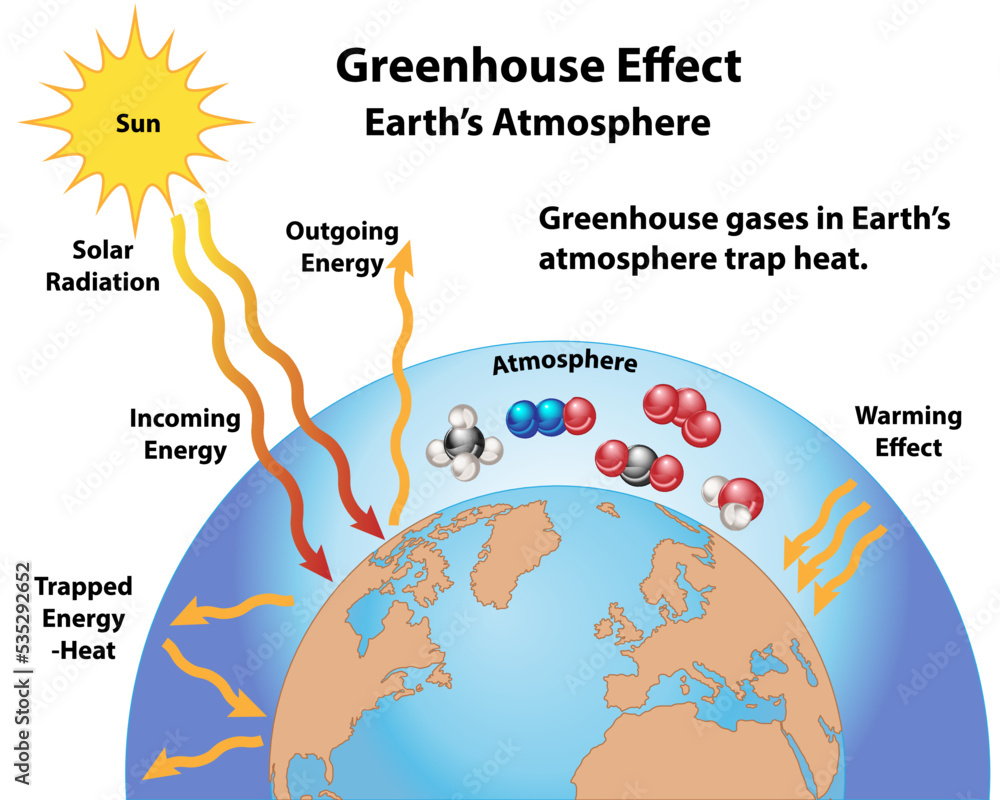
The greenhouse effect describes the process by which certain gases in the atmosphere absorb infrared radiation emitted by Earth’s surface and re‑radiate it in all directions, including back toward the surface. This “blanket” of heat retention raises the planet’s average temperature to levels that support liquid water, plant growth, and animal life. Without it, Earth’s mean temperature would be roughly –18 °C (0 °F), making the planet largely inhospitable. The term differs from “global warming,” which refers specifically to the recent, human‑driven increase in average temperatures.
How Does It Work?
Step‑by‑step Physical Process
- Solar radiation, mainly short‑wave visible light, passes through the atmosphere and reaches the surface.
- The surface absorbs this energy and warms, then emits long‑wave infrared radiation upward.
- Greenhouse gases (GHGs) such as CO₂, CH₄, N₂O, and H₂O have molecular structures that vibrate when they absorb infrared photons.
- These excited molecules re‑emit infrared radiation in all directions; roughly half escapes to space, while the other half returns to the surface, adding to its warmth.
- The net result is a higher equilibrium temperature than would occur without GHGs.
Feedbacks amplify or dampen the effect. For example, a warmer atmosphere can hold more water vapor—a potent GHG—creating a positive feedback loop. Conversely, increased cloud cover can reflect more sunlight, providing a negative feedback, though the net effect of clouds remains an active research area.
What Does the Evidence Show?
Long‑term instrumental records, beginning in the mid‑19th century, show a global mean surface temperature increase of about 1.1 °C (IPCC, 2021). Satellite measurements of outgoing long‑wave radiation confirm that the spectral signatures of CO₂, CH₄, and N₂O have increased in the atmospheric window where they absorb infrared energy. Paleoclimate reconstructions using ice cores and sediment records reveal that past periods with higher GHG concentrations corresponded to warmer climates, supporting the causal link. Large‑ensemble climate model simulations that include observed GHG increases reproduce the warming trend, whereas models that keep GHG levels constant do not, indicating a strong attribution to anthropogenic emissions.
Main Causes or Drivers
Direct Human Sources
- Burning of fossil fuels for electricity, transport, and industry releases CO₂ and CH₄.
- Agricultural practices, especially ruminant livestock and rice paddies, emit CH₄ and N₂O.
- Deforestation reduces the land‑based carbon sink, releasing stored CO₂.
Underlying Drivers
- Economic growth and energy demand have expanded fossil‑fuel consumption.
- Population increase raises demand for food, energy, and land.
- Policy frameworks and market incentives influence the speed of transition to low‑carbon technologies.
Environmental and Human Impacts
Environmental Impacts
Rising temperatures accelerate melting of glaciers and polar ice, contributing to sea‑level rise of about 20 cm since 1900 (NOAA, 2022). Ocean warming and acidification stress coral reefs, leading to bleaching events that have affected roughly 75 % of the world’s reefs since 1980. Terrestrial ecosystems experience shifts in species ranges, with many plants and animals moving toward higher latitudes or elevations; this can disrupt pollination networks and increase extinction risk for species with limited dispersal ability.
Human Health and Social Impacts
Heatwaves increase mortality, especially among the elderly and low‑income populations lacking cooling infrastructure. Changes in precipitation patterns affect water availability, threatening agriculture in arid regions and increasing flood risk in tropical basins. Vector‑borne diseases such as malaria and dengue expand their geographic range as temperatures become suitable for mosquito breeding.
Economic and Infrastructure Impacts
Extreme weather events—hurricanes, wildfires, and droughts—inflict billions of dollars in damage annually. Coastal cities face heightened flood risk, requiring costly adaptation measures like sea walls and managed retreat. The World Bank estimates that climate‑related losses could amount to up to 3 % of global GDP by 2030 under high‑emission scenarios.
Regional Differences
High‑latitude regions, such as the Arctic, warm at roughly twice the global average, leading to permafrost thaw and release of additional methane—a potential feedback. Tropical regions experience intensified rainfall variability, heightening both flood and drought hazards. Small island developing states confront sea‑level rise that threatens entire land areas, while landlocked nations may see less direct exposure but still face agricultural stress and water scarcity.
What Scientists Know With High Confidence
- The greenhouse effect is a fundamental physical principle that keeps Earth warm enough for life.
- Human activities have increased atmospheric concentrations of CO₂, CH₄, and N₂O since the industrial era.
- The enhanced greenhouse effect is the dominant driver of observed global‑average warming since the mid‑20th century.
- Observed warming is linked to rising sea levels, shrinking ice mass, and increased frequency of extreme heat events.
What Remains Uncertain
Key uncertainties involve the magnitude of climate sensitivity—the temperature response to a doubling of CO₂—estimated between 1.5 °C and 4.5 °C, due to complex feedbacks such as cloud behavior and carbon‑cycle responses. Regional climate projections, especially for precipitation, carry larger confidence intervals because of model variability and limited observational data. The rate at which permafrost carbon may be released remains an active research area, influencing long‑term carbon budget assessments.
Common Misconceptions
Misconception: “The greenhouse effect is bad; we should eliminate it.”
Reality: The natural greenhouse effect is essential for life. The problem is the *enhanced* greenhouse effect caused by excess greenhouse gases, which pushes the climate beyond safe boundaries.
Misconception: “Only CO₂ matters for climate change.”
Reality: While CO₂ is the largest anthropogenic greenhouse gas, methane, nitrous oxide, and water vapor also contribute significantly; methane is over 25 times more potent than CO₂ over a 100‑year horizon.
Misconception: “Individual actions like recycling can solve climate change.”
Reality: Individual lifestyle changes can reduce personal carbon footprints, but systemic emission reductions—through energy‑system decarbonization, policy measures, and industrial transformation—are required to meet the scale of the problem.
Solutions and Limitations
Mitigation strategies focus on lowering GHG emissions, while adaptation addresses the impacts that are already unavoidable.
- Renewable Energy Transition: Solar, wind, and hydroelectric power can replace fossil‑fuel electricity. The International Energy Agency (IEA, 2023) reports that renewables supplied 30 % of global electricity in 2022, but integration challenges such as grid stability and storage remain.
- Energy Efficiency: Improving building insulation, industrial processes, and vehicle fuel economy reduces demand. Energy‑efficiency measures can deliver up to 40 % of the emissions reductions needed by 2050, according to the IPCC.
- Carbon Pricing: Carbon taxes or cap‑and‑trade systems internalize the climate cost of emissions. Evidence from the European Union Emissions Trading System shows modest emissions declines, yet price levels are often too low to drive major shifts.
- Nature‑Based Solutions: Restoring forests, wetlands, and mangroves enhances natural carbon sinks. However, land‑use competition, permanence of storage, and measurement uncertainties limit their standalone impact.
- Carbon Capture and Storage (CCS): CCS can capture CO₂ from point sources and store it underground. Pilot projects demonstrate technical feasibility, but high costs and limited deployment hinder large‑scale use.
Each solution carries trade‑offs. For example, large‑scale bioenergy can compete with food production, and some renewable installations require substantial land or mineral inputs. Effective climate action therefore combines multiple strategies, tailored to regional contexts.
What Individuals, Communities, and Governments Can Do
What Individuals Can Do
- Choose low‑carbon transportation options—public transit, cycling, or electric vehicles where feasible.
- Reduce home energy use through efficient appliances, weather‑stripping, and smart thermostats.
- Support clean‑energy policies by voting, contacting representatives, or participating in local climate initiatives.
What Communities and Organizations Can Do
- Develop local renewable projects, such as community solar farms.
- Implement green building standards for new construction and retrofits.
- Promote climate‑resilient land‑use planning that preserves wetlands and urban green spaces.
What Governments Can Do
- Set ambitious, legally binding emissions‑reduction targets aligned with the Paris Agreement.
- Invest in public transit, grid modernization, and research into low‑carbon technologies.
- Provide financing and technical support for adaptation measures in vulnerable regions.
Closing Synthesis
The greenhouse effect is a natural planetary thermostat that makes life possible; human‑induced enhancements to this system are driving measurable climate change. Robust evidence from observations, experiments, and models confirms the link between rising greenhouse‑gas concentrations and global warming. While uncertainties remain about specific feedbacks and regional outcomes, the direction of change is clear. Addressing the challenge requires coordinated mitigation—through clean energy, efficiency, and nature‑based solutions—and adaptation to protect ecosystems and societies. By understanding the science and acting on evidence‑based strategies, we can steer the greenhouse effect back toward a balanced state that sustains the planet for future generations.
Frequently Asked Questions
What is the greenhouse effect?
The greenhouse effect is a natural process where atmospheric gases let sunlight reach Earth’s surface, then absorb and re‑emit the infrared heat that the surface radiates, creating a warming blanket that keeps average temperatures around 15 °C.
How do greenhouse gases trap heat in the atmosphere?
Greenhouse gases have molecular bonds that vibrate when they absorb infrared photons emitted by Earth. After absorption, they re‑emit the energy in all directions, sending part of it back toward the surface and thereby raising the planet’s temperature.
Which human activities contribute most to the increase in greenhouse gases?
The largest contributors are burning fossil fuels for electricity, transport, and industry, agricultural practices that release methane and nitrous oxide, and deforestation, which both emits carbon stored in trees and reduces the land’s ability to absorb CO₂.
What are the most confident scientific findings about the greenhouse effect?
Scientists are highly confident that the greenhouse effect is essential for life, that human activities have raised atmospheric CO₂, CH₄, and N₂O levels, that this enhancement drives the observed warming since the mid‑20th century, and that warming is linked to sea‑level rise, ice loss, and more frequent extreme heat events.
What practical actions can individuals take to help reduce the enhanced greenhouse effect?
Individuals can lower their carbon footprints by choosing low‑carbon transport, improving home energy efficiency, reducing waste, and supporting climate‑friendly policies through voting, advocacy, and participation in community sustainability projects.






Leave a Comment