

The greenhouse effect is a natural atmospheric process that traps infrared radiation, warming the planet, but human‑added gases amplify it, leading to climate change and widespread environmental impacts.
Quick Answer
The greenhouse effect occurs when gases such as carbon dioxide, methane, nitrous oxide and water vapor absorb infrared radiation emitted by Earth’s surface and re‑emit it in all directions, including back toward the ground. This natural warming enables life, but concentrations of these gases have risen dramatically since the industrial era, strengthening the effect and raising global average temperatures. The most important implication is that amplified warming drives changes in weather patterns, sea level, and ecosystems, while scientific confidence remains high that human activities are the primary driver.
Key Takeaways
- The greenhouse effect is a fundamental physical process that keeps Earth habitable.
- Human activities have increased atmospheric greenhouse gases by about 50 % since pre‑industrial times.
- Enhanced greenhouse warming is linked to higher surface temperatures, altered precipitation, and sea‑level rise.
- Evidence comes from long‑term observations, satellite data, and multiple independent assessments.
- Mitigation requires reducing emissions, while adaptation prepares societies for unavoidable changes.
What Is How Greenhouse Effects Occur in Earth’s Atmosphere?
The term describes the physical mechanism by which certain atmospheric constituents—known as greenhouse gases (GHGs)—capture outgoing long‑wave infrared radiation and redirect part of it toward the planet’s surface. This process is distinct from the broader concept of “climate change,” which includes the impacts of the enhanced greenhouse effect, feedbacks, and societal responses. The greenhouse effect operates throughout the troposphere and lower stratosphere, where concentrations of carbon dioxide (CO₂), methane (CH₄), nitrous oxide (N₂O) and water vapor (H₂O) are highest.
How Does It Work?
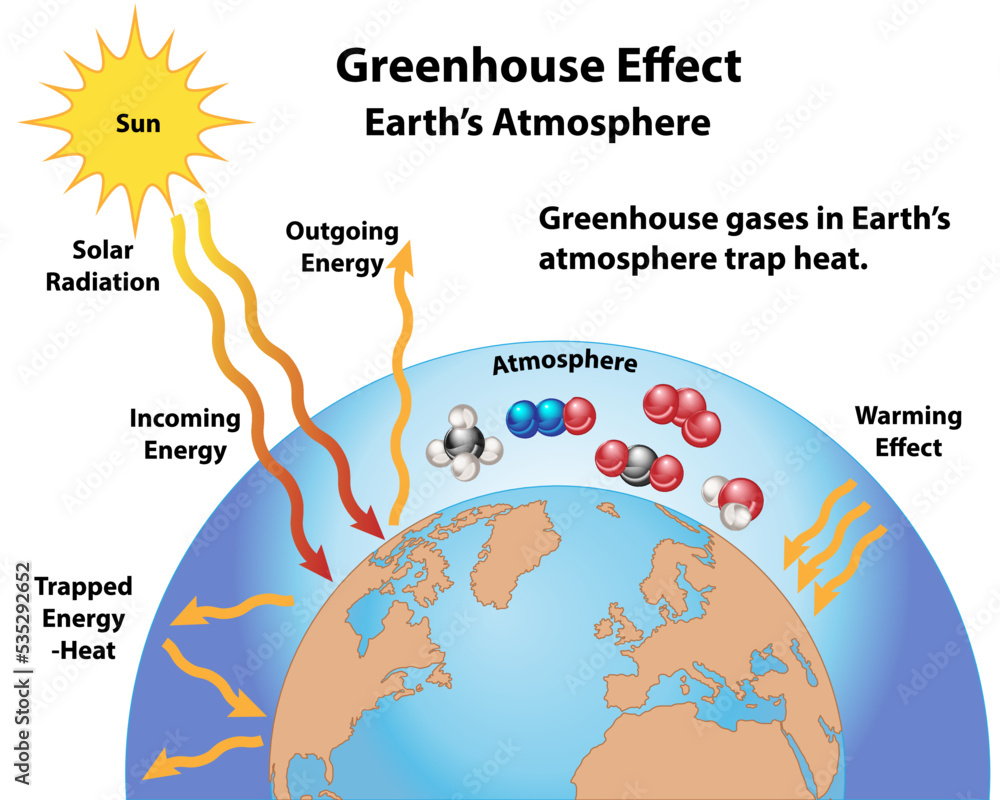
1. Solar Radiation Reaches the Surface
Sunlight, primarily short‑wave visible and ultraviolet radiation, passes through the atmosphere with minimal absorption. About 30 % is reflected by clouds, atmospheric particles, or bright surfaces, while roughly 70 % is absorbed by land, oceans and ice, heating the planet.
2. The Surface Emits Infrared Radiation
Warm surfaces re‑emit energy as long‑wave infrared (IR) radiation. In the absence of GHGs, this IR would escape directly to space, allowing Earth’s temperature to stabilize near –18 °C (the “effective radiating temperature”).
3. Greenhouse Gases Absorb and Re‑Emit IR
Molecules of CO₂, CH₄, N₂O and H₂O have vibrational modes that resonate with specific IR wavelengths. When they absorb IR photons, they become vibrationally excited and subsequently release photons in random directions, sending some energy back toward the surface. This “back‑radiation” reduces the net loss of heat to space, raising surface temperature to the observed average of ~15 °C.
4. Feedbacks Amplify or Damp the Signal
Warmer air holds more water vapor, which itself is a potent GHG, creating a positive feedback. Melting ice reduces surface albedo, allowing more solar absorption. Conversely, increased cloud cover can reflect sunlight, providing a modest negative feedback. The net effect of these feedbacks is an amplification of the initial warming.
What Does the Evidence Show?
Multiple lines of evidence converge on the same conclusion:
- Instrumental records: Surface temperature datasets compiled by NOAA, NASA and the UK Met Office show a global mean increase of about 1.1 °C since 1880.
- Atmospheric composition: Mauna Loa observations record CO₂ rising from ~315 ppm in 1958 to over 416 ppm in 2023 (NOAA, 2024).
- Satellite measurements: Infrared sounding satellites detect reduced outgoing long‑wave radiation in spectral bands associated with CO₂ and CH₄, confirming direct radiative forcing.
- Climate model attribution: The Intergovernmental Panel on Climate Change (IPCC) Fifth Assessment Report (2014) and Sixth Assessment Report (2023) attribute >99 % of observed warming since 1950 to anthropogenic GHG emissions.
- Paleoclimate proxies: Ice‑core records reveal tight correlations between past CO₂ levels and temperature over glacial‑interglacial cycles.
Main Causes or Drivers
Direct Human Sources
- Fossil‑fuel combustion for electricity, transport and industry releases ~36 Gt CO₂ per year (IEA, 2023).
- Agricultural livestock emit ~120 Mt CH₄ annually, primarily from enteric fermentation.
- Use of synthetic fertilizers produces ~6 Mt N₂O each year.
- Deforestation reduces the biosphere’s capacity to absorb CO₂.
Underlying Drivers
Economic growth, population increase, and energy demand drive the above emissions. Technological lock‑in to carbon‑intensive infrastructure and limited carbon pricing in many regions further amplify releases.
Environmental and Human Impacts
Environmental Impacts
- Temperature rise: Heat‑waves become more frequent and intense across most climate zones.
- Ice melt and sea‑level rise: The Greenland Ice Sheet lost ~279 Gt of ice per year (2003‑2019), contributing to global sea‑level rise of ~3.3 mm yr⁻¹.
- Ocean acidification: About 30 % of anthropogenic CO₂ dissolves in seawater, lowering pH by ~0.1 units since pre‑industrial times.
- Ecosystem shifts: Species migrate poleward or uphill; coral bleaching events have increased fivefold since the 1980s.
Human Health and Social Impacts
- Heat stress elevates mortality, especially among older adults and outdoor workers.
- Changes in precipitation affect water security and agricultural yields, threatening food supplies.
- Increased frequency of extreme events (storms, floods, wildfires) incurs economic losses and can displace communities.
Regional Differences
Impact magnitude varies with latitude, socioeconomic status and local climate. High‑latitude regions experience amplified warming (Arctic amplification up to 3 °C per decade), while tropical low‑lying islands face the greatest risk from sea‑level rise and storm surge. Developing nations often have limited adaptive capacity, making climate‑related losses proportionally larger.
What Scientists Know With High Confidence
- The physics of infrared absorption by greenhouse gases is well‑established.
- Atmospheric concentrations of CO₂, CH₄ and N₂O have risen sharply due to human activities.
- Enhanced greenhouse effect is the dominant cause of global warming observed since the mid‑20th century.
- Warming is already influencing weather extremes, sea level and ecosystems worldwide.
What Remains Uncertain
Uncertainties focus on the magnitude of future feedbacks, especially cloud responses and permafrost carbon release. Regional climate projections also carry higher uncertainty because of complex local processes and limited observational networks. These gaps do not undermine the fundamental conclusion that human‑driven greenhouse gas emissions are warming the planet.
Common Misconceptions
Misconception: The greenhouse effect is “bad” and should be stopped entirely.
Reality: A natural greenhouse effect is essential for life; the problem is the *enhanced* effect caused by excess gases.
Misconception: Only carbon dioxide matters.
Reality: While CO₂ is the largest long‑lived GHG, methane, nitrous oxide and water vapor each contribute significantly to radiative forcing.
Misconception: Climate change is just about hotter summers.
Reality: It also includes altered precipitation patterns, ocean acidification, sea‑level rise and increased frequency of extreme events.
Solutions and Limitations
Mitigation strategies aim to lower GHG emissions; adaptation seeks to reduce vulnerability.
- Renewable energy transition: Solar and wind can replace fossil fuels, but intermittency requires storage and grid upgrades.
- Energy efficiency: Buildings and industry can achieve 20‑30 % reductions, yet retrofitting costs can be high in developing regions.
- Reforestation and afforestation: Trees sequester carbon, but land‑use competition and permanence issues limit long‑term effectiveness.
- Carbon‑capture technologies: Emerging methods can capture CO₂ at point sources, yet scalability and cost remain challenges.
- Adaptation measures: Coastal defenses, drought‑resilient crops and early‑warning systems protect communities, but cannot reverse underlying warming.
What Individuals, Communities, and Governments Can Do
What Individuals Can Do
- Reduce personal energy use (e.g., efficient appliances, home insulation).
- Choose low‑carbon transportation (public transit, cycling, electric vehicles where feasible).
- Support policies and companies that prioritize renewable energy.
What Communities and Organizations Can Do
- Implement local renewable projects (community solar, micro‑grids).
- Adopt sustainable land‑use practices such as urban tree planting and green roofs.
- Develop climate‑risk assessments to guide infrastructure planning.
What Governments Can Do
- Set ambitious, enforceable emission‑reduction targets aligned with the Paris Agreement.
- Invest in public transit, grid modernization and climate‑resilient infrastructure.
- Provide financial and technical support to vulnerable nations for adaptation.
Closing Synthesis
The greenhouse effect is a natural, physics‑based process that keeps Earth warm enough for life. Human emissions have amplified this effect, leading to measurable warming and a cascade of environmental and societal impacts. Scientific confidence is high that the enhanced greenhouse effect drives current climate change, while uncertainties remain around the size of future feedbacks and regional outcomes. Effective responses combine mitigation—reducing emissions through clean energy, efficiency and nature‑based solutions—with adaptation that safeguards communities. Though individual actions matter, systemic change driven by policy and collective investment is essential for long‑term climate stability.
Frequently Asked Questions
What is the greenhouse effect and why is it important?
The greenhouse effect is the process by which gases like carbon dioxide and water vapor absorb infrared radiation emitted by Earth’s surface and re‑emit it, warming the planet. It is essential for life because it keeps the average surface temperature around 15 °C, but human‑added gases strengthen the effect, leading to climate change.
How do greenhouse gases trap heat in the atmosphere?
Greenhouse gas molecules have vibrational modes that match the wavelength of infrared radiation. When they absorb this radiation, they become excited and later release photons in all directions, sending some energy back toward the surface and reducing the net loss of heat to space.
What evidence confirms that human activities are enhancing the greenhouse effect?
Evidence includes long‑term temperature records showing a 1.1 °C rise since 1880, atmospheric CO₂ measurements rising from 315 ppm in 1958 to over 416 ppm in 2023, satellite detection of reduced outgoing infrared in greenhouse‑gas bands, and IPCC assessments attributing >99 % of post‑1950 warming to anthropogenic emissions.
Which regions are most vulnerable to the impacts of an enhanced greenhouse effect?
High‑latitude areas experience amplified warming (Arctic amplification), while tropical low‑lying islands face the greatest risk from sea‑level rise and storm surge. Developing regions often have limited adaptive capacity, making climate‑related losses proportionally larger.
What actions can governments take to mitigate the enhanced greenhouse effect?
Governments can set enforceable emission‑reduction targets aligned with the Paris Agreement, invest in renewable energy, modernize power grids, develop climate‑resilient infrastructure, and provide financial and technical assistance to vulnerable nations for adaptation.







Leave a Comment