
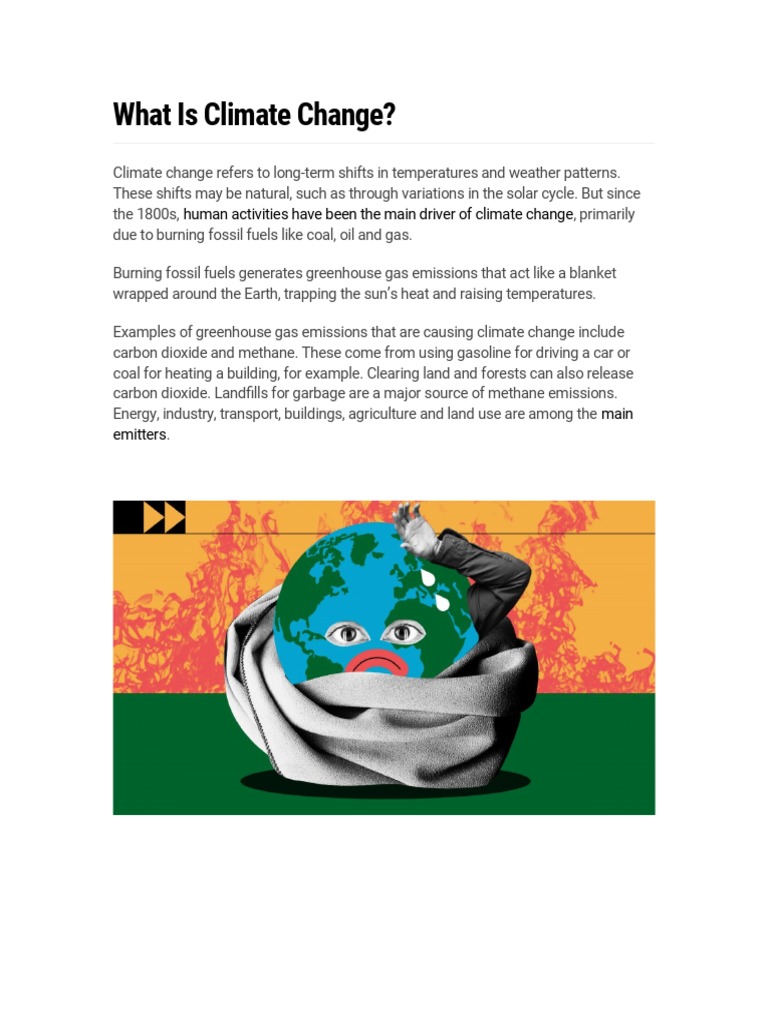
Climate change is the long‑term alteration of Earth’s average weather patterns caused primarily by human‑driven greenhouse gas emissions, leading to warming, sea‑level rise, and widespread ecological and societal impacts.
Quick Answer
Climate change refers to persistent shifts in global temperature, precipitation, and extreme‑weather patterns that stem mainly from the accumulation of carbon dioxide, methane, and nitrous oxide in the atmosphere due to fossil‑fuel combustion, deforestation, and industrial activities. These gases trap infrared radiation, creating a greenhouse effect that warms the planet. The most robust scientific consensus, as summarized in the Intergovernmental Panel on Climate Change (IPCC) assessments, confirms that human activities are the dominant driver of warming since the mid‑20th century. Consequences include higher heat‑related mortality, agricultural stress, and coastal flooding, while uncertainties remain around regional climate sensitivity and the timing of feedback loops.
Key Takeaways
- Human‑generated greenhouse gases are the primary cause of modern climate change.
- Multiple lines of evidence—instrumental records, ice cores, and satellite data—converge on a warming trend of ~1.1 °C since pre‑industrial times.
- Impacts are uneven: low‑lying islands, heat‑vulnerable populations, and biodiversity‑rich ecosystems face the greatest risks.
- Mitigation (reducing emissions) and adaptation (building resilience) are both essential, each with technical and socio‑economic trade‑offs.
- Uncertainties focus on the strength of climate feedbacks, regional precipitation changes, and future socioeconomic pathways.
What Is Climate Change Explained in Two Clear Paragraphs?
Climate change describes the statistically significant, long‑term shift in average atmospheric conditions, including temperature, precipitation, and wind patterns, that occurs over decades to centuries. It differs from short‑term weather variability and is measured against a baseline period (typically 1850‑1900). The phenomenon is driven by an imbalance between incoming solar radiation and outgoing infrared radiation, a balance that is disrupted when greenhouse gases accumulate in the atmosphere.
How Does It Work?
1. Greenhouse Gas Emissions
When fossil fuels are burned for energy, carbon stored for millions of years is released as carbon dioxide (CO₂). Agriculture and waste management add methane (CH₄) and nitrous oxide (N₂O), both far more potent per molecule than CO₂ at trapping heat.
2. Radiative Forcing
These gases absorb infrared radiation emitted by Earth’s surface and re‑emit it in all directions, including back toward the surface. This “greenhouse effect” raises the average surface temperature, a process quantified as radiative forcing measured in watts per square metre.
3. Feedback Loops
Warming can trigger feedbacks that amplify or dampen change. Examples include ice‑albedo feedback (melting ice reduces reflectivity, absorbing more heat) and water‑vapor feedback (warmer air holds more moisture, a strong greenhouse gas).
4. Climate System Response
The oceans absorb over 90 % of excess heat, leading to thermal expansion and sea‑level rise. Increased evaporation fuels more intense storms, while altered temperature gradients shift atmospheric circulation patterns.
What Does the Evidence Show?
Long‑term instrumental records from the World Meteorological Organization show a global mean surface temperature increase of about 1.1 °C between 1880 and 2023. Ice‑core analyses reveal that current CO₂ concentrations (≈420 ppm in 2023) are unprecedented in the past 800,000 years. Satellite observations confirm reduced outgoing long‑wave radiation consistent with greenhouse‑gas forcing. Attribution studies, using climate models and observed data, repeatedly isolate human emissions as the dominant cause of the warming trend, with a confidence level of >99 % according to the IPCC Sixth Assessment Report.
Main Causes or Drivers
Direct Human Drivers
- Combustion of coal, oil, and natural gas for electricity, transport, and industry.
- Land‑use change, especially deforestation, which reduces carbon sinks.
- Agricultural practices that emit methane from livestock and rice paddies, and nitrous oxide from fertilizer use.
Underlying Socio‑Economic Drivers
- Population growth and urbanization increasing energy demand.
- Economic systems reliant on carbon‑intensive production and consumption.
- Policy frameworks that have historically subsidized fossil‑fuel extraction.
Environmental and Human Impacts
Environmental Impacts
- Accelerated melting of glaciers and ice sheets contributes to sea‑level rise, threatening coastal habitats.
- Ocean acidification, driven by CO₂ absorption, harms coral reefs and shell‑forming marine organisms.
- Shifts in species’ geographic ranges disrupt ecosystems and increase extinction risk, especially for temperature‑sensitive taxa.
Human Health and Social Impacts
- Heatwaves raise mortality risk, particularly for the elderly and outdoor workers.
- Changes in precipitation affect water availability, amplifying scarcity in arid regions.
- Increased frequency of extreme storms damages infrastructure, displaces communities, and imposes economic losses.
Economic and Infrastructure Impacts
- Agricultural yields are projected to decline in tropical regions while some temperate zones may see modest gains, creating food‑security challenges.
- Coastal flooding threatens property values and requires costly adaptation measures such as seawalls or managed retreat.
\n
Regional Differences
High‑latitude regions experience warming at roughly twice the global average, leading to permafrost thaw and amplified feedbacks. In contrast, equatorial and low‑lying tropical islands face heightened exposure to heat stress and sea‑level rise but have limited adaptive capacity due to resource constraints. Mid‑latitude agricultural belts, such as the U.S. Midwest and the Indo‑Gangetic Plain, encounter variable precipitation patterns that can cause both droughts and floods within a single growing season.
What Scientists Know With High Confidence
- The Earth’s average surface temperature has risen markedly since the mid‑20th century.
- Human activities, especially fossil‑fuel combustion, are the dominant cause of recent warming.
- Greenhouse gases trap infrared radiation, creating a radiative forcing that drives temperature increase.
- Sea level is rising due to thermal expansion and melting ice, with rates measured at about 3.4 mm per year over the past three decades.
- Climate change is already affecting ecosystems and human societies worldwide.
What Remains Uncertain
Key uncertainties involve the magnitude of future carbon‑cycle feedbacks, such as permafrost carbon release, and the regional specificity of precipitation changes. Socio‑economic pathways that determine future emissions are also uncertain, influencing the range of projected temperature outcomes. While the direction of change is clear, the exact timing of thresholds—such as irreversible ice‑sheet loss—remains an active research area.
Common Misconceptions
Misconception: Climate change is just a short‑term weather event.
Reality: Climate refers to long‑term averages over decades, whereas weather describes day‑to‑day variations. The observed warming trend persists across multiple decades and is distinct from individual weather events.
Misconception: Only CO₂ matters for global warming.
Reality: While CO₂ is the largest contributor, methane, nitrous oxide, and fluorinated gases also have high global warming potentials and together account for roughly 45 % of total radiative forcing.
Misconception: Climate models are unreliable.
Reality: Climate models successfully reproduce past temperature trends and have been validated against independent observations. Uncertainty lies mainly in future emissions scenarios, not in the fundamental physics of the models.
Misconception: Individual lifestyle changes alone can stop climate change.
Reality: Personal actions, such as reducing energy use, are valuable but must be combined with systemic changes in energy infrastructure, policy, and industrial practices to achieve the emission reductions required by the Paris Agreement.
Solutions and Limitations
Mitigation strategies focus on reducing greenhouse‑gas emissions. Renewable energy deployment (solar, wind, geothermal) can displace fossil fuels, yet challenges include intermittency, grid integration, and the need for material resources such as rare‑earth metals. Energy efficiency in buildings and industry offers cost‑effective reductions but requires upfront investment and regulatory incentives.
Adaptation measures—such as coastal defenses, drought‑resilient crops, and early‑warning systems—enhance resilience but cannot reverse existing climate impacts. Nature‑based solutions, like reforestation, sequester carbon and provide co‑benefits for biodiversity, yet they depend on land availability and long‑term management.
Carbon‑capture technologies (CCS) show promise for hard‑to‑abate sectors, but current deployment is limited, and long‑term storage security remains a concern. Policymaking tools, including carbon pricing and emissions standards, can drive systemic change, though political feasibility varies across jurisdictions.
What Individuals, Communities, and Governments Can Do
What Individuals Can Do
- Choose renewable electricity where available or purchase green‑energy credits.
- Reduce personal vehicle mileage by using public transport, car‑pooling, or active travel.
- Adopt energy‑efficient appliances and improve home insulation.
- Support policies that promote clean energy and climate resilience.
What Communities and Organizations Can Do
- Develop local climate action plans that incorporate renewable micro‑grids and green infrastructure.
- Implement community‑wide composting and waste‑reduction programs to lower methane emissions.
- Facilitate education and capacity‑building workshops on climate resilience.
What Governments Can Do
- Set ambitious, enforceable emissions‑reduction targets aligned with the Paris Agreement.
- Invest in public transit, high‑speed rail, and electrified transport networks.
- Provide subsidies or tax incentives for renewable energy installation and energy‑efficiency retrofits.
- Strengthen building codes to incorporate climate‑resilient design.
Closing Synthesis
Climate change is a scientifically robust, human‑driven alteration of Earth’s climate system, driven by greenhouse‑gas emissions that trap heat and trigger feedbacks. Decades of observations and model simulations give high confidence in the warming trend, its primary causes, and its broad impacts on ecosystems and societies. While uncertainties remain regarding specific regional outcomes and the strength of feedback mechanisms, the overall trajectory is clear. Effective responses require a mix of mitigation—shifting to clean energy, improving efficiency, and protecting carbon sinks—and adaptation—building resilient infrastructure and safeguarding vulnerable communities. Collective action across individuals, communities, and governments offers the most realistic pathway to limit warming and safeguard the planet for future generations.
Frequently Asked Questions
What is the basic definition of climate change?
Climate change is the long‑term shift in average weather patterns, such as temperature and precipitation, caused mainly by the buildup of greenhouse gases from human activities.
How do greenhouse gases cause the planet to warm?
Greenhouse gases like carbon dioxide absorb infrared radiation emitted by Earth and re‑emit it back toward the surface, trapping heat and raising global average temperatures.
What are the most confident scientific findings about climate change?
Scientists are highly confident that the planet has warmed since the mid‑20th century, human activities are the dominant cause, sea level is rising, and the warming is already affecting ecosystems and societies.
Why are some regions more vulnerable to climate impacts than others?
Vulnerability depends on geography, economic resources, and adaptive capacity; low‑lying islands, high‑latitude areas, and low‑income regions face greater exposure to sea‑level rise, heat stress, and limited means to adapt.
What actions can individuals realistically take to help mitigate climate change?
Individuals can reduce emissions by choosing renewable electricity, using public transport or active travel, improving home energy efficiency, and supporting climate‑positive policies through voting and advocacy.









Leave a Comment