
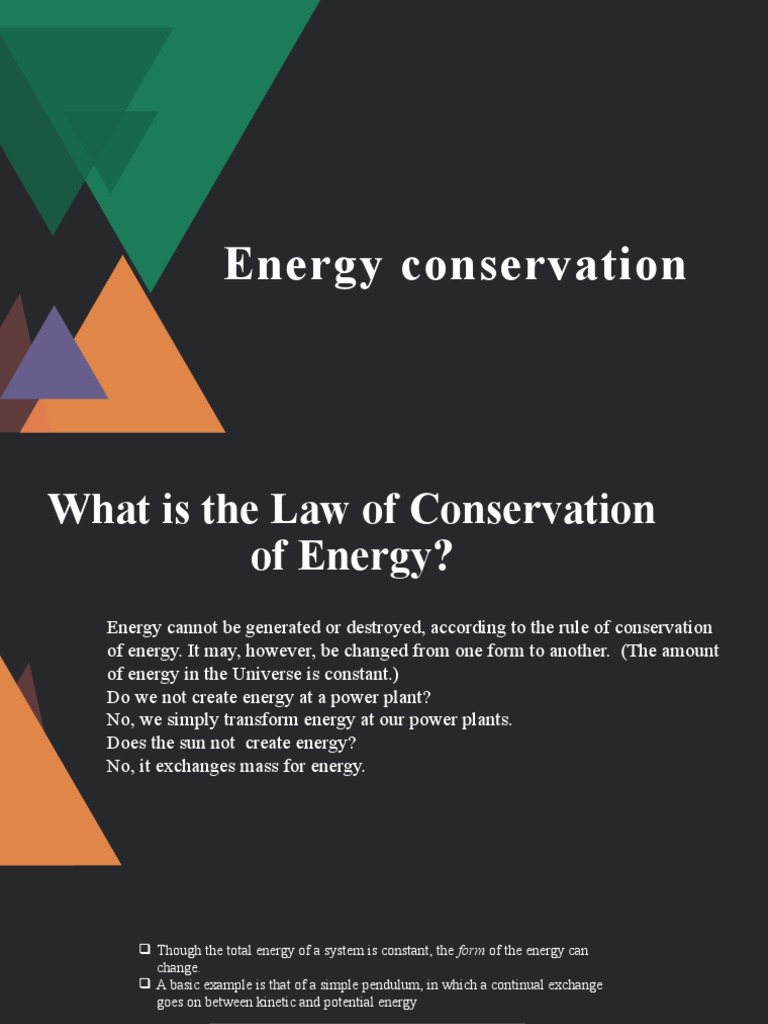
The conservation of energy principle states that energy cannot be created or destroyed, only transformed, and it governs natural systems, engineered devices, and human practices worldwide.
Quick Answer
The conservation of energy is a universal law of physics that applies wherever energy is transferred or transformed— from sunlight captured by plants in forests, to kinetic and potential energy in machines, to electrical generation in power plants. It means that the total amount of energy in an isolated system remains constant, though its form changes. Recognizing this principle helps scientists design efficient technologies and guides societies toward sustainable resource use, while acknowledging that real‑world systems experience losses (e.g., friction, heat) that must be managed.
Key Takeaways
- Energy is neither created nor destroyed; it only changes form.
- Natural ecosystems exemplify continuous energy flow from solar radiation to chemical bonds and back through decomposition.
- Mechanical and electrical systems obey the same law, enabling engineers to predict performance and improve efficiency.
- Human‑driven energy use can be reduced by applying the principle to design, policy, and everyday behavior.
- High‑confidence science confirms the law’s universality, while uncertainties remain in complex, coupled human‑environment systems.
What Is When and Where the Conservation of Energy Applies?
The phrase refers to the contexts—both natural and engineered—in which the law of energy conservation operates. In physics, an “isolated system” is one that does not exchange energy with its surroundings; in practice, most real systems exchange energy but the total amount across the larger environment stays constant. The principle applies to:
- Natural systems: solar radiation, photosynthesis, food webs, and decomposition.
- Mechanical systems: pendulums, engines, turbines, and any device where kinetic and potential energy interconvert.
- Electrical systems: generation, transmission, and storage of electricity.
- Human practices: building heating, transportation, and industrial processes.
Understanding where the law holds helps identify energy losses, improve efficiency, and minimize wasteful emissions.
How Does It Work?
1. Energy Transfer in Natural Ecosystems
Sunlight (radiant energy) is absorbed by chlorophyll in plant leaves, converting photons into chemical energy stored as glucose. Herbivores eat the plants, transferring that chemical energy to animal tissue. Decomposers break down dead matter, releasing stored energy as heat and nutrients, which feed the next generation of microbes. Throughout, the total energy remains constant; only its form changes.
2. Mechanical Energy Interconversion
When a pendulum swings, its height gives it gravitational potential energy (PE = m·g·h). As it falls, PE converts to kinetic energy (KE = ½·m·v²). In an ideal frictionless system, the sum PE+KE stays the same. Real machines experience friction and air resistance, turning some mechanical energy into thermal energy, which is eventually dissipated.
3. Electrical Generation and Storage
Hydroelectric dams convert the potential energy of elevated water into kinetic energy as it flows through turbines, which then produce electrical energy via electromagnetic induction. Batteries store electrical energy chemically; when discharged, the chemical energy reverts to electrical form. In all cases, energy is conserved, though conversion efficiencies vary (e.g., modern hydroelectric plants achieve 90 %+ efficiency).
4. Human‑Centred Energy Use
Buildings use fossil‑fuel combustion (chemical to thermal to mechanical to electrical) or renewable sources (solar photovoltaic: radiant to electrical). Each step incurs losses, typically expressed as an efficiency rating. Applying the conservation principle means accounting for every transformation and seeking to reduce unrecoverable waste heat.
What Does the Evidence Show?
Decades of laboratory experiments, field measurements, and satellite observations confirm that energy is conserved across scales. The Intergovernmental Panel on Climate Change (IPCC) 2021 report notes that the global energy budget—solar input, atmospheric heat, oceanic storage—balances within measurement uncertainty. Engineering textbooks and peer‑reviewed studies document conversion efficiencies for turbines, engines, and photovoltaic cells, all consistent with the law. Ecological research, such as the long‑term LTER (Long Term Ecological Research) sites, demonstrates closed‑loop energy flow in forests, with net primary productivity matching the summed energy inputs from sunlight.
Main Causes or Drivers
Natural Drivers
Solar irradiance, planetary albedo, and geothermal heat are the primary external energy sources that feed Earth’s systems. Seasonal variations and latitude affect how much energy is available for conversion.
Human Drivers
Extraction and combustion of fossil fuels, construction of dams, and deployment of renewable technologies alter the pathways through which energy moves. Policy incentives, technology adoption rates, and economic growth shape the scale and direction of these changes.
Environmental and Human Impacts
Environmental Impacts
Efficient energy conversion reduces waste heat released to the atmosphere, limiting local micro‑climate warming. Poorly designed systems increase thermal pollution in waterways and raise greenhouse‑gas emissions when extra fuel is burned to compensate for losses.
Human Health and Social Impacts
Energy inefficiency often forces higher fuel consumption, leading to air‑quality degradation that is linked to respiratory diseases (World Health Organization, 2022). Communities lacking access to reliable electricity experience reduced educational and economic opportunities.
Economic and Infrastructure Impacts
Every percent improvement in turbine efficiency can save millions of dollars annually in power‑generation costs. Conversely, energy losses in transmission (average 5‑10 % for modern grids) represent economic waste and increase the need for new generation capacity.
Regional Differences
High‑latitude regions receive less solar energy, making wind and hydro more important, while tropical zones rely heavily on solar input. Developing nations often depend on biomass combustion, where low efficiency leads to higher indoor air pollution. In contrast, many high‑income countries have upgraded building codes that enforce minimum insulation standards, reducing heat loss.
What Scientists Know With High Confidence
What Scientists Know With High Confidence
- The total energy of the Earth‑atmosphere‑ocean system is conserved over decadal to centennial timescales (IPCC, 2021).
- Photosynthesis is the dominant pathway for solar energy to enter terrestrial ecosystems (FAO, 2020).
- Mechanical and electrical conversion efficiencies are bounded by thermodynamic limits (Carnot efficiency) and are measurable with high precision.
- Energy‑inefficient practices increase greenhouse‑gas emissions proportionally to the amount of wasted energy.
What Remains Uncertain
What Remains Uncertain
Uncertainties persist in quantifying indirect energy losses in complex, coupled socio‑ecological systems, such as the embedded energy in global supply chains. Spatially detailed measurements of energy flow in deep‑sea ecosystems remain limited, leaving gaps in the global energy budget at fine scales. Additionally, the long‑term performance of emerging storage technologies (e.g., solid‑state batteries) under real‑world cycling is still being researched.
Common Misconceptions
Common Misconceptions
Misconception: Energy can be “saved” by simply turning off a light.
Reality: Turning off a light reduces the conversion of electrical energy to heat and light, but the overall energy balance of the grid remains conserved; the saved electricity simply remains unused or is reallocated.
Misconception: Renewable energy creates new energy.
Reality: Solar and wind convert existing solar radiation or kinetic energy of atmospheric motion; they do not create energy, they merely transform it with varying efficiency.
Misconception: All energy loss is wasteful.
Reality: Some loss, such as waste heat from power plants, can be captured for district heating, turning what appears to be waste into useful energy.
Misconception: Conservation of energy does not apply to biological systems.
Reality: Biological processes obey the same physical laws; the energy stored in biomass originates from solar photons and is released as heat or chemical energy during metabolism.
Solutions and Limitations
Improving energy efficiency across sectors is the most direct way to respect the conservation principle while reducing demand. Strategies include:
- Building retrofits: Adding insulation and high‑efficiency HVAC can cut heating‑related losses by 30‑50 % (IEA, 2020). Limitation: Upfront capital costs and historic building constraints.
- Advanced turbine design: Aerodynamic blades increase wind‑farm capacity factors, but material scarcity and site‑specific wind patterns limit universal deployment.
- Smart grids: Real‑time demand response reduces peak loads, yet requires widespread digital infrastructure and consumer participation.
- Energy storage: Batteries capture excess renewable generation, but current technologies have finite lifespans and environmental footprints from mining.
All solutions involve trade‑offs between cost, resource use, and societal acceptance, and none alone can resolve the global energy challenge.
What Individuals, Communities, and Governments Can Do
What Individuals Can Do
- Upgrade home lighting to LED, which converts electrical energy to light with >80 % efficiency.
- Use programmable thermostats to avoid unnecessary heating or cooling.
- Choose appliances with high ENERGY STAR ratings, reducing conversion losses.
What Communities and Organizations Can Do
- Implement district‑heating networks that reuse waste heat from power plants or industrial processes.
- Adopt community solar projects that increase local renewable capture.
- Conduct energy audits to identify and remediate major loss points in public buildings.
What Governments Can Do
- Set minimum efficiency standards for buildings, vehicles, and appliances.
- Invest in research and deployment of low‑loss transmission technologies, such as high‑temperature superconductors.
- Provide incentives for retrofitting existing infrastructure to improve overall system efficiency.
Closing Synthesis
The conservation of energy is a foundational, universally valid principle that governs natural ecosystems, engineered machines, and the way societies consume power. Robust evidence confirms its applicability, while uncertainties remain in complex, integrated human‑environment systems. By recognizing where energy is lost and applying efficiency‑focused solutions—balanced against economic and social considerations—individuals, communities, and policymakers can reduce waste, lower emissions, and support a sustainable energy future.
Frequently Asked Questions
What does the conservation of energy principle mean?
The conservation of energy principle states that energy cannot be created or destroyed; it can only change form, so the total energy in an isolated system remains constant.
How does the principle apply to natural ecosystems?
In ecosystems, solar energy is captured by plants through photosynthesis, transferred through food webs, and released as heat during decomposition, illustrating continuous energy transformation without loss of total energy.
Why do mechanical systems experience energy loss?
Mechanical systems lose energy mainly through friction and air resistance, which convert useful kinetic or potential energy into thermal energy that dissipates into the environment.
What are the main uncertainties related to energy conservation in complex systems?
Key uncertainties include quantifying indirect energy losses in global supply chains, measuring fine‑scale energy flows in deep‑sea ecosystems, and predicting long‑term performance of emerging storage technologies.
What practical steps can individuals take to respect the conservation of energy?
Individuals can switch to LED lighting, use programmable thermostats, and choose high‑efficiency appliances, all of which reduce unnecessary energy transformations and waste.








Leave a Comment