
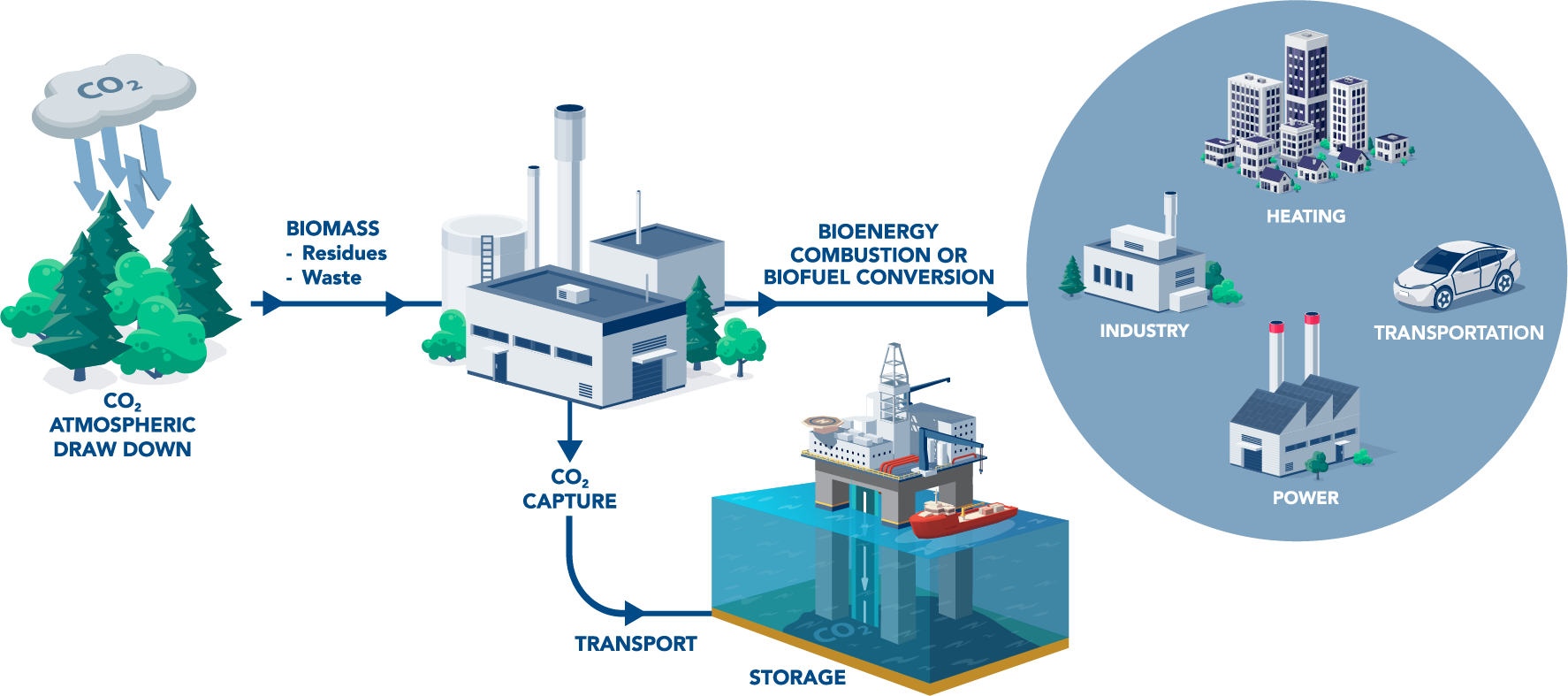
Bioenergy with Carbon Capture and Storage (BECCS) combines renewable biomass energy with technologies that capture and permanently store carbon dioxide, offering a pathway to generate power while achieving negative greenhouse‑gas emissions.
Quick Answer
BECCS is a climate‑mitigation approach that burns or ferments biomass to produce heat or fuel, then captures the resulting carbon dioxide and stores it deep underground or uses it in industrial processes. Because the biomass absorbed CO₂ while growing, permanently sequestering the captured CO₂ creates net‑negative emissions. The method is supported by multiple assessment reports, but its large‑scale deployment faces uncertainties around land use, cost, and long‑term storage security.
Key Takeaways
- BECCS can deliver net‑negative emissions by removing more CO₂ from the atmosphere than it releases.
- The technology integrates three components: biomass production, carbon capture, and geological storage.
- Evidence from pilot plants and life‑cycle analyses shows feasible CO₂ capture rates above 90 %.
- Key challenges include sustainable biomass supply, high capital costs, and ensuring permanent storage.
- Policy support, carbon pricing, and robust monitoring are essential for scaling BECCS responsibly.
What Is Bioenergy With Carbon Capture and Storage Explained?
Bioenergy refers to energy derived from organic matter—such as agricultural residues, forest waste, or purpose‑grown energy crops. When biomass is burned or converted into biofuels, carbon dioxide is released. BECCS adds a carbon‑capture step that traps this CO₂ and stores it in deep saline formations, depleted oil and gas reservoirs, or basaltic rock. The term differs from “bioenergy with carbon capture” (which may reuse CO₂) and from “carbon capture and storage” applied to fossil‑fuel plants, because the carbon originally came from atmospheric CO₂ fixed by photosynthesis.
How Does It Work?
1. Biomass Production
Farmers grow or harvest biomass on land that may be marginal or dedicated to energy crops. Photosynthesis removes CO₂ from the atmosphere, storing it as carbon in plant tissue.
2. Conversion to Energy
Biomass can be:
- Combusted in a power plant to generate electricity or heat.
- Processed in a biorefinery to produce liquid biofuels (e.g., bio‑ethanol, bio‑jet fuel) or biogas via anaerobic digestion.
3. Carbon Capture
During combustion or fermentation, flue gases contain CO₂. Capture technologies—post‑combustion solvents, pre‑combustion gasification, or oxy‑fuel combustion—extract CO₂ at efficiencies often exceeding 90 % (demonstrated in pilots such as the Drax BECCS project in the United Kingdom).
4. Compression, Transport, and Storage
Captured CO₂ is purified, compressed to a supercritical state, and moved via pipelines or ships to a storage site. Injection into porous rock formations, sealed by an impermeable caprock, keeps the gas isolated for thousands of years.
What Does the Evidence Show?
Life‑cycle assessments compiled by the International Energy Agency (IEA) in its 2023 World Energy Outlook indicate that BECCS can achieve net‑negative emissions of 0.5–1.0 tCO₂ per tonne of biomass, depending on feedstock and technology. Field studies at the Illinois Industrial Carbon Capture (IICC) facility report capture efficiencies of 93 % for a lignocellulosic feedstock. The Intergovernmental Panel on Climate Change (IPCC) Sixth Assessment Report (2022) lists BECCS as one of the few technologies capable of delivering negative emissions at scale, but notes that large‑scale deployment would require careful management of land, water, and biodiversity.
Main Causes or Drivers
Climate Mitigation Targets
Global climate models show that limiting warming to 1.5 °C requires removing billions of tonnes of CO₂ each year after 2050. BECCS is highlighted as a critical tool for meeting those net‑negative pathways.
Energy Security
Biomass can be stored and dispatched on demand, providing baseload power that complements intermittent solar and wind.
Policy and Carbon Pricing
Carbon markets that reward negative emissions, such as the EU Emissions Trading System’s removal credits, create economic incentives for BECCS projects.
Environmental and Human Impacts
Environmental Impacts
When sustainably sourced, BECCS can reduce net greenhouse‑gas emissions and help restore degraded lands through careful crop rotation. However, large‑scale biomass cultivation may compete with food production, affect water availability, and alter biodiversity if not managed responsibly.
Human Health and Social Impacts
Reduced fossil‑fuel combustion can lower air‑pollutant exposure, benefiting respiratory health in nearby communities. Conversely, intensive farming for energy crops may increase pesticide use and affect labor conditions unless regulated.
Economic and Infrastructure Impacts
BECCS projects generate construction jobs, require new pipelines and storage monitoring facilities, and can stimulate rural economies. High capital costs—often $100–$200 per tonne of CO₂ captured—pose financial barriers without supportive policy frameworks.
Regional Differences
In temperate Europe, abundant forest residues and mature carbon‑storage geology make BECCS attractive, leading to pilot projects in Sweden and the United Kingdom. In the United States, the Midwest’s corn‑based ethanol industry provides feedstock, while the Gulf Coast offers extensive saline aquifers for storage. Tropical regions possess high biomass productivity but face greater risks of land‑use change and water stress, requiring rigorous sustainability criteria.
What Scientists Know With High Confidence
- Photosynthesis removes CO₂ from the atmosphere, and biomass retains that carbon until it is burned or decomposes.
- Carbon‑capture technologies can reliably capture >90 % of CO₂ from flue gases in controlled settings.
- Geological storage in deep saline formations has been demonstrated to retain CO₂ for millennia, as shown by long‑term monitoring of the Sleipner field in Norway.
- Integrated assessment models consistently rank BECCS as one of the few scalable negative‑emission options.
What Remains Uncertain
Key uncertainties include the long‑term sustainability of large‑area biomass production, the economics of capture and storage at commercial scale, and the potential for unintended leakage from storage sites. Regional variations in soil carbon, water availability, and land‑use policies add further complexity. Ongoing field trials and improved monitoring will be needed to reduce these knowledge gaps.
Common Misconceptions
Misconception: BECCS is a “free lunch” that solves climate change without trade‑offs.
Reality: While BECCS can deliver net‑negative emissions, it requires land, water, and financial resources. Unsustainable biomass sourcing can harm ecosystems and food security.
Misconception: Captured CO₂ is always stored permanently.
Reality: Long‑term storage depends on geological integrity and ongoing monitoring; some sites may require remediation if leakage pathways develop.
Misconception: BECCS can replace the need for reducing fossil‑fuel use.
Reality: Negative‑emission technologies complement, not substitute, rapid decarbonisation of energy systems; emissions must still be reduced at the source.
Solutions and Limitations
Effective deployment of BECCS rests on a combination of technology, policy, and sustainability measures:
- Technology development: Improving solvent efficiency, reducing energy penalty of capture, and scaling modular bioreactors.
- Policy frameworks: Carbon pricing that values negative emissions, subsidies for sustainable biomass, and clear regulations for storage monitoring.
- Land‑use planning: Prioritising residues and marginal lands over prime agricultural soils to avoid food‑vs‑fuel conflicts.
- Monitoring and verification: Deploying seismic surveys and tracer studies to ensure CO₂ remains trapped.
Limitations include high upfront costs, the need for extensive infrastructure, and potential competition for land and water. Without robust sustainability standards, BECCS could inadvertently increase emissions or degrade ecosystems.
What Individuals, Communities, and Governments Can Do
What Individuals Can Do
Support policies that price carbon and fund negative‑emission research, choose products certified for sustainable biomass, and reduce personal energy consumption to lower overall demand for new BECCS capacity.
What Communities and Organizations Can Do
Develop local biomass supply chains using agricultural residues, partner with research institutions to host pilot BECCS units, and establish community monitoring programs for storage sites.
What Governments Can Do
Provide long‑term incentives for BECCS projects, integrate BECCS into national climate‑net‑zero strategies, fund research on land‑use impacts, and enforce rigorous environmental standards for storage sites.
Closing Synthesis
Bioenergy with Carbon Capture and Storage merges renewable biomass energy with proven carbon‑sequestration techniques, offering a credible route to net‑negative emissions. Strong scientific evidence confirms the core processes—photosynthetic carbon uptake, high‑efficiency capture, and secure geological storage—while uncertainties around scale, sustainability, and cost remain. By coupling robust policy, careful land‑use planning, and transparent monitoring, BECCS can become a valuable component of a broader climate‑mitigation portfolio, complementing rapid decarbonisation of the energy system.
Frequently Asked Questions
What is BECCS and how does it differ from regular bioenergy?
BECCS is bioenergy production combined with carbon capture and storage, creating net‑negative emissions, whereas regular bioenergy releases the CO₂ absorbed during plant growth without capture.
How does the carbon capture process work in BECCS plants?
After biomass is burned or fermented, flue gases pass through capture systems—such as solvent scrubbers, oxy‑fuel combustion, or pre‑combustion gasification—that remove more than 90 % of CO₂, which is then compressed for transport and storage.
What evidence shows that BECCS can achieve negative emissions?
Life‑cycle assessments from the IEA and pilot projects like the Drax BECCS plant demonstrate net‑negative emissions of 0.5–1.0 tCO₂ per tonne of biomass, and the IPCC lists BECCS as a viable negative‑emission technology.
What are the main environmental concerns associated with large‑scale BECCS?
Potential concerns include competition for land with food production, water use, biodiversity impacts from monoculture energy crops, and the need for permanent, leak‑free geological storage.
How can governments support the responsible deployment of BECCS?
Governments can create carbon‑pricing mechanisms that reward negative emissions, subsidize sustainable biomass supply, fund research on storage security, and set strict land‑use and monitoring regulations.





Leave a Comment