
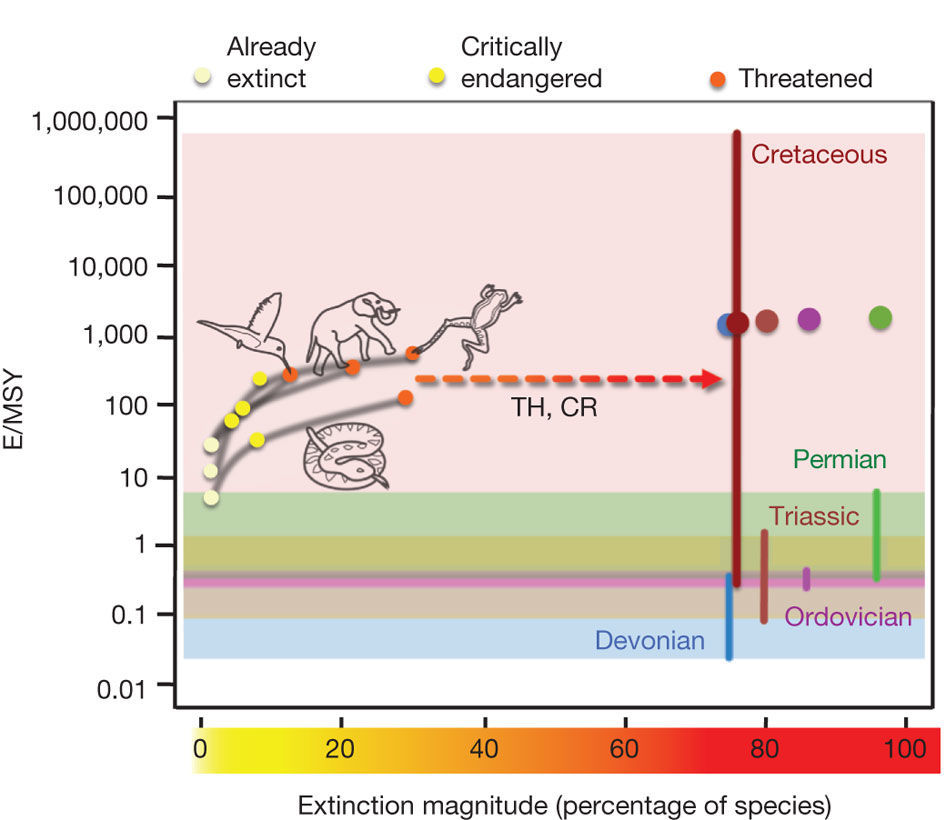
While extinction is a natural part of Earth’s history, current scientific evidence shows that the accelerated loss of species far exceeds background rates and poses serious ecological and societal risks.
Quick Answer
Extinction is the permanent loss of a species, and the modern rate is estimated to be up to 1,000 times higher than the natural background rate (IPCC, 2022). Human activities—habitat destruction, climate change, overexploitation, pollution, and invasive species—drive this acceleration. The consensus among major assessments is that such rapid loss undermines ecosystem services, reduces resilience, and can amplify other environmental problems. Although some species disappear without obvious immediate effects, the cumulative impact is significant, and uncertainty remains about precise future trajectories.
Key Takeaways
- The current extinction rate vastly outpaces the background rate documented over millions of years.
- Habitat loss, climate change, overharvest, pollution, and invasive species are the primary drivers.
- Loss of keystone and ecosystem‑engineer species can trigger cascading failures in food webs.
- High‑confidence evidence links biodiversity loss to reduced carbon sequestration, water regulation, and pollination.
- Effective responses combine habitat protection, sustainable resource use, climate mitigation, and targeted restoration.
What Is Are Extinction Rates Really Nothing to Worry About??
The phrase questions whether the observed acceleration in species loss warrants concern. In scientific terms, “extinction rate” refers to the number of species that become extinct per unit of time, usually expressed as extinctions per million species-years (E/MSY). The “background rate” is the long‑term average derived from the fossil record, roughly 0.1–1 E/MSY. When we compare modern observations to this baseline, we assess whether the current trajectory is exceptional and what it implies for ecosystems and human well‑being.
How Does It Work?
Biological and Ecological Mechanisms
- Species loss reduces functional diversity. Each species contributes unique traits—such as specific pollination relationships or nutrient‑cycling roles—that support ecosystem processes.
- Keystone species maintain network stability. Their removal can cause disproportionate ripple effects, altering predator–prey dynamics and habitat structure.
- Ecological redundancy can buffer impacts. When multiple species share similar functions, the system may tolerate some loss without immediate collapse.
Human‑Driven Drivers
- Habitat conversion. Agriculture, urban expansion, and infrastructure fragment or eliminate natural habitats, directly reducing population sizes.
- Climate change. Rising temperatures and shifting precipitation patterns force species to migrate, adapt, or face extinction, especially for those with limited dispersal ability.
- Overexploitation. Unsustainable fishing, hunting, and trade deplete populations faster than they can reproduce.
- Pollution. Chemical contaminants, plastic debris, and eutrophication degrade habitats and cause physiological stress.
- Invasive species. Non‑native organisms outcompete, predate, or transmit diseases to native species.
What Does the Evidence Show?
Long‑term monitoring by the International Union for Conservation of Nature (IUCN) indicates that, as of 2023, over 37,400 species are classified as threatened with extinction, representing roughly 28 % of all assessed species (IUCN Red List, 2023). A 2022 systematic review of vertebrate monitoring data found average population declines of 68 % since 1970 (WWF, 2022). Fossil‑based reconstructions confirm that background extinction rates are on the order of 0.1–1 E/MSY, whereas recent peer‑reviewed estimates for mammals and birds range from 10 to 100 E/MSY (Ceballos et al., 2020). These independent lines of evidence—field observations, global assessments, and paleontological baselines—converge on the conclusion that modern extinction is anomalously rapid.
Main Causes or Drivers
Direct Human Impacts
- Deforestation for agriculture removes 10 % of tropical forest each decade (FAO, 2021).
- Global fisheries harvest an estimated 34 % of marine fish stocks beyond sustainable limits (FAO, 2022).
- Carbon dioxide concentrations reached 421 ppm in 2023, driving temperature increases that exceed the 1.5 °C target (IPCC, 2022).
Underlying Socio‑Economic Drivers
- Population growth and rising consumption intensify land‑use pressure.
- Economic incentives for short‑term resource extraction often outweigh long‑term conservation benefits.
- Weak governance and limited enforcement enable illegal wildlife trade.
Environmental and Human Impacts
Environmental Impacts
Loss of pollinators reduces crop yields by an estimated 3–5 % globally (IPBES, 2019). Declines in forest‑dwelling species diminish carbon storage, potentially releasing an additional 0.5 Gt CO₂ per year (Pan et al., 2021). Freshwater biodiversity loss impairs water filtration, increasing treatment costs for downstream communities.
Human Health and Social Impacts
Reduced biodiversity can increase disease transmission; for example, fragmented habitats elevate Lyme disease risk by altering rodent and tick dynamics (Keesing et al., 2010). Cultural identities tied to specific species—such as Indigenous peoples’ relationships with salmon—are jeopardized when those species disappear.
Economic and Infrastructure Impacts
Tourism revenue linked to wildlife (e.g., African safari industry) accounts for over US$100 billion annually (UNWTO, 2022). Species loss can erode this income and diminish ecosystem services that support agriculture, fisheries, and flood regulation.
Regional Differences
In the Amazon Basin, deforestation rates of 7 % per decade have driven local extinctions of amphibians and plant specialists (Amazon Biodiversity Report, 2021). Conversely, Europe’s extensive protected‑area network has slowed vertebrate declines, although insect biomass continues to fall by up to 40 % in some agricultural landscapes (Hallmann et al., 2020). Island ecosystems, such as Madagascar, experience higher per‑species extinction risk because of endemic species with limited ranges.
What Scientists Know With High Confidence
- Human activities have accelerated extinction rates to levels far above the background rate.
- Habitat loss is the leading cause of species decline across taxa.
- Loss of biodiversity reduces ecosystem services essential for food, water, and climate regulation.
- Climate change compounds other drivers by shifting suitable habitats and increasing extinction risk for temperature‑sensitive species.
What Remains Uncertain
Precise future extinction trajectories depend on socio‑economic pathways, mitigation success, and the adaptive capacity of species—areas where model projections diverge. The degree to which functional redundancy can offset loss of specific species remains under investigation, especially for microbial and soil organisms. Improved long‑term monitoring in under‑studied regions (e.g., the deep sea) could refine global estimates.
Common Misconceptions
Misconception: Extinction is a natural process, so current losses are harmless.
Reality: While extinction is natural, the present rate is unprecedentedly rapid and driven by humans, overwhelming the capacity of ecosystems to adapt.
Misconception: Only charismatic megafauna matter; loss of insects or microbes is inconsequential.
Reality: Insects pollinate 75 % of leading crops and soil microbes drive nutrient cycles; their decline can undermine food security and soil health.
Misconception: One species can be replaced by another, so no ecosystem function is lost.
Reality: Many species perform unique ecological roles; replacement is rare, especially for specialist interactions.
Solutions and Limitations
Effective responses integrate prevention, mitigation, and restoration:
- Protected areas and wildlife corridors. They preserve habitat connectivity but require adequate funding and enforcement.
- Sustainable agriculture and fisheries. Certification schemes can reduce overexploitation, yet market uptake varies.
- Climate mitigation. Limiting warming below 1.5 °C reduces future range contractions, but global emissions reductions are politically challenging.
- Invasive species management. Early detection programs are cost‑effective, but eradication of established invasives is often impossible.
- Restoration of degraded ecosystems. Reforestation and wetland rehabilitation rebuild services, but restored ecosystems may not fully replicate original biodiversity.
Each strategy entails trade‑offs: land set‑aside may conflict with food production; climate mitigation may require economic transitions that affect livelihoods. Tailoring solutions to local contexts and ensuring equity are essential.
What Individuals, Communities, and Governments Can Do
What Individuals Can Do
- Support certified sustainable products (e.g., MSC‑labelled seafood, Rainforest Alliance coffee).
- Reduce food waste, which lessens pressure on agricultural land.
- Participate in citizen‑science monitoring programs to improve data on local species.
What Communities and Organizations Can Do
- Develop and maintain local habitat patches and green corridors.
- Adopt integrated pest‑management to limit pesticide runoff.
- Engage in collaborative land‑use planning that balances development and conservation.
What Governments Can Do
- Expand and adequately fund protected‑area networks to meet the Aichi Target of 17 % terrestrial coverage.
- Implement and enforce stricter regulations on wildlife trade and illegal logging.
- Invest in climate‑resilient infrastructure and restoration projects that prioritize keystone species.
- Provide incentives for sustainable farming and low‑impact fisheries.
Synthesis
Extinction is not merely a background process; the accelerated loss of species driven by human activity threatens ecosystem stability, climate regulation, and human well‑being. High‑confidence science confirms that habitat loss, climate change, overexploitation, pollution, and invasive species are the primary culprits. While uncertainties remain about exact future rates and the capacity of ecosystems to compensate, the precautionary principle dictates immediate, coordinated action across scales. By protecting habitats, curbing emissions, and promoting sustainable resource use, societies can reduce the pace of loss and preserve the natural foundations upon which we all depend.
Frequently Asked Questions
What is the current scientific estimate of the modern extinction rate compared to the background rate?
Scientists estimate that the modern extinction rate is up to 1,000 times higher than the natural background rate of 0.1–1 extinctions per million species‑years, based on assessments such as the IPCC Sixth Assessment Report (2022).
Which human activities are the main drivers of accelerated species loss?
The primary drivers are habitat destruction from agriculture and urbanization, climate change, overexploitation of wildlife, pollution, and the spread of invasive species, all documented by organizations like the IUCN and FAO.
How does biodiversity loss affect ecosystem services important to people?
Loss of biodiversity reduces pollination, carbon sequestration, water purification, and disease regulation, leading to lower crop yields, higher greenhouse‑gas levels, poorer water quality, and increased health risks.
What are some high‑confidence findings about extinction and its impacts?
High‑confidence findings include that human activities have dramatically accelerated extinction rates, habitat loss is the leading cause, biodiversity loss undermines essential ecosystem services, and climate change amplifies these threats.
What actions can governments take to curb the current extinction crisis?
Governments can expand protected‑area networks, enforce stricter wildlife‑trade laws, fund climate‑resilient restoration projects, and create incentives for sustainable agriculture and fisheries to address the root causes of species loss.








Leave a Comment