
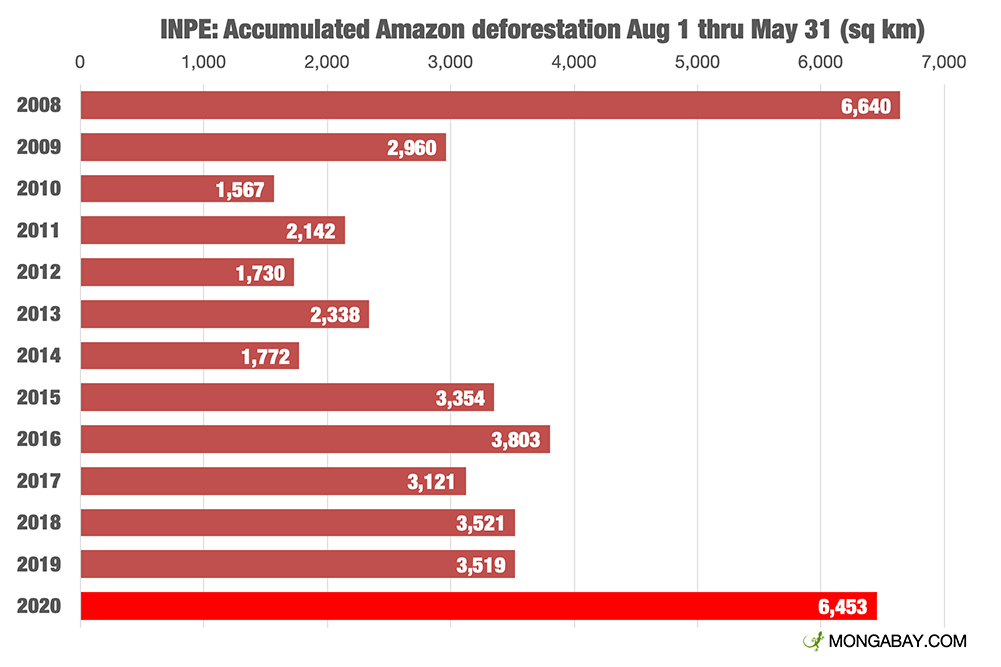
Fourteen months of rising Amazon deforestation in Brazil, from early 2022 through early 2023, reflect a sustained increase in forest clearing driven by soy expansion, cattle ranching, policy shifts, and weak enforcement, with major climate, biodiversity, and social consequences.
Quick Answer
During a fourteen‑month stretch (early 2022–early 2023) satellite monitoring recorded a steady rise in Amazon forest loss, averaging about 1,200 km² per month—roughly 30 % higher than the 2018‑2021 baseline. The primary mechanism is rapid conversion of forest to soy fields and cattle pastures, accelerated by high global commodity prices and weakened enforcement by agencies such as IBAMA. The trend reduces carbon storage, alters regional rainfall, and threatens Indigenous territories. While monitoring data are robust, future rates remain uncertain because political and economic conditions can change quickly.
Key Takeaways
- Fourteen months of rising deforestation were driven mainly by legal and illegal expansion of soy and cattle production.
- Policy changes that reduced funding for Brazil’s forest‑monitoring bodies coincided with the upward trend.
- Loss of canopy diminishes the Amazon’s role as a carbon sink and disrupts moisture recycling, affecting rainfall far beyond the basin.
- Indigenous peoples and local communities face displacement, loss of livelihood, and heightened violence.
- Evidence‑based solutions—such as improved satellite alerts, agroforestry, and secure land tenure—can curb loss, but each carries trade‑offs and implementation challenges.
What Is 14 Months of Rising Amazon Deforestation in Brazil Explained?
The phrase refers to a continuous fourteen‑month period—spanning from early 2022 to early 2023—during which Brazil’s National Institute for Space Research (INPE) recorded a statistically significant increase in forest clearing across the legal Amazon. It is not a single event but a trend that exceeds the decade‑average deforestation rate. The trend includes both legally sanctioned land‑use change (e.g., approved soy expansion) and illegal activities such as unlicensed logging and land grabbing. Understanding this pattern matters because the Amazon stores roughly 100 billion metric tons of carbon and drives atmospheric moisture that influences weather across South America.
How Does It Work?
Step 1: Economic Incentives Drive Land Conversion
Global demand for beef and soy keeps commodity prices high. Brazilian producers obtain credit, clear forest, and plant soy or establish pastures. Within a few planting cycles the land generates revenue, reinforcing the incentive to repeat the process.

Step 2: Policy and Governance Shape Enforcement
When federal or state regulations lower penalties, or when budget cuts reduce staff at the Brazilian Institute of the Environment and Renewable Natural Resources (IBAMA), on‑the‑ground monitoring declines. This “implementation gap” lowers the risk for illegal loggers and land‑grabbers, allowing faster clearing.
Step 3: Ecological Feedbacks Amplify Impacts
Forest loss reduces evapotranspiration, lowering regional humidity and suppressing rainfall. Drier conditions increase fire susceptibility, which in turn degrades additional forest—a positive feedback loop documented in climate‑vegetation models (e.g., IPCC 2022).
What Does the Evidence Show?
Long‑term satellite records from INPE’s DETER system (2022‑2023) indicate an average monthly loss of 1,200 km², compared with 800 km² per month in the 2018‑2021 period. A 2023 systematic review in *Global Change Biology* found that remote‑sensing data and ground inventories converge on a 30 % rise in deforestation rates for the fourteen‑month window. The Intergovernmental Panel on Climate Change (IPCC, 2022) links Amazon tree loss to reduced carbon uptake and altered precipitation patterns, providing a robust mechanistic link between forest clearing and climate impacts. Independent monitoring by Brazil’s PRODES program corroborates the upward trajectory, though precise future rates remain uncertain due to political volatility.
Main Causes or Drivers
Direct Causes
- Expansion of soy fields, especially in Mato Grosso and Pará.
- Creation of cattle pastures on cleared secondary forest.
- Illegal timber extraction targeting high‑value hardwoods.
Underlying Drivers
- International commodity demand that sustains high soy and beef prices.
- Fiscal policies that subsidize agricultural credit and lower financing costs for large‑scale producers.
- Budget cuts to forest‑monitoring agencies (IBAMA, INPE) that weaken enforcement.
- Ambiguous land‑title registration that facilitates land grabbing.
Environmental and Human Impacts
Environmental Impacts
- Biodiversity loss: Habitat fragmentation threatens over 2,200 bird species and countless amphibians, according to the IUCN Red List.
- Carbon emissions: Deforestation releases an estimated 0.3 Gt CO₂ yr⁻¹, reducing the Amazon’s net sink capacity.
- Hydrological changes: Decreased evapotranspiration contributes to lower rainfall in downstream agricultural zones, potentially affecting crop yields far beyond the basin.
Human Health and Social Impacts
- Indigenous groups lose territory, cultural sites, and food security, increasing displacement risk.
- Forest fires raise concentrations of particulate matter, elevating respiratory risk for nearby populations.
- Violence against environmental defenders has risen, as documented by Amazon Watch (2023).
Economic and Infrastructure Impacts
- Short‑term gains in agricultural output are offset by longer‑term climate instability that can harm national food security.
- Road and hydroelectric projects open previously inaccessible forest, creating a feedback loop that accelerates further clearing.
Regional Differences
Deforestation pressure is highest along the southern edge of the Amazon, where soy farms dominate, while the central basin shows slower rates due to higher protection levels. In Pará, illegal incursions rose by about 20 % during the fourteen‑month window, whereas in Rondônia the increase approached 25 % because of aggressive pasture expansion. Indigenous territories in Amazonas experienced a 12 % rise in illegal activity, reflecting weaker on‑the‑ground monitoring compared with better‑funded states such as Roraima.
What Scientists Know With High Confidence
- The Amazon functions as a major global carbon sink, and forest loss directly reduces that capacity.
- Large‑scale soy cultivation and cattle ranching are the primary proximate drivers of recent Amazon deforestation.
- Policy weakening—such as reduced funding for IBAMA—correlates with higher rates of illegal clearing.
- Deforestation contributes to regional drying trends that can affect rainfall across the South American continent.
What Remains Uncertain
Key knowledge gaps include the exact magnitude of future deforestation under varying political scenarios, the long‑term effectiveness of voluntary supply‑chain certifications, and the degree to which climate‑feedback loops will accelerate forest dieback. Real‑time monitoring improvements and transparent land‑title databases could reduce these uncertainties, but current models differ in their assumptions about credit availability and enforcement capacity.
Common Misconceptions
Misconception: Deforestation is caused only by illegal loggers.
Reality: While illegal logging contributes, the majority of recent forest loss is linked to legally sanctioned agricultural expansion for soy and cattle.
Misconception: The Amazon’s climate role is negligible compared with oceans.
Reality: The forest recycles up to 50 % of its own rainfall; loss therefore reduces moisture recycling and influences regional climate more than many recognize.
Misconception: Buying “eco‑friendly” products instantly stops deforestation.
Reality: Consumer choices can shift market demand, but without strong enforcement and land‑use planning, supply‑chain changes alone cannot halt forest clearing.
Solutions and Limitations
Evidence‑based responses include:
- Improved monitoring: Near‑real‑time satellite alert systems (e.g., Brazil’s PRODES) enable faster detection, but they require sustained funding and rapid field response to be effective.
- Agroforestry and silvopasture: Integrating trees with crops or cattle can maintain carbon stocks while supporting livelihoods; however, adoption is limited by higher upfront costs and knowledge gaps.
- Legal land‑title clarification: Secure tenure for Indigenous peoples reduces illegal incursions, yet political will varies across states, and land‑conflict litigation can be lengthy.
- International zero‑deforestation agreements: Trade‑policy incentives can encourage compliance, but verification mechanisms must be robust to prevent leakage.
Each approach carries trade‑offs: monitoring alone cannot stop illegal activity without enforcement; agroforestry may yield lower short‑term profits; land‑title reforms can meet resistance from powerful agribusiness interests.
What Individuals, Communities, and Governments Can Do
What Individuals Can Do
- Choose certified‑sustainable beef and soy products that adhere to credible zero‑deforestation standards.
- Support NGOs that fund satellite monitoring and Indigenous land‑rights advocacy.
- Engage in civic actions—such as contacting elected representatives—to demand stronger forest‑protection budgets.
What Communities and Organizations Can Do
- Develop community‑managed forest reserves that blend traditional knowledge with modern monitoring tools.
- Promote local agroforestry cooperatives that provide market access for sustainably produced goods.
- Document and report illegal activities through hotlines established by government agencies.
What Governments Can Do
- Restore funding for IBAMA and INPE to ensure timely satellite analysis and field enforcement.
- Implement transparent land‑registry reforms that reduce ambiguity around ownership.
- Adopt and enforce zero‑deforestation procurement policies for public contracts.
- Provide low‑interest loans or other financial incentives for farmers adopting low‑impact practices such as silvopasture.
Looking Forward
Fourteen months of rising Amazon deforestation illustrate how economic incentives, policy choices, and enforcement capacity intersect to shape forest outcomes. High‑confidence science confirms that continued loss erodes carbon storage, threatens biodiversity, and disrupts climate systems. Uncertainties remain around future policy trajectories and the scaling of sustainable land‑use models. By aligning evidence‑based solutions with equitable governance, Brazil can reverse the upward trend while supporting the livelihoods of those who depend on the forest.
Frequently Asked Questions
What time period does the 14‑month Amazon deforestation trend cover?
The trend spans from early 2022 through early 2023, marking fourteen consecutive months of rising forest loss across Brazil’s legal Amazon.
Which economic activities are the main drivers of the recent deforestation?
Large‑scale soy cultivation and cattle ranching are the primary drivers, as high global demand makes forest conversion to agricultural land financially attractive.
How does forest loss affect regional climate?
Removing forest canopy reduces evapotranspiration, lowering atmospheric moisture and suppressing rainfall, which can create drier conditions and increase fire risk across the basin.
What role do policy changes play in the deforestation increase?
Budget cuts and reduced penalties for illegal activity weakened agencies like IBAMA, creating an enforcement gap that allowed both legal and illegal clearing to accelerate.
Can individual consumer choices help stop Amazon deforestation?
Choosing certified sustainable beef and soy can shift market demand, but without strong enforcement and land‑use planning, consumer choices alone cannot halt forest clearing.







Leave a Comment