
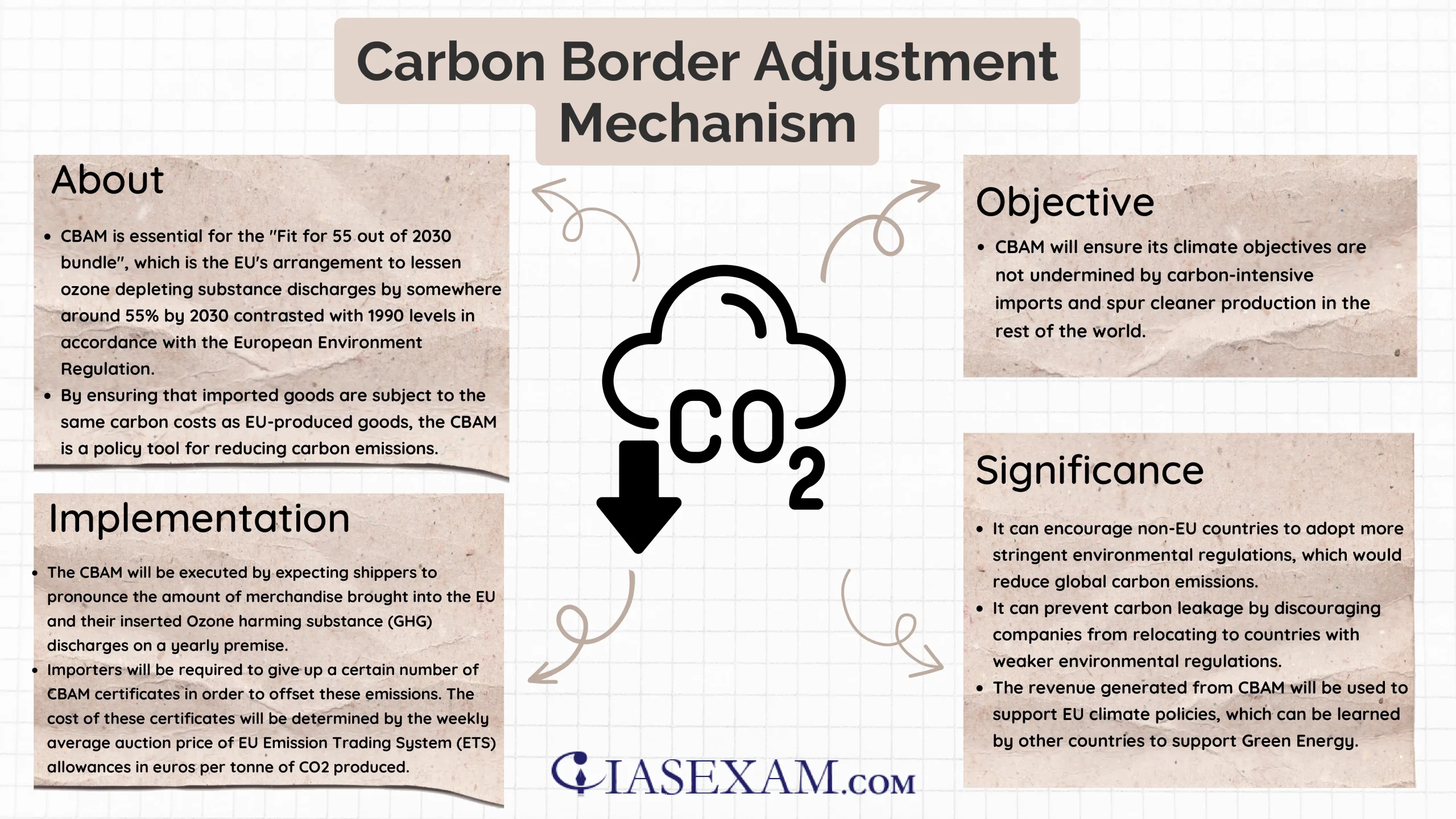
The Carbon Border Adjustment Mechanism (CBAM) is a tariff‑like tool that charges imports for their embedded carbon emissions, aiming to align global trade with climate goals while limiting carbon leakage.
Quick Answer
CBAM is a policy instrument that places a charge on imported goods based on the amount of CO₂ emitted during their production. By mirroring domestic carbon‑pricing schemes, it levels the competitive field between firms that face strict emissions regulations and those that do not. Evidence from the European Union’s pilot phases shows that such border adjustments can incentivize lower‑carbon production abroad, though uncertainties remain around measurement methods and international legal challenges.
Key Takeaways
- CBAM applies a carbon‑cost equivalent to imports, reducing the incentive for “carbon‑leakage.”
- Accurate accounting of embedded emissions is technically demanding and requires robust verification systems.
- Early EU implementations target steel, cement, aluminium, electricity, and fertiliser.
- Potential benefits include global emissions reductions, but trade tensions and equity concerns persist.
- Businesses can mitigate risk by assessing supply‑chain carbon footprints and diversifying to lower‑carbon sources.
What Is Carbon Border Adjustment Mechanism Explained: Trade Meets Climate Policy?
The Carbon Border Adjustment Mechanism (CBAM) is a fiscal instrument that imposes a charge on imported products proportional to the greenhouse‑gas emissions generated during their manufacture. It is designed to prevent “carbon leakage,” where production shifts to jurisdictions with laxer climate rules, thereby undermining domestic mitigation efforts. CBAM differs from traditional tariffs because the charge reflects environmental cost rather than revenue‑raising intent. The mechanism typically aligns with an existing domestic carbon‑price, such as the EU Emissions Trading System (EU ETS), ensuring that imported goods face comparable carbon costs to locally produced equivalents.
How Does It Work?
Step‑by‑Step Process
- Emission Reporting: Importers submit a verified declaration of the CO₂ embedded in each imported unit, using methodologies approved by the administering authority.
- Conversion to Carbon Cost: The reported emissions are multiplied by the prevailing domestic carbon price (e.g., the EU ETS allowance price).
- Adjustment Payment: Importers pay the calculated amount at the point of customs clearance. If the exporting country already applies a comparable carbon price, a credit may be granted to avoid double charging.
- Verification & Enforcement: National authorities audit declarations, conduct spot checks, and require third‑party verification to limit fraud.
- Revenue Use: Collected funds can be recycled into climate‑related projects, innovation subsidies, or used to reduce overall carbon‑pricing costs for domestic firms.
What Does the Evidence Show?
Empirical evidence from the EU’s limited CBAM pilot (2021‑2023) indicates that importers began reporting lower‑carbon inputs when faced with the adjustment cost. A systematic review by the European Environment Agency (2023) concluded that border carbon adjustments have the potential to reduce global emissions by 0.5‑1 % under full implementation, assuming robust verification. Model simulations in the International Energy Agency’s 2022 World Energy Outlook suggest that a well‑designed CBAM could shift up to 15 % of high‑emission steel production to lower‑carbon facilities within a decade.
Main Causes or Drivers
Direct Causes
The immediate driver of CBAM is the risk of carbon leakage caused by disparate carbon‑pricing regimes across countries.
Underlying Drivers
- Globalised Supply Chains: Complex, cross‑border production networks make it easy for firms to relocate emissions‑intensive steps.
- Divergent Climate Policies: Some economies lack carbon taxes or emissions trading, creating cost differentials.
- Market Incentives: Producers seek the cheapest regulatory environment, which can undermine global mitigation pathways.
Environmental and Human Impacts
Environmental Impacts
By internalising the carbon cost of imports, CBAM can encourage lower‑emission production methods, leading to reduced atmospheric CO₂ concentrations over time. A 2022 assessment by the Intergovernmental Panel on Climate Change (IPCC) notes that policies that address carbon leakage are essential for meeting the Paris Agreement’s 1.5 °C target.
Human Health and Social Impacts
Reduced emissions from high‑intensity industries improve local air quality, lowering rates of respiratory disease in communities near production sites. However, if CBAM raises import prices without compensatory measures, low‑income consumers could face higher costs for goods such as cement or steel‑based products.
Economic and Infrastructure Impacts
Domestic manufacturers benefit from a more level playing field, preserving jobs in sectors vulnerable to foreign competition. Conversely, exporting nations reliant on carbon‑intensive goods may experience short‑term trade losses, potentially prompting policy adjustments or investment in cleaner technologies.
Regional Differences
Implementation and impact vary by region. In the European Union, CBAM focuses on sectors that account for roughly 30 % of EU industrial emissions. In contrast, developing economies in Southeast Asia, where steel and cement exports dominate, may experience greater export pressure but also have opportunities to attract green‑technology investment. The United States has discussed a similar “Carbon Adjustment” framework, but as of 2024 it remains in proposal stage, reflecting differing political and regulatory contexts.
What Scientists Know With High Confidence
- Carbon leakage can offset domestic emission reductions if not addressed (IPCC, 2022).
- Pricing carbon at the border aligns incentives across trading partners (IEA, 2022).
- Accurate measurement of embedded emissions is technically feasible using life‑cycle assessment standards (EU Methodology, 2021).
- Trade‑related climate policies influence global supply‑chain investment decisions (EEA, 2023).
What Remains Uncertain
Key uncertainties include the long‑term price elasticity of imported goods, the capacity of developing nations to adopt rigorous verification systems, and the potential for WTO disputes over the compatibility of CBAM with existing trade rules. Further data on actual emissions reductions attributable to CBAM will become clearer only after full rollout and multi‑year monitoring.
Common Misconceptions
Misconception: CBAM is a protectionist trade barrier.
Reality: While CBAM does affect import prices, its purpose is to equalise carbon costs, not to shield domestic producers from competition per se. WTO rulings have indicated that environmental measures can be compatible with free trade when applied nondiscriminatorily.
Misconception: CBAM will instantly eliminate carbon‑intensive imports.
Reality: The adjustment creates a price signal that encourages gradual supply‑chain shifts. Transition periods and exemptions for low‑carbon imports are typical features of early‑stage designs.
Misconception: Only wealthy countries can afford CBAM.
Reality: The mechanism can be scaled to the administrative capacity of a region. Smaller economies may adopt simplified reporting or use international certification schemes to reduce compliance costs.
Solutions and Limitations
CBAM is one component of a broader climate‑trade strategy. Complementary solutions include:
- Harmonised Carbon Pricing: Aligning carbon prices across major economies reduces the need for border adjustments but requires extensive diplomatic coordination.
- International Standards for Emission Reporting: Adoption of common life‑cycle assessment protocols improves comparability but depends on capacity‑building in low‑income countries.
- Technology Transfer Programs: Funding for low‑carbon production technology can offset competitiveness concerns, yet financing mechanisms must be carefully designed to avoid misuse.
Each approach carries trade‑offs. Harmonisation may be politically challenging; standardisation can be costly to implement; technology transfer requires long‑term commitments and monitoring.
What Individuals, Communities, and Governments Can Do
What Individuals Can Do
Consumers can request carbon‑footprint information from retailers, support products with verified low‑embedded emissions, and advocate for transparent labeling. While individual choices alone cannot drive systemic change, aggregated demand influences corporate supply‑chain strategies.
What Communities and Organizations Can Do
Local chambers of commerce can facilitate workshops on CBAM compliance, assist small businesses in measuring embedded emissions, and partner with universities for technical assistance.
What Governments Can Do
Policymakers should develop clear, science‑based methodologies, provide transition assistance for vulnerable sectors, and engage in multilateral dialogue to align CBAM with WTO rules. Investing in capacity‑building for developing trade partners helps mitigate equity concerns.
What Businesses and Industries Can Do
Enterprises should audit their supply chains, adopt third‑party verification, explore low‑carbon sourcing, and consider internal carbon‑pricing to anticipate CBAM costs. Early alignment reduces compliance risk and can create a competitive advantage in emerging low‑carbon markets.
Synthesis
CBAM translates the environmental cost of carbon into the realm of international trade, offering a pragmatic tool to curb carbon leakage while encouraging global decarbonisation. High‑confidence evidence confirms that price‑based signals are effective, yet uncertainties around measurement, legal compatibility, and equity remain. By pairing CBAM with supportive policies—such as harmonised pricing, robust standards, and technology transfer—governments and businesses can steer the global economy toward a more sustainable trajectory.
Frequently Asked Questions
What is a carbon border adjustment mechanism?
A carbon border adjustment mechanism (CBAM) is a tariff‑like charge applied to imported goods based on the amount of CO₂ emitted during their production, intended to equalise carbon costs between domestic and foreign producers.
How does CBAM aim to prevent carbon leakage?
CBAM prevents carbon leakage by ensuring that imports face a carbon cost comparable to that of domestically produced goods, removing the price advantage of producing in jurisdictions with weaker climate regulations.
Which sectors are most likely to be affected by CBAM in the EU?
The EU’s CBAM initially targets high‑emission sectors such as steel, cement, aluminium, electricity, and fertiliser, which together represent a significant share of industrial CO₂ emissions.
What are the main challenges in measuring the carbon content of imported goods?
Key challenges include obtaining accurate life‑cycle data, verifying supplier reports, harmonising methodologies across countries, and preventing fraud or double‑counting in the verification process.
How can businesses prepare for CBAM implementation?
Businesses can assess and disclose the embedded emissions of their supply chains, seek third‑party verification, diversify towards lower‑carbon suppliers, and incorporate internal carbon pricing to anticipate adjustment costs.











Leave a Comment