
Human population growth intensifies habitat loss, resource use, pollution, and climate change, creating multiple pressures that erode biodiversity worldwide.
Quick Answer
Human population growth increases the demand for land, food, water, and energy, driving habitat conversion, over‑exploitation of species, pollution, and higher greenhouse‑gas emissions. The combined effect is a measurable decline in species abundance and ecosystem function, especially in regions where growth is rapid and governance is weak. While the overall trend is clear, uncertainties remain about exact thresholds for collapse and the capacity of ecosystems to adapt.
Key Takeaways
- Population expansion is the primary driver of habitat loss, the leading cause of biodiversity decline.
- Resource extraction and over‑consumption amplify pressure on marine and terrestrial species.
- Pollution—from nutrients to plastics—creates dead zones and toxic stress for many organisms.
- Higher carbon emissions linked to larger populations accelerate climate change, altering species’ geographic ranges.
- Effective mitigation requires integrated policies that address family planning, sustainable resource use, and ecosystem restoration.
What Is How Human Population Growth Pressures Biodiversity?
Human population growth refers to the increase in the number of people on Earth, measured as a net change in births, deaths, and migration. When this growth is sustained, societies require more land for housing, agriculture, and infrastructure, more water for drinking and irrigation, and more energy for industry and transport. Biodiversity is the variety of life at genetic, species, and ecosystem levels. The pressure arises when expanding human needs encroach on natural habitats, over‑exploit species, introduce pollutants, and alter climate conditions, thereby reducing the richness and resilience of biological communities.
How Does It Work?
1. Habitat Loss and Fragmentation
As populations concentrate in cities and expand outward, forests, wetlands, and grasslands are cleared for housing, roads, and farms. The loss of contiguous habitat reduces the area available for species to feed, breed, and migrate, while fragmentation isolates populations, increasing extinction risk.
2. Over‑exploitation of Resources
More people mean higher demand for protein, timber, and minerals. Commercial fishing, hunting, and illegal wildlife trade intensify, depleting target species faster than they can reproduce. Agricultural expansion often replaces diverse ecosystems with monocultures, lowering habitat heterogeneity.
3. Pollution
Industrial and agricultural activities generate waste that contaminates air, water, and soil. Nutrient runoff causes algal blooms that create hypoxic zones, while pesticides and heavy metals accumulate in food webs, impairing reproduction and survival of many organisms.
4. Climate Change Amplification
Population‑driven energy consumption raises greenhouse‑gas emissions, warming the planet. Shifts in temperature and precipitation alter the suitability of habitats, forcing species to migrate, adapt, or face extinction. Ocean acidification, a result of increased CO₂, threatens coral reefs and shell‑forming organisms.
5. Feedback Loops
Loss of biodiversity reduces ecosystem services such as pollination, carbon sequestration, and water regulation. Diminished services can exacerbate food insecurity and increase reliance on intensive inputs, further stressing ecosystems in a reinforcing cycle.
What Does the Evidence Show?
Long‑term monitoring by the Intergovernmental Science‑Policy Platform on Biodiversity and Ecosystem Services (IPBES, 2019) indicates that about 1 million animal and plant species are at risk of extinction, a rate ten times higher than the background rate. Satellite imagery analyses (e.g., Global Forest Watch, 2022) reveal that forest loss accelerated from 7.6 million hectares per year (2000‑2010) to 10.2 million hectares per year (2010‑2020), closely tracking population growth in tropical regions. Meta‑analyses of fisheries data (FAO, 2021) show a global decline of 10 % in fish stocks since 1970, linked to increased demand from growing coastal populations. Studies of nitrogen and phosphorus runoff (UNEP, 2020) demonstrate that eutrophication now affects 40 % of coastal waters, correlating with agricultural expansion driven by population pressure.
Main Causes or Drivers
Direct Causes
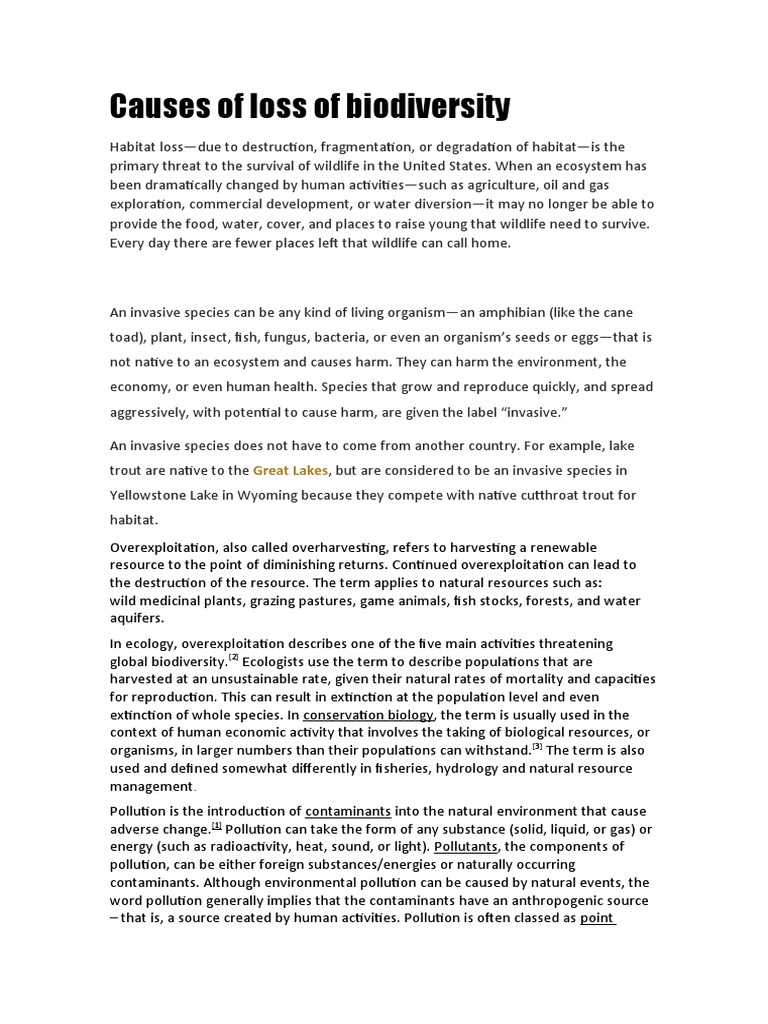
- Land conversion for housing, roads, and agriculture.
- Intensive harvesting of wildlife and marine resources.
- Industrial discharge and agricultural chemical use.
- Increased fossil‑fuel combustion.
Underlying Drivers
- Rapid urbanization and demographic shifts toward megacities.
- Rising per‑capita consumption, especially of meat and processed goods.
- Limited access to family‑planning services in low‑income regions.
- Economic incentives that favor resource extraction over conservation.
Amplifying Factors
- Weak governance and insufficient enforcement of environmental regulations.
- Global trade that shifts ecological footprints across borders.
- Climate‑change impacts that exacerbate habitat vulnerability.
Environmental and Human Impacts
Environmental Impacts
Habitat loss leads to declines in species richness, with tropical forests losing an estimated 0.5 % of species per decade (IPBES, 2019). Pollutants cause reproductive failure in amphibians and fish, while ocean acidification reduces calcifying plankton, compromising marine food webs. Climate‑driven range shifts have already caused poleward movement of many bird and insect species, altering community composition.
Human Health and Social Impacts
Reduced biodiversity compromises ecosystem services that support food security, clean water, and disease regulation. For example, loss of predator species can increase rodent populations that carry hantavirus. Communities dependent on fisheries experience declining catches, affecting nutrition and livelihoods.
Economic and Infrastructure Impacts
Declining ecosystem services impose economic costs estimated at US$ 2.5 trillion annually (World Bank, 2020). Infrastructure built on degraded land is more vulnerable to landslides and floods, raising repair and adaptation expenses.
Regional Differences
In sub‑Saharan Africa, rapid population growth (≈2.5 % per year) coincides with high reliance on subsistence agriculture, leading to extensive deforestation and wildlife poaching. In contrast, East Asia’s slower population growth but high urban density has resulted in intense habitat fragmentation around megacities such as Shanghai, while marine over‑fishing remains a major pressure in the South China Sea. Boreal regions experience lower direct human density but are increasingly affected by resource extraction and climate‑induced fire regimes.
What Scientists Know With High Confidence
- Habitat loss is the leading cause of contemporary species extinction.
- Over‑exploitation of fisheries has reduced global fish biomass by roughly 10 % since the 1970s.
- Human‑driven greenhouse‑gas emissions are the dominant driver of observed global warming since the mid‑20th century.
- Pollution, especially nutrient runoff, is a primary factor in the formation of coastal dead zones.
What Remains Uncertain
Key uncertainties include the precise tipping points at which ecosystem collapse becomes irreversible, the capacity of species to adapt genetically to rapid climate change, and the long‑term effectiveness of large‑scale restoration projects under continued demographic pressure. Data gaps persist for many invertebrate groups and for biodiversity trends in remote regions.
Common Misconceptions
Misconception: Biodiversity loss is caused only by “rich” countries.
Reality: While high‑income nations have historically contributed large carbon footprints, most current habitat loss occurs in low‑ and middle‑income regions where population growth is fastest and land‑use regulations are weaker.
Misconception: Reducing meat consumption alone will stop biodiversity decline.
Reality: Dietary shifts can lower pressure on land and water, but habitat conversion, illegal wildlife trade, and pollution also require targeted policies and enforcement.
Misconception: Protected areas are enough to conserve species.
Reality: Protected zones cover about 15 % of terrestrial land, but many are under‑funded, isolated, or lack connectivity, limiting their ability to offset surrounding development pressures.
Solutions and Limitations
Effective responses combine prevention, mitigation, and restoration:
- Family‑planning and education: Proven to reduce fertility rates, yet cultural and political barriers can slow implementation.
- Sustainable agriculture: Agro‑ecology and precision farming reduce land demand, but transition costs and market access remain challenges.
- Fishing quotas and marine protected areas: Improve stock recovery when well‑enforced; enforcement is often limited by funding.
- Pollution control: Nutrient‑management regulations lower eutrophication, but require coordination across agricultural and urban sectors.
- Climate mitigation: Renewable energy reduces emissions, yet the scale needed to offset population‑driven demand is massive.
All solutions involve trade‑offs; for example, biofuel crops can compete with food production and habitat.
What Individuals, Communities, and Governments Can Do
What Individuals Can Do
- Choose lower‑impact diets (e.g., reduce meat and dairy).
- Support certified sustainable seafood and timber.
- Participate in local habitat restoration projects.
- Advocate for policies that fund family‑planning services.
What Communities and Organizations Can Do
- Develop community‑based land‑use plans that balance development and conservation.
- Implement rain‑water harvesting and waste‑reduction programs to lessen local pollution.
- Partner with NGOs to monitor biodiversity and report illegal activities.
What Governments Can Do
- Integrate population dynamics into national development strategies.
- Expand and adequately fund protected‑area networks, ensuring ecological connectivity.
- Enforce stricter limits on deforestation, over‑fishing, and industrial emissions.
- Invest in renewable energy infrastructure and public transit to curb emissions.
Closing Synthesis
Human population growth intensifies habitat loss, resource over‑use, pollution, and climate change, collectively driving a measurable decline in biodiversity. High‑confidence evidence confirms these mechanisms, while uncertainties remain about ecosystem thresholds and the long‑term efficacy of restoration. Addressing the challenge requires coordinated actions—from family‑planning and sustainable consumption to robust policy enforcement and ecosystem restoration—recognizing that no single measure alone can halt biodiversity loss.
Frequently Asked Questions
How does population growth lead to habitat loss?
Population growth increases demand for land for housing, agriculture, and infrastructure, which results in the clearing of forests, wetlands, and grasslands. This conversion reduces the area available for wildlife and fragments ecosystems, raising extinction risk.
What evidence links human activity to species decline?
Long‑term monitoring by IPBES shows that roughly one million species face extinction, and satellite data reveal accelerating forest loss that matches population spikes in tropical regions. Fish stock assessments also record a global 10 % decline linked to higher seafood demand.
Is reducing meat consumption enough to protect biodiversity?
Switching to lower‑impact diets can lessen pressure on land and water, but biodiversity loss also stems from habitat conversion, illegal wildlife trade, and pollution. Comprehensive policies are needed alongside dietary changes.
Which regions are most affected by population‑driven biodiversity loss?
Sub‑Saharan Africa experiences rapid population growth and high reliance on subsistence agriculture, leading to extensive deforestation and poaching. East Asia faces intense habitat fragmentation around megacities, while boreal forests are increasingly threatened by resource extraction and climate‑driven fires.
What actions can governments take to mitigate these pressures?
Governments can integrate population dynamics into development plans, expand and fund connected protected‑area networks, enforce stricter limits on deforestation and over‑fishing, and invest in renewable energy and public transit to curb emissions.






Leave a Comment