
{
“title”: “The Greenhouse Effect’s Direct Role in Climate Change Explained”,
“content”: “
The greenhouse effect, a natural warming process amplified by human‑added gases, directly drives the rise in global temperatures and associated climate disruptions.
\n
Quick Answer
\n
The greenhouse effect is the trapping of infrared radiation by gases such as carbon dioxide, methane, and nitrous oxide in Earth’s atmosphere; when concentrations of these gases increase due to fossil‑fuel combustion, deforestation, and industrial activities, more heat is retained, leading to a measurable rise in average surface temperature. The Intergovernmental Panel on Climate Change (IPCC) reports that this enhanced effect is the primary cause of observed warming since the late 19th century, with serious implications for weather extremes, sea‑level rise, and ecosystems. While the basic physics are well‑understood, uncertainties remain regarding regional climate feedbacks and the timing of specific impacts.
\n
\n
Key Takeaways
\n
- \n
- The natural greenhouse effect keeps Earth habitable; human activities have increased atmospheric greenhouse gases by >40% since pre‑industrial times.
- Average global surface temperature has risen about 1.2 °C since 1880, a change strongly linked to higher greenhouse‑gas concentrations.
- Enhanced warming intensifies heatwaves, heavy precipitation, droughts, and sea‑level rise, affecting both natural systems and human societies.
- High‑confidence findings come from multiple independent lines of evidence, including satellite observations, long‑term surface records, and paleoclimate reconstructions.
- Uncertainties focus on regional climate feedbacks, cloud responses, and the socioeconomic pathways that will shape future emissions.
\n
\n
\n
\n
\n
\n
\n
What Is The Greenhouse Effect’s Direct Role in Climate Change?
\n
The greenhouse effect refers to the physical process by which certain atmospheric gases absorb outgoing longwave (infrared) radiation and re‑emit it in all directions, including back toward the surface. This natural insulation raises Earth’s average temperature by roughly 15 °C above what it would be without any greenhouse gases, making the planet suitable for liquid water and life. When human activities add extra greenhouse gases—primarily carbon dioxide (CO₂), methane (CH₄), and nitrous oxide (N₂O)—the atmosphere retains additional heat, shifting the energy balance in a way that directly drives climate change.
\n
How Does It Work?
\n
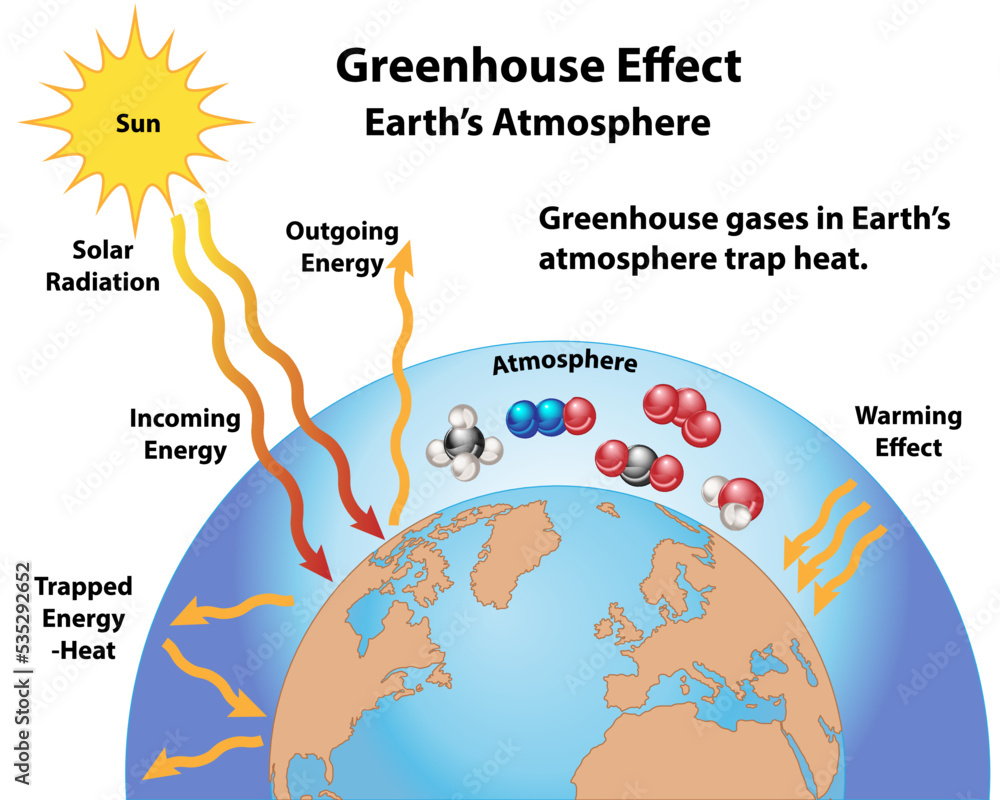
1. Solar Energy Arrives as Shortwave Radiation
\n
Sunlight, mainly visible and ultraviolet light, passes through the atmosphere and warms the land, oceans, and vegetation.
\n
2. Earth Emits Longwave Radiation
\n
The warmed surface radiates energy as infrared (longwave) radiation back toward space.
\n
3. Greenhouse Gases Absorb and Re‑Emit
\n
Molecules of CO₂, CH₄, N₂O, and water vapor have vibrational modes that resonate with infrared photons. They absorb a portion of the outgoing radiation and re‑emit it isotropically, sending some energy back to the surface and effectively reducing the net loss of heat.
\n
4. Net Energy Imbalance
\n
When the absorbed infrared exceeds the amount escaping to space, the planet experiences a positive radiative forcing, leading to a gradual increase in surface temperature. The IPCC’s 2021 assessment quantifies the total anthropogenic forcing from long‑lived greenhouse gases at +2.83 W m⁻² relative to pre‑industrial levels.
\n
5. Feedback Loops Amplify Warming
\n
Warmer air holds more water vapor, itself a potent greenhouse gas, creating a positive feedback. Melting ice reduces surface albedo, allowing more solar absorption. These feedbacks are incorporated into climate‑system models and contribute to the projected amplification of warming.
\n
What Does the Evidence Show?
\n
Multiple, independent lines of evidence confirm that enhanced greenhouse forcing is the dominant driver of recent climate change:
\n
- \n
- Instrumental records: Global surface temperature datasets (e.g., NASA GISS, NOAA) show a rise of ~1.2 °C from 1880 to 2020.
- Atmospheric composition: Direct measurements from Mauna Loa Observatory record CO₂ concentrations increasing from 280 ppm in the late 1800s to 419 ppm in 2023.
- Satellite observations: Since 1979, satellite radiometers have documented reduced outgoing longwave radiation in the absorption bands of CO₂ and CH₄, matching model expectations.
- Paleoclimate proxies: Ice‑core records reveal tight coupling between past CO₂ levels and temperature over glacial‑interglacial cycles.
- Attribution studies: Formal detection‑and‑attribution analyses (e.g., IPCC AR6) attribute >95% of the observed warming to anthropogenic greenhouse gases.
\n
\n
\n
\n
\n
\n
Main Causes or Drivers
\n
Direct Human Sources
\n
Combustion of coal, oil, and gas for electricity, transport, and industry releases roughly 36 Gt of CO₂ per year (2022 data, International Energy Agency). Agriculture contributes about 7 Gt CO₂‑equivalent mainly through methane from livestock and rice paddies, and nitrous oxide from fertilizer use.
\n
Underlying Drivers
\n
Population growth, urbanization, and economic development increase demand for energy and food, which in turn elevate emissions. Land‑use change—deforestation and conversion of wetlands—reduces the biosphere’s capacity to absorb CO₂.
\n
Natural Influences
\n
Volcanic eruptions, solar variability, and natural carbon cycle fluxes affect atmospheric composition, but their net contribution to the recent warming trend is minor compared with anthropogenic forcing.
\n
Environmental and Human Impacts
\n
Environmental Impacts
\n
- \n
- Heat‑related stress on coral reefs and terrestrial ecosystems, contributing to biodiversity loss.
- Accelerated glacial melt and sea‑level rise (average global sea level has risen about 20 cm since 1900; IPCC AR6).
- Shifted precipitation patterns, intensifying droughts in arid regions and increasing flood risk in temperate zones.
\n
\n
\n
\n
Human Health and Social Impacts
\n
- \n
- Higher incidence of heat‑related illnesses and mortality, especially among the elderly and outdoor workers.
- Expansion of vector‑borne diseases (e.g., malaria, dengue) as suitable habitats move poleward.
- Food‑security challenges from reduced crop yields in heat‑stressed regions.
\n
\n
\n
\n
Economic and Infrastructure Impacts
\n
- \n
- Increased costs for disaster response and rebuilding after extreme weather events.
- Higher insurance premiums and financial risk for coastal real‑estate due to sea‑level rise.
- Potential loss of productivity from climate‑related labor disruptions.
\n
\n
\n
\n
Regional Differences
\n
Because climate systems interact with local geography, the magnitude and type of impacts vary:
\n
- \n
- Arctic and sub‑Arctic: Temperatures are rising more than twice the global average, causing permafrost thaw and methane release.
- Tropical low‑lying islands: Sea‑level rise threatens habitability; United Nations estimates up to 150 million people could be displaced by 2050 under high‑emission scenarios.
- Mid‑latitude continents: More frequent heatwaves and shifting agricultural zones; the U.S. Corn Belt has seen a northward migration of optimal growing conditions.
- Dryland regions (e.g., Sahel, Australian interior): Intensified droughts reduce water availability and increase wildfire risk.
\n
\n
\n
\n
\n
What Scientists Know With High Confidence
\n
- \n
- Human‑generated greenhouse gases are the dominant cause of global warming since the late 19th century.
- The basic physics of infrared absorption by CO₂, CH₄, and N₂O are well‑established and experimentally verified.
- Global average surface temperature has risen about 1.2 °C, with most of the increase occurring in the past four decades.
- Warming is linked to more intense heatwaves, increased heavy‑precipitation events, and rising sea levels.
- Reducing emissions can slow the rate of warming and limit long‑term climate risks.
\n
\n
\n
\n
\n
\n
\n
What Remains Uncertain
\n
Key uncertainties involve the magnitude of climate feedbacks—especially cloud responses and permafrost carbon release—because they operate on small spatial scales and are difficult to observe directly. Regional projections for precipitation changes carry higher uncertainty than temperature trends due to complex atmospheric dynamics. Socio‑economic pathways that determine future emissions also introduce scenario‑dependent variability, meaning precise timing of specific impacts remains less certain than the direction of change.
\n
\n
Common Misconceptions
\n
Misconception: The greenhouse effect is a modern invention.
\n
Reality: The natural greenhouse effect has existed for billions of years; human activities only increase the concentrations of heat‑trapping gases beyond natural levels.
\n
Misconception: All warming is caused by the Sun.
\n
Reality: Satellite measurements show that solar output has been flat or slightly decreasing since the 1970s, while the Earth’s energy imbalance has grown, pointing to greenhouse gases as the primary driver.
\n
Misconception: Individual lifestyle changes alone can stop climate change.
\n
Reality: Personal actions matter, but systemic emission reductions through policy, industry transformation, and large‑scale renewable energy deployment are essential to achieve the deep cuts required.
\n
\n
Solutions and Limitations
\n
Effective responses combine mitigation (reducing emissions) and adaptation (preparing for impacts). Mitigation strategies include rapid deployment of renewable electricity (wind, solar, hydro), improving energy efficiency in buildings and industry, and phasing out coal. Limitations involve upfront capital costs, grid integration challenges, and the need for supportive policy frameworks.
\n
Adaptation measures such as coastal flood defenses, drought‑resilient agriculture, and early‑warning systems can reduce vulnerability, but they do not address the root cause and may become insufficient if warming exceeds certain thresholds.
\n
Nature‑based solutions—restoring mangroves, afforestation, and soil carbon sequestration—offer co‑benefits for biodiversity and water quality, yet their climate impact is bounded by land‑availability and long‑term maintenance requirements.
\n
What Individuals, Communities, and Governments Can Do
\n
What Individuals Can Do
\n
- \n
- Choose low‑carbon transportation (public transit, cycling, electric vehicles) where feasible.
- Reduce household energy use through efficient appliances, insulation, and smart thermostats.
- Support policies and companies that prioritize renewable energy and transparent emissions reporting.
\n
\n
\n
\n
What Communities and Organizations Can Do
\n
- \n
- Implement local renewable‑energy projects and micro‑grids to lower community reliance on fossil fuels.
- Develop climate‑resilient land‑use plans that preserve wetlands, urban trees, and flood‑plain capacity.
- Provide public education on heat‑wave preparedness and water‑conservation practices.
\n
\n
\n
\n
What Governments Can Do
\n
- \n
- Enact carbon‑pricing mechanisms or emission‑trading schemes to internalize the climate cost of fossil fuels.
- Set ambitious, legally binding net‑zero targets aligned with the IPCC’s 1.5 °C pathway.
- Invest in research, infrastructure, and workforce training for clean‑energy technologies.
- Support climate‑finance for vulnerable developing nations to aid adaptation and mitigation.
\n
\n
\n
\n
\n
Closing Synthesis
\n
The greenhouse effect is a fundamental physical process that keeps Earth warm enough for life; however, the unprecedented increase in greenhouse‑gas concentrations caused by human activity has tipped the balance, driving the climate changes we now observe. Robust evidence from observations, satellite data, and paleoclimate records confirms this direct link, while high‑confidence findings outline the core mechanisms and impacts. Remaining uncertainties center on feedback strength and regional specifics, but they do not undermine the overall conclusion that rapid emission reductions are essential. By combining scientifically grounded mitigation, thoughtful adaptation, and equitable policy action, societies can limit further warming and protect ecosystems and human wellbeing for generations to come.
“,
“excerpt”: “Explore how the enhanced greenhouse effect directly drives global warming, its evidence, impacts, and practical solutions for a sustainable future.”,
“tags”: [
“greenhouse effect”,
“climate change”,
“global warming”,
carbon dioxide,
methane,
climate science
],
“faq”: [
{
“question”: “What is the greenhouse effect and why is it important?”,
“answer”: “The greenhouse effect is the process by which gases like CO₂, CH₄, and N₂O trap infrared radiation in Earth’s atmosphere, raising surface temperature by about 15 °C and making the planet habitable.”
},
{
“question”: “How do human activities enhance the greenhouse effect?”,
“answer”: “Human activities such as burning fossil fuels, deforestation, and industrial processes release large amounts of CO₂, methane, and nitrous oxide, increasing atmospheric concentrations by more than 40% since pre‑industrial times and amplifying heat retention.”
},
{
“question”: “What evidence shows that the enhanced greenhouse effect is driving climate change?”,
“answer”: “Evidence includes rising global surface temperatures, increasing CO₂ measurements at Mauna Loa, satellite detection of reduced infrared emission in greenhouse‑gas bands, and attribution studies that link over 95% of recent warming to human‑generated gases.”
},
{
“question”: “Which regions are most affected by the enhanced greenhouse effect?”,
“answer”: “Arctic regions warm twice the global average, low‑lying tropical islands face sea‑level threats, mid‑latitude continents experience more heatwaves and shifting agriculture, and dryland areas see intensified droughts and wildfire risk.”
},
{
“question”: “What actions can individuals take to help reduce the greenhouse effect?”,
“answer”: “Individuals can lower personal emissions by using public transit or electric vehicles, improving home energy efficiency, and supporting policies and businesses that adopt renewable energy and transparent emissions reporting.”
}
]
}





Leave a Comment