
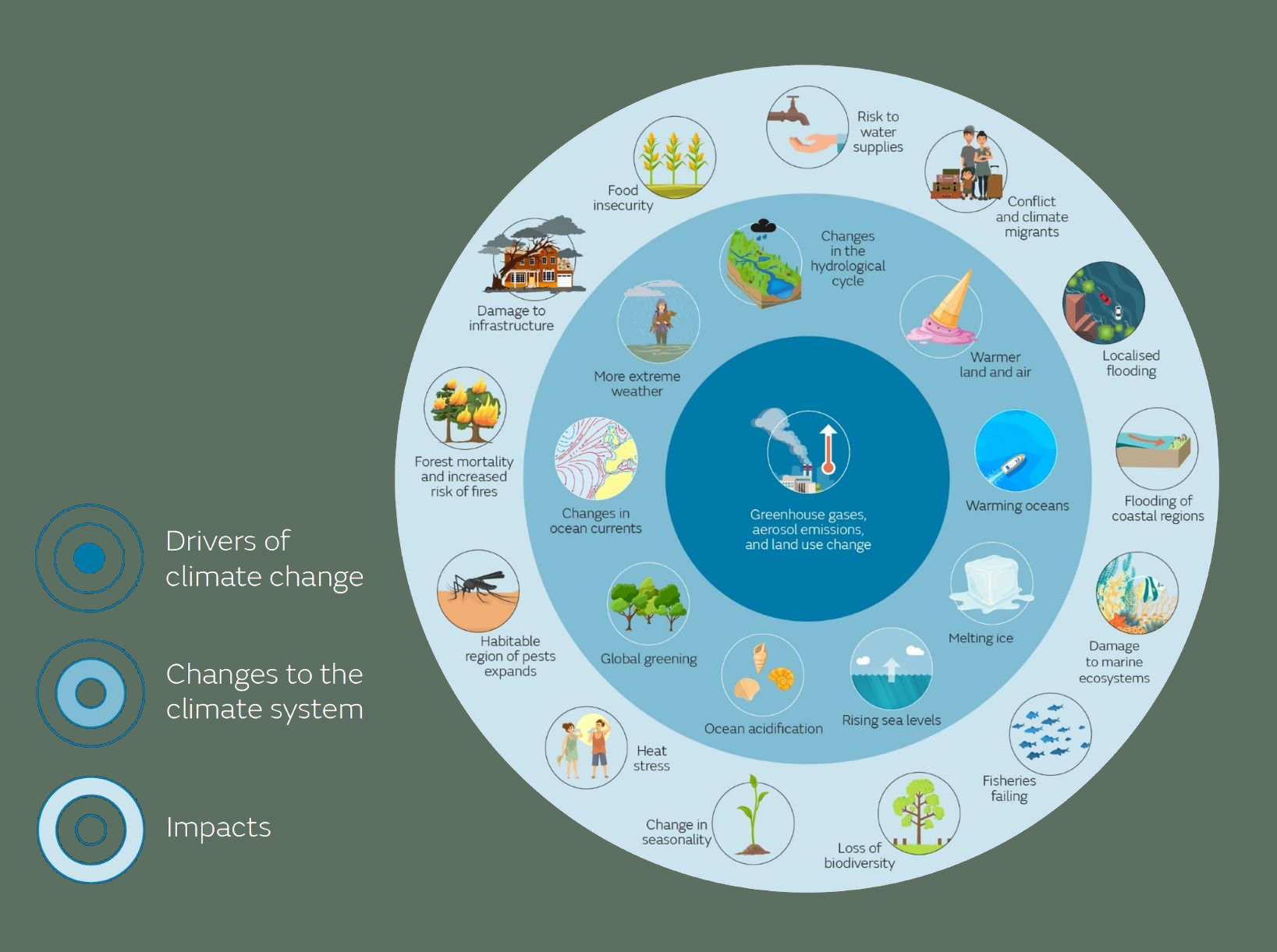
Climate change is the long‑term warming of Earth’s climate system, driven primarily by human greenhouse‑gas emissions, and it produces diverse geographic impacts on ecosystems, weather patterns, and societies worldwide.
Quick Answer
Climate change refers to the statistically significant shift in average weather conditions over decades to centuries, caused mainly by increased concentrations of carbon dioxide, methane, and other greenhouse gases from fossil‑fuel combustion, industrial processes, and land‑use change. The enhanced greenhouse effect traps more infrared radiation, warming the planet, altering precipitation patterns, and raising sea levels. Evidence from multiple independent lines of observation shows a clear warming trend, and the most immediate implication is heightened exposure of coastal communities and vulnerable ecosystems to extreme heat, flooding, and biodiversity loss, though uncertainties remain regarding the precise timing of some regional impacts.
Key Takeaways
- Human‑generated greenhouse gases are the primary driver of the observed global warming since the mid‑20th century.
- Warming amplifies extreme weather, sea‑level rise, and ecosystem disruption, with impacts varying sharply across regions.
- High‑confidence findings include rising global average temperature, expanding ocean heat content, and accelerating ice loss in polar regions.
- Key uncertainties involve regional climate sensitivity, future emission pathways, and the speed of ecosystem adaptation.
- Effective responses combine rapid mitigation of emissions, targeted adaptation, and nature‑based solutions, each with trade‑offs that must be managed.
What Is Climate Change and Its Impacts: A World Geography Perspective?
Climate change describes long‑term alterations in the statistical properties of the atmosphere, oceans, and cryosphere that arise from natural variability and, increasingly, from anthropogenic influences. The term encompasses temperature rise, shifts in precipitation regimes, increased frequency of extreme events, and sea‑level rise. It differs from short‑term weather fluctuations because it reflects persistent trends over decades or longer. Understanding climate change matters because the physical changes cascade through ecological systems, water resources, food production, and human health, shaping the future habitability of regions worldwide.
How Does It Work?
1. Greenhouse‑Gas Forcing
Solar radiation reaches Earth’s surface as shortwave energy. Some of this energy is re‑emitted as long‑wave infrared radiation, which greenhouse gases (CO₂, CH₄, N₂O, water vapour) absorb and re‑radiate back toward the surface, creating a warming effect. Human activities have increased atmospheric CO₂ from pre‑industrial levels of ~280 ppm to over 420 ppm (Mauna Loa observations, 2023), enhancing this natural greenhouse effect.
2. Feedback Loops
Warming triggers feedbacks that can amplify or dampen the initial forcing. Examples include:
- Ice‑albedo feedback: Melting snow and ice expose darker surfaces, absorbing more solar energy.
- Water‑vapour feedback: Higher temperatures increase atmospheric moisture, a potent greenhouse gas.
- Permafrost carbon release: Thawing permafrost can emit stored CO₂ and CH₄, further raising concentrations.
These feedbacks are supported by model simulations and field observations and contribute to the non‑linear nature of climate response.
3. Ocean Heat Uptake
Oceans absorb more than 90 % of the excess heat generated by greenhouse forcing, slowing surface warming but causing thermal expansion and marine ecosystem stress. Ocean heat content has risen steadily, with a global increase of about 0.6 °C in the upper 2 km since 1960 (IPCC AR6, 2021).
What Does the Evidence Show?
The Intergovernmental Panel on Climate Change (IPCC) Fifth Assessment Report (2014) and Sixth Assessment Report (2021) synthesize thousands of studies. Key lines of evidence include:
- Instrumental temperature records showing a global mean surface increase of ~1.1 °C since 1850 (NASA GISS, 2023).
- Glacier mass balance measurements indicating net loss of >9 000 Gt of ice since 1961 (World Glacier Monitoring Service, 2022).
- Sea‑level rise of 3.3 mm yr⁻¹ averaged over 1993‑2022, driven by thermal expansion and ice melt (NOAA, 2023).
- Long‑term proxy data (tree rings, ice cores) confirming that recent warming exceeds natural variability over the past millennium.
- Attribution studies using climate models that isolate anthropogenic forcing, showing that >95 % of warming since 1950 is attributable to human emissions.
These converging observations provide strong confidence in the reality and human cause of modern climate change.
Main Causes or Drivers
Direct Human Causes
- Burning of coal, oil, and gas for energy, accounting for roughly 73 % of global CO₂ emissions in 2022 (IEA, 2023).
- Industrial processes (cement, steel) and waste management releasing CO₂ and other gases.
- Agriculture and livestock producing methane and nitrous oxide.
- Deforestation and land‑use change reducing carbon sinks.
Underlying Drivers
- Global economic growth and rising energy demand.
- Population increase, especially in rapidly urbanizing regions.
- Policy frameworks that favour fossil‑fuel subsidies.
Natural Influences
Solar variability and volcanic eruptions affect climate on decadal scales but account for a minor fraction of recent warming compared with greenhouse‑gas forcing.
Environmental and Human Impacts
Environmental Impacts
- Ice loss: Arctic sea ice extent has declined by ~13 % per decade since 1979 (NSIDC, 2022).
- Ecosystem shifts: Species are moving poleward or to higher elevations at an average rate of 17 km per decade (Nature Climate Change, 2020).
- Ocean acidification: Surface ocean pH has fallen by 0.1 units since pre‑industrial times, reducing carbonate availability for shell‑forming organisms.
Human Health and Social Impacts
- Heat‑related mortality increases, with an estimated 65 000 additional deaths per year globally for each 1 °C rise above baseline (WHO, 2021).
- Changes in vector‑borne disease ranges, such as expanding dengue risk into temperate zones.
- Food‑security threats from reduced crop yields in tropical and subtropical regions, potentially affecting up to 400 million people by 2050 (FAO, 2022).
Economic and Infrastructure Impacts
- Coastal flooding costs: The World Bank estimates that by 2050, cumulative losses could exceed $1 trillion in low‑lying coastal cities without adaptation.
- Increased insurance premiums and reduced availability of coverage in high‑risk zones.
- Disruption of water supply from shrinking glaciers that feed major rivers in Asia, affecting agriculture for billions.
Regional Differences
Impacts manifest unevenly because geography controls exposure and adaptive capacity.
- Arctic and Antarctic: Rapid ice melt contributes to sea‑level rise and threatens indigenous livelihoods.
- Tropical rainforests (e.g., Amazon): Higher temperatures and drought stress increase fire frequency, undermining carbon storage.
- South Asia: Monsoon intensification and glacier retreat in the Himalayas jeopardize water security for over a billion people.
- Europe: Shifts in agricultural zones and increased heat‑wave incidence affect viticulture and public health.
- Small Island Developing States: Sea‑level rise threatens entire landmass, prompting discussions of climate‑driven migration.
What Scientists Know With High Confidence
What Scientists Know With High Confidence
- The Earth’s average surface temperature has risen by about 1.1 °C since the pre‑industrial era.
- Human activities, especially fossil‑fuel combustion, are the dominant cause of warming since the mid‑20th century.
- The oceans have absorbed most of the excess heat, leading to measurable thermal expansion.
- Global mean sea level is rising, primarily due to thermal expansion and ice‑sheet loss.
- Heat‑related health risks increase with each degree of warming.
What Remains Uncertain
What Remains Uncertain
Key uncertainties revolve around regional climate sensitivity, especially in the tropics and high latitudes, and the magnitude of feedbacks such as permafrost carbon release. Predicting the exact timing of irreversible thresholds—like large‑scale ice‑sheet collapse in Greenland—remains difficult because observations are limited and model representations vary. These gaps do not overturn the overall conclusion of human‑driven warming but do affect the precision of local impact projections and the design of adaptation strategies.
Common Misconceptions
Common Misconceptions
Misconception: “Climate change is just about hotter summers.”
Reality: Climate change alters the entire climate system, including precipitation patterns, storm intensity, ocean chemistry, and seasonal cycles, not merely average temperature.
Misconception: “The Antarctic is not melting because it is getting colder.”
Reality: While some Antarctic regions experience cooling, the overall ice mass is declining, with West Antarctica losing ice at a rate that contributes to sea‑level rise.
Misconception: “Individual lifestyle changes can solve climate change alone.”
Reality: Personal actions matter, but systemic change—policy, infrastructure, and industry transformation—is required to achieve the emissions reductions needed for global temperature stabilization.
Solutions and Limitations
Responses can be grouped into mitigation, adaptation, and conservation.
- Renewable‑energy transition: Solar and wind provide low‑carbon electricity, yet intermittency and grid‑integration costs require storage solutions and policy support.
- Energy efficiency: Improving building codes and industrial processes cuts demand, but retrofitting existing stock can be costly and time‑intensive.
- Reforestation and afforestation: Restoring forests sequesters carbon, yet benefits depend on species selection, land availability, and long‑term management.
- Adaptation infrastructure: Sea‑walls, flood‑plain zoning, and drought‑resilient agriculture reduce exposure, but they may shift risk elsewhere and require substantial investment.
- Nature‑based solutions: Protecting mangroves and wetlands buffers coastlines and stores carbon, yet these ecosystems are vulnerable to sea‑level rise and require community stewardship.
Each strategy carries trade‑offs: land‑use competition, economic costs, technology readiness, and social acceptance must be weighed against climate benefits.
What Individuals, Communities, and Governments Can Do
What Individuals Can Do
- Reduce personal carbon footprints by choosing low‑emission transport, improving home energy efficiency, and limiting high‑impact consumption (e.g., beef).
- Support climate‑wise policies through voting, advocacy, and community organizing.
- Participate in local tree‑planting or habitat restoration projects to enhance community resilience.
What Communities and Organizations Can Do
- Develop climate‑action plans that prioritize renewable energy, green infrastructure, and equitable disaster preparedness.
- Implement water‑conservation measures and climate‑smart agriculture to safeguard food security.
- Foster public‑private partnerships that fund clean‑energy projects and climate‑resilient housing.
What Governments Can Do
- Enact carbon‑pricing mechanisms or emissions‑trading systems to internalize the climate cost of fossil fuels.
- Set ambitious nationally determined contributions (NDCs) aligned with the Paris Agreement’s 1.5 °C pathway.
- Invest in research, development, and deployment of low‑carbon technologies, including storage and carbon‑capture.
- Strengthen climate‑risk assessment tools and integrate them into urban planning, infrastructure budgeting, and disaster response.
Synthesis
Climate change is a globally pervasive, human‑driven transformation of the Earth system that manifests through warming, sea‑level rise, and altered weather patterns. Robust observations and assessment reports give high confidence to its causes and many impacts, while uncertainties remain around regional sensitivities and long‑term feedbacks. Effective action requires a balanced portfolio of mitigation to curb emissions, adaptation to protect vulnerable societies, and conservation to preserve natural carbon sinks—each with its own set of limitations. By aligning scientific insight with equitable policies and community engagement, societies can navigate the geographic complexities of climate change and move toward a more resilient future.
Frequently Asked Questions
What is the greenhouse effect and how does it relate to climate change?
The greenhouse effect is a natural process where gases like water vapour, carbon dioxide, and methane trap infrared radiation, warming the planet. Human activities have increased concentrations of these gases, strengthening the effect and leading to the long‑term warming known as climate change.
Which regions are most vulnerable to sea‑level rise?
Low‑lying coastal areas and small island nations are most vulnerable. Examples include the Maldives, Bangladesh, and parts of the U.S. Gulf Coast, where even modest sea‑level increases can inundate land, increase flood risk, and threaten livelihoods.
How confident are scientists that human activities are the main cause of recent warming?
Scientists have very high confidence—over 95 % certainty—that human emissions of greenhouse gases are the dominant cause of global warming since the mid‑20th century, based on multiple lines of evidence from observations, models, and attribution studies.
What are the most effective actions to reduce emissions at the national level?
The most effective national actions include implementing carbon‑pricing mechanisms, rapidly expanding renewable‑energy capacity, improving energy efficiency across industry and buildings, and setting ambitious emissions‑reduction targets aligned with the Paris Agreement.
How does climate change affect human health?
Climate change influences health by increasing heat‑related illnesses and deaths, expanding the range of vector‑borne diseases, worsening air‑quality pollutants, and threatening food and water security, especially for vulnerable populations.







Leave a Comment