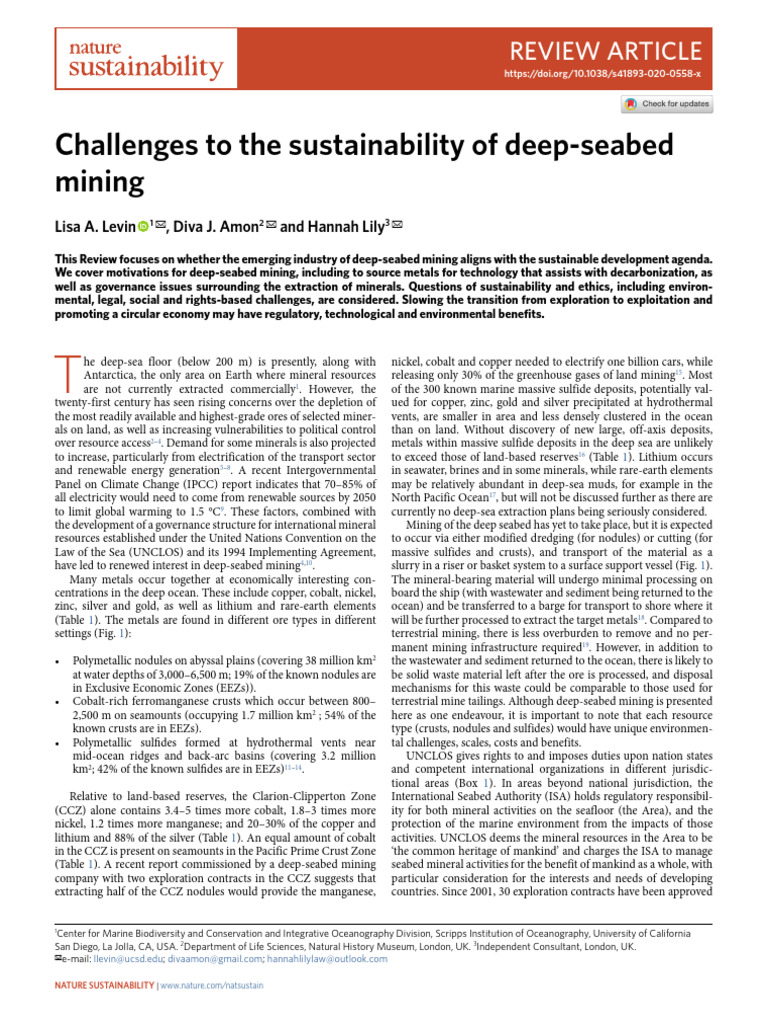
Deep-seabed mining has emerged as a contentious frontier in the quest for natural resources. While enthusiasts herald it as an opportunity for economic expansion and technological advancement, environmentalists raise a clarion call about the potential ecological ramifications of such endeavors. The central query that looms over these discussions is: Can deep-seabed mining ever be truly sustainable? To navigate this labyrinth of opinions, we must first understand what deep-seabed mining entails, the possible benefits, the attendant risks, and ultimately, whether a sustainable framework can be achieved.
Imagine for a moment a treasure trove hidden beneath the waves, where vast deposits of metals like cobalt, nickel, and rare earth elements lie in wait. These materials are foundational to modern technology—from smartphones to renewable energy solutions. With the burgeoning demand for these resources, companies have rapidly pivoted to exploit the ocean floor, thereby promising a new economic boon. However, this prospect is accompanied by profound ethical and environmental dilemmas that warrant rigorous scrutiny.
Deep-seabed mining primarily occurs in three contexts: polymetallic nodule mining, seafloor massive sulfide mining, and cobalt-rich ferromanganese crust mining. Each method presents unique technological challenges and specifies different ecological impacts. For instance, polymetallic nodules are often found on the abyssal plains, where their extraction can devastate benthic ecosystems. Disturbances to these habitats can result in a loss of biodiversity that is irreversible, challenging the very essence of sustainability.
To add another layer of complexity, the seabed is not merely a barren wasteland. It teems with life, much of which remains undocumented. Deep-sea organisms have adapted to extreme environments over millennia, and disrupting their habitats can have cascading effects. Herein lies the playful question: Is it ethical to mine for treasures at the cost of myriad unknown species? This ethical quandary should force us to consider whether the potential benefits outweigh the irreversible damage to biodiversity.
Moreover, proponents argue that mining the deep sea could lead to reduced pressure on terrestrial ecosystems. Deforestation, habitat destruction, and land degradation are rampant issues associated with extractive industries. By tapping into oceanic resources, advocates posit that we can protect terrestrial habitats from further degradation. Yet, this argument teeters precariously on a tightrope, as it presupposes that we can efficiently implement environmental protections in the deep sea—a task fraught with unforeseen challenges.
The notion of a sustainable framework for deep-seabed mining hinges on numerous factors, including stringent regulations, technological advancements, and monitoring systems. The International Seabed Authority (ISA) oversees mineral-related activities in areas beyond national jurisdiction, yet critics argue that the existing regulatory framework falls short of addressing environmental concerns adequately. A lack of empirical data about deep-sea ecosystems complicates matters further, as prudent decision-making requires comprehensive knowledge of the potential consequences.
One proposed solution is the implementation of a robust environmental impact assessment (EIA) process prior to any mining operations. This could involve baseline studies to gather data about marine lifecycles and the potential effects of mining activities. Without such groundwork, any claims of sustainability remain hollow, echoing through the depths of the ocean without substantive backing.
Technological innovation also plays a pivotal role in the sustainability conversation. As seabed mining techniques evolve, the ambition should be to develop less invasive methods that mitigate ecological disruption. Advances in robotics and autonomous underwater vehicles may pave the way for precision mining, wherein specific nodules can be targeted without devastating entire regions. However, the question remains: can technology keep pace with the inevitable demand for these resources?
Furthermore, the potential benefits of deep-seabed mining extend beyond mere economic gain. The access to vital resources could accelerate the transition to a low-carbon economy, aiding in the global fight against climate change. For example, rare earth elements are crucial for manufacturing batteries used in electric vehicles and renewable energy technologies. Thus, by nurturing a sustainable approach to deep-seabed mining, society could, in theory, secure not just economic growth but also environmental progress.
However, challenges persist. As the world grapples with climate emergency, any industry operating without an ethical compass risks societal pushback. Public opinion is constantly evolving, and environmental activists are growing more sophisticated in their objections. This disconnect needs addressing if the industry hopes to gain social license to operate. A compromise between resource extraction and ecological preservation could be the key, but achieving such equilibrium demands vigilance, accountability, and unwavering commitment to environmental stewardship.
In conclusion, the question of whether deep-seabed mining can ever be truly sustainable does not yield a simple answer. It requires a multifaceted approach that scrutinizes technological, ethical, and environmental perspectives. With thoughtful regulations and a genuine commitment to protecting marine ecosystems, we may inch closer to an acceptable model for resource extraction. Until then, the ocean floor remains a battleground within the larger conflict between progress and preservation. The answer, therefore, lies not just in what we extract from the deep, but in how we choose to nurture the delicate interplay of life within its depths.










Leave a Comment