
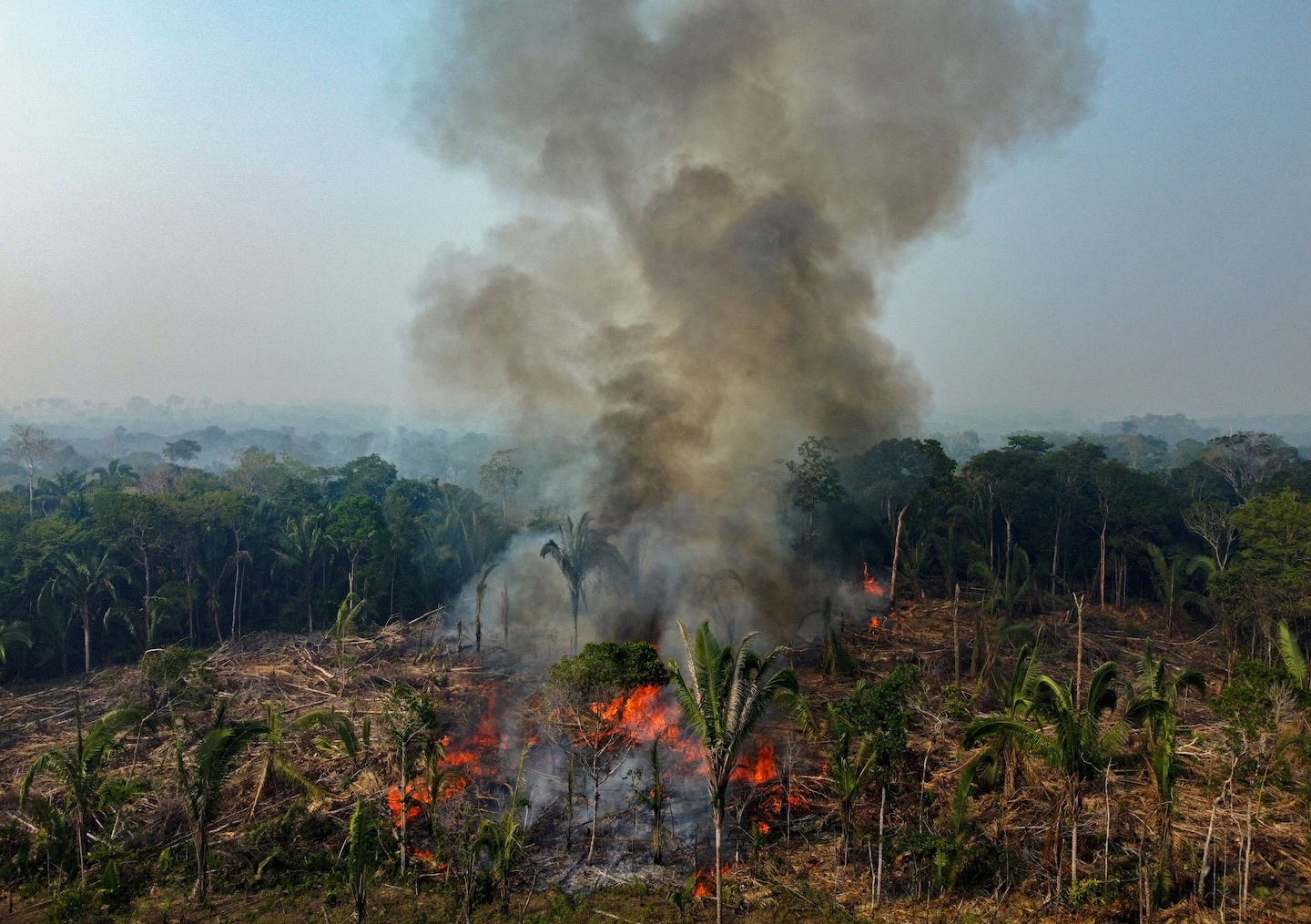
The Amazon rainforest is approaching a climate tipping point where rising temperatures and extensive deforestation could trigger large‑scale dieback, threatening biodiversity, climate regulation, and millions of people who depend on its services.
Quick Answer
The Amazon rainforest is at risk of crossing a climate tipping point because warming temperatures and continued loss of forest cover reduce moisture recycling, potentially shifting large areas to a savanna‑like state. Scientific assessments, especially the Intergovernmental Panel on Climate Change (IPCC) and peer‑reviewed synthesis papers, conclude that a 2 °C rise above pre‑industrial levels could trigger this transition in the most vulnerable zones. The main implication is a loss of carbon storage, biodiversity, and regional rainfall, which would amplify global climate change. Uncertainty remains around the exact threshold and timing, but the direction of risk is well established.
Key Takeaways
- The Amazon stores about 100 billion tonnes of carbon; its loss would add millions of tonnes of CO₂ to the atmosphere each year.
- Deforestation rates of roughly 0.5 % per year (≈ 7 million ha) since the early 2000s have weakened the forest’s moisture‑recycling feedback.
- Climate models and field studies indicate that a 2 °C global temperature increase could push large parts of the basin into a drier, savanna‑like regime.
- Indigenous territories, which cover about 40 % of the forest, experience lower deforestation rates and higher resilience.
- Effective solutions combine strict anti‑deforestation policies, sustainable land‑use incentives, and international financing, but they require strong governance and monitoring.
What Is Amazon Rainforest Nearing a Dangerous Climate Tipping Point?
The phrase refers to a critical threshold in the Earth system where small additional stresses—mainly higher temperatures and forest loss—can trigger rapid, self‑reinforcing changes in the Amazon’s climate and vegetation. Below the threshold, the forest can recover from disturbances; above it, feedbacks such as reduced evapotranspiration and increased fire frequency accelerate a shift toward non‑forest ecosystems. This is distinct from ordinary seasonal droughts because the change can become persistent and irreversible on human timescales.
How Does It Work?
1. Moisture Recycling
Trees release water vapor through transpiration, which contributes to regional rainfall. When forest cover declines, less moisture is returned to the atmosphere, leading to drier conditions and reduced cloud formation.
2. Temperature‑Driven Stress
Rising air temperatures increase evapotranspiration demand while also stressing plant physiology. Experimental plots show that a 2 °C rise can reduce growth rates of many Amazonian tree species by up to 30 %.
3. Fire Feedback Loop
Drier conditions raise the likelihood of fire. Fires open the canopy, allowing more sunlight and further drying, which in turn makes additional fires more likely. This positive feedback can convert forest to savanna faster than linear models predict.
4. Carbon Release
When trees die or burn, the carbon stored in biomass is released as CO₂. This adds to atmospheric greenhouse gases, reinforcing global warming—a classic climate‑vegetation feedback.
What Does the Evidence Show?
Multiple lines of evidence converge on the tipping‑point risk. Long‑term satellite monitoring by Brazil’s National Institute for Space Research (INPE) records a cumulative loss of ~ 17 % of primary forest since 1970. Field experiments across the basin, summarized in a 2021 systematic review in *Nature Climate Change*, demonstrate that reduced rainfall of 10–20 % sharply lowers seedling survival. The IPCC’s Sixth Assessment Report (2022) cites model ensembles that project a transition to savanna‑like conditions in up to 30 % of the basin under a 2 °C warming scenario. Together, these observations, experiments, and model projections indicate a coherent risk pattern, though exact spatial boundaries differ among studies.
Main Causes or Drivers
Direct Causes
- Deforestation for cattle ranching and soy cultivation – responsible for ~ 70 % of forest loss according to the Brazilian Ministry of Environment (2021).
- Fire use for land clearing – often escapes control, especially during dry seasons.
Underlying Drivers
- Global commodity demand – rising meat and soy consumption in Europe, China, and the United States fuels expansion.
- Policy incentives – subsidies for agriculture and weak enforcement of protected‑area regulations.
- Infrastructure development – roads open remote forest to logging and settlement.
Amplifying Factors
- Climate change – higher temperatures and altered precipitation patterns increase fire risk.
- Land‑use fragmentation – creates edge effects that make forests more vulnerable to drought and invasion.
Environmental and Human Impacts
Environmental Impacts
- Loss of biodiversity: the Amazon harbors ~ 10 % of known species; many are endemic and highly specialized.
- Reduced carbon sink: the forest currently absorbs ~ 2 Gt CO₂ yr⁻¹; a tipping point could turn it into a net source.
- Altered regional climate: rainfall declines of up to 20 % have been modeled for downstream agricultural regions such as Brazil’s Cerrado.
Human Health and Social Impacts
- Indigenous communities face loss of cultural heritage, food security, and clean water sources.
- Increased air pollution from fires raises respiratory disease risk for nearby populations.
- Economic disruption for families dependent on forest products (e.g., Brazil nut, latex).
Economic and Infrastructure Impacts
- Reduced agricultural yields in regions that rely on Amazon‑generated rainfall, potentially costing billions of dollars.
- Higher costs for flood control and water management in downstream cities like Manaus.
Regional Differences
The Amazon spans nine countries, but pressure varies. Brazil accounts for ~ 60 % of deforestation, driven largely by cattle expansion in the southern and eastern frontiers. In contrast, the Peruvian and Colombian Amazones have lower rates (< 0.2 % yr⁻¹) and a higher proportion of intact primary forest, partly because Indigenous territories are better protected. The “arc of deforestation” along Brazil’s southern edge experiences the strongest warming and drying trends, while the western basin remains comparatively moist but is increasingly threatened by illegal mining.
What Scientists Know With High Confidence
- The Amazon stores a massive amount of carbon and influences global climate through moisture recycling.
- Deforestation directly reduces evapotranspiration, leading to regional drying.
- Repeated observations show that fire frequency has risen in tandem with forest loss.
- Indigenous-managed lands have lower deforestation rates and higher ecological resilience.
What Remains Uncertain
Key uncertainties include the precise temperature threshold that triggers large‑scale dieback, the role of extreme drought events, and how quickly degraded areas can be restored under future climate conditions. Model disagreement stems from differences in how vegetation dynamics and soil moisture feedbacks are represented. Improved ground‑based monitoring and higher‑resolution satellite data are needed to narrow these gaps.
Common Misconceptions
Misconception: The Amazon will disappear completely within a decade.
Reality: While the risk of extensive dieback is real, scientific consensus indicates a gradual transition over decades, not an immediate collapse.
Misconception: Only climate change, not deforestation, drives the tipping point.
Reality: Deforestation reduces moisture recycling, making the forest more vulnerable to climate‑induced drought; both factors interact synergistically.
Misconception: Planting trees elsewhere can replace the Amazon’s carbon storage.
Reality: The Amazon’s biodiversity, soil carbon, and complex canopy structure are unique; afforestation cannot replicate its full ecosystem services.
Solutions and Limitations
Effective responses fall into three categories:
- Prevention – enforce and expand protected areas, especially in the “arc of deforestation.” Enforcement is limited by funding and political will.
- Mitigation – promote zero‑deforestation supply chains for beef and soy. Market mechanisms can be undermined by leakage and verification challenges.
- Restoration – invest in assisted natural regeneration and agroforestry on already degraded lands. Success depends on soil health, seed availability, and long‑term land‑tenure security.
Each strategy faces trade‑offs: strict protection may conflict with local livelihoods if alternative income is not provided; restoration requires decades to recover carbon stocks; market‑based incentives can be vulnerable to price fluctuations.
What Individuals, Communities, and Governments Can Do
What Individuals Can Do
- Choose certified sustainable beef and soy products (e.g., RSPO, Rainforest Alliance).
- Support NGOs that fund Indigenous land‑rights initiatives.
- Raise awareness through social media using reputable sources such as the IPCC or WWF.
What Communities and Organizations Can Do
- Implement community‑led monitoring using low‑cost satellite tools to detect illegal logging.
- Develop agroforestry models that combine cash crops with native trees, improving income and forest cover.
- Form partnerships with universities for citizen‑science data collection on biodiversity.
What Governments Can Do
- Enforce the 2008 Forest Code and increase penalties for illegal clearing.
- Allocate climate finance (e.g., from the Green Climate Fund) to support Indigenous stewardship.
- Integrate satellite‑based deforestation alerts into rapid‑response law‑enforcement units.
Looking Ahead
The Amazon’s approach to a climate tipping point underscores the intimate link between forest health and global climate stability. Strong evidence confirms that continued warming and deforestation increase the risk of a large‑scale shift, while uncertainties mainly concern the exact timing and reversibility. Addressing the challenge requires coordinated prevention, mitigation, and restoration actions that respect Indigenous rights and balance economic needs. By acting now, societies can keep the Amazon within its resilient state and preserve the climate benefits it provides for generations.
Frequently Asked Questions
What does “climate tipping point” mean for the Amazon?
A climate tipping point for the Amazon is a threshold at which rising temperatures and forest loss trigger self‑reinforcing changes that can permanently shift large areas from rainforest to savanna‑like ecosystems, reducing carbon storage and rainfall.
How does deforestation accelerate Amazon dieback?
Deforestation removes trees that recycle moisture through transpiration, leading to drier regional climate, higher fire risk, and weakened resilience; these changes amplify warming and can push the forest past its tipping point.
Which species are most at risk if the Amazon shifts to savanna?
Species that depend on continuous canopy cover, such as many arboreal primates, large cats like the jaguar, and countless epiphytic plants, face the greatest risk because a savanna landscape cannot provide their required habitat and food sources.
What are the most effective actions governments can take to prevent the tipping point?
Governments can enforce and expand protected areas, strengthen the 2008 Forest Code, provide climate finance to Indigenous land stewards, and deploy satellite‑based monitoring for rapid response to illegal clearing.
How can individuals help reduce the pressure on the Amazon?
Individuals can choose certified sustainable beef and soy, support NGOs that protect Indigenous rights, and spread accurate information from reputable sources such as the IPCC or WWF.





Leave a Comment