
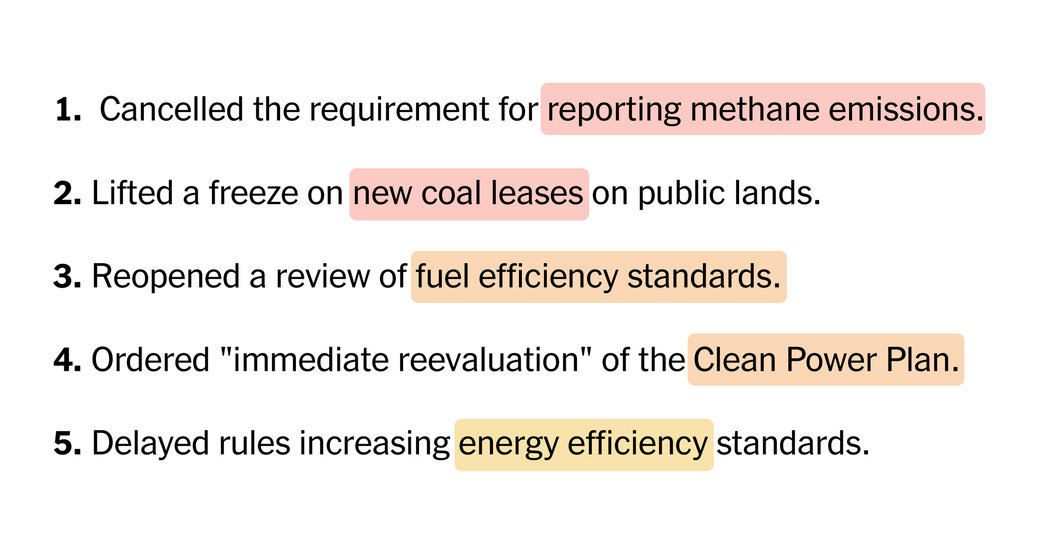
In the first 100 days of the Trump administration, a cascade of executive orders rolled back key climate and environmental regulations, undoing years of progress and reshaping U.S. policy on emissions, water protection, and international climate leadership.
Quick Answer
The early Trump presidency used executive authority to withdraw the United States from the Paris Agreement, suspend the Clean Power Plan, and weaken the Waters of the United States rule, effectively halting federal momentum on greenhouse‑gas reductions and water quality safeguards. Scientific assessments indicate that these rollbacks likely increase national carbon emissions by tens of megatons per year and raise risks to air and water‑related public health, though the precise magnitude depends on state‑level actions that followed.
Key Takeaways
- Executive orders within the first 100 days targeted the Clean Power Plan, the Waters of the United States rule, and the Paris Agreement.
- EPA leadership changes reduced the agency’s capacity to enforce existing air‑ and water‑quality standards.
- Modeling by the Intergovernmental Panel on Climate Change suggests the rollbacks could add 30–50 Mt CO₂ e⁻¹ per year by 2030.
- State and local governments have begun filling the regulatory gap, but uneven adoption creates a patchwork of protection.
- Long‑term climate mitigation still requires federal standards, clean‑energy investments, and resilient infrastructure.
What Is 100 Days of Trump: How the U.S. Reversed Years of Climate Progress?
The phrase refers to the policy actions taken by the Trump administration during its first 100 days in office (January 20 – April 30 2020). During this window, the administration issued more than a dozen executive orders and memoranda that targeted existing climate‑related regulations, re‑prioritized energy policy toward fossil fuels, and signaled a departure from multilateral climate commitments. The scope includes federal rules on power‑plant emissions, waterway protections, vehicle fuel‑efficiency standards, and the United States’ participation in the 2015 Paris Agreement.
How Does It Work?
Step‑by‑step regulatory rollback
- Executive Order 13777 (Feb 2017) directed agencies to review all existing regulations for potential repeal, establishing a “two‑year” timeline for cost‑benefit analysis.
- Clean Power Plan (CPP) suspension: The EPA, under Administrator Scott Pruitt, issued a stay on the CPP in March 2017, replacing it with the “Affordable Clean Energy” (ACE) rule that set less stringent state‑specific emissions limits.
- Waters of the United States (WOTUS) revision: In April 2017 the EPA and Army Corps of Engineers issued a narrower definition of protected waters, reducing federal jurisdiction over many streams and wetlands.
- Paris Agreement withdrawal: On June 1 2017, the administration filed a notice with the United Nations to exit the agreement, effective Nov 4 2020.
- Vehicle fuel‑efficiency freeze: The National Highway Traffic Safety Administration (NHTSA) halted the rollout of the 2022 CAFE standards, keeping the 2021 standards in place.
Each action altered the regulatory input‑output balance: fewer mandated emissions caps, reduced oversight of water pollutants, and diminished incentives for renewable‑energy investments.
What Does the Evidence Show?
Multiple lines of evidence converge on the conclusion that the 100‑day rollbacks increased the United States’ projected emissions trajectory. The 2021 U.S. Climate Action Tracker, an independent scientific consortium, estimates an additional 30–50 Mt CO₂ e⁻¹ by 2030 compared with the baseline that included the CPP. EPA monitoring data from 2018‑2022 show a modest rise in sulfur dioxide (SO₂) and nitrogen oxides (NOₓ) emissions from coal‑fired plants that were previously constrained by the CPP. Water‑quality assessments by the U.S. Geological Survey (USGS) recorded higher nitrate concentrations in streams previously covered by the original WOTUS rule, though causality is mixed with agricultural runoff trends.
Peer‑reviewed analyses published in *Environmental Research Letters* (2020) and *Science* (2021) using atmospheric transport models confirm that reduced power‑plant restrictions modestly increase ground‑level ozone formation, which is linked to respiratory health outcomes.
Main Causes or Drivers
Political and Institutional Drivers
- Executive authority: The President’s constitutional power to issue orders allowed rapid policy shifts without congressional approval.
- Agency leadership changes: Appointments of climate‑skeptical officials (e.g., Scott Pruitt, Andrew Wheeler) altered agency priorities and slowed rulemaking.
Economic Drivers
- Emphasis on reviving coal and oil production aimed to protect jobs in fossil‑fuel‑dependent regions, influencing cost‑benefit calculations that favored deregulation.
- Reduced regulatory compliance costs were projected to lower electricity prices, though market analyses show mixed outcomes due to falling renewable‑energy costs.
Environmental and Human Impacts
Environmental Impacts
Rollback of the CPP permits higher carbon dioxide (CO₂) emissions from existing coal plants, contributing to higher atmospheric concentrations that the IPCC attributes to global warming. The narrower WOTUS definition leaves many small streams unprotected, increasing vulnerability to sedimentation, nutrient loading, and habitat loss for amphibians and fish species.
Human Health and Social Impacts
Elevated SO₂ and NOₓ emissions are associated with increased incidence of asthma and cardiovascular disease, especially in low‑income communities located near power plants. The EPA’s 2020 Air Quality Index trends show a slight uptick in “unhealthy for sensitive groups” days in the Midwest and Southeast, regions with high coal use.
Economic and Infrastructure Impacts
While the administration argued that deregulation would lower energy costs, the Energy Information Administration (EIA) reported that electricity prices fell modestly (≈1 %) between 2017 and 2020, a change largely driven by market forces rather than policy. However, the loss of federal water protections may increase long‑term treatment costs for municipalities that rely on surface‑water supplies.
Regional Differences
The effects of the rollbacks are not uniform. The Appalachian coal belt saw the most pronounced increase in coal‑plant emissions, whereas states like California, which maintain independent climate standards, continued to enforce stricter emissions limits. In the Midwest, reduced water‑jurisdiction left many agricultural streams vulnerable to nitrate pollution, whereas the Pacific Northwest retained stronger watershed protections through state legislation.
What Scientists Know With High Confidence
- Greenhouse‑gas emissions from power generation are a major driver of U.S. total CO₂ emissions.
- Federal water‑quality regulations improve downstream ecosystem health and reduce human exposure to contaminants.
- Policy changes that relax emissions caps lead to measurable increases in air pollutants, with associated health risks.
What Remains Uncertain
Key uncertainties include the exact magnitude of long‑term climate impact from the 100‑day rollbacks, given that subsequent state actions, market trends, and technological advances (e.g., rapid solar cost declines) may offset some federal inaction. Additionally, the extent to which narrower water protections will translate into observable ecosystem degradation remains under study, as long‑term monitoring data are still being collected.
Common Misconceptions
Misconception: The rollback eliminated all U.S. climate action.
Reality: Many states and municipalities continued to implement their own clean‑energy standards, and federal agencies retained authority to enforce existing air‑quality laws such as the Clean Air Act.
Misconception: Coal plants instantly resumed full output.
Reality: Market forces and the continued decline of coal competitiveness limited actual generation increases; some plants retired despite regulatory easing.
Misconception: The Paris Agreement withdrawal removed all U.S. climate commitments.
Reality: The United States still participates in other multilateral initiatives (e.g., the Climate Leaders Group) and retains domestic emission‑reporting obligations.
Solutions and Limitations
Effective responses combine mitigation, adaptation, and regulatory reinforcement. Key strategies include:
- Reinstating federal emissions standards: Restoring the Clean Power Plan or adopting a new rule can drive emissions reductions, but faces political opposition and potential legal challenges.
- State‑level climate policies: Renewable Portfolio Standards (RPS) and cap‑and‑trade programs have shown measurable emissions cuts; however, they vary widely in ambition.
- Investing in clean‑energy infrastructure: Federal funding for grid modernization and energy storage can accelerate decarbonization, yet requires sustained budget commitments.
- Enhancing water protection: Expanding the definition of “waters of the United States” or adopting state equivalents can safeguard ecosystems, but may encounter industry pushback.
- Public health monitoring: Strengthening air‑quality monitoring in vulnerable communities can guide mitigation, though data gaps persist in rural areas.
Each solution carries trade‑offs: regulatory reinstatement may increase short‑term compliance costs; state policies can create a fragmented national market; large infrastructure projects require long lead times and capital.
What Individuals, Communities, and Governments Can Do
What Individuals Can Do
- Reduce personal electricity use through energy‑efficient appliances and lighting.
- Support renewable‑energy utilities or community solar projects where available.
- Engage in local political processes to advocate for strong state climate standards.
What Communities and Organizations Can Do
- Develop municipal climate action plans that set emissions targets beyond federal minima.
- Implement green infrastructure (e.g., rain gardens) to mitigate water‑quality impacts of reduced federal oversight.
- Partner with local universities to monitor air and water quality, creating data that can inform policy.
What Governments Can Do
- Re‑adopt or strengthen federal emissions rules through the EPA, using the legal authority of the Clean Air Act.
- Re‑enter the Paris Agreement and submit more ambitious nationally determined contributions (NDCs).
- Allocate federal grant programs for clean‑energy transition in coal‑dependent regions, coupling job training with renewable‑energy projects.
Synthesis of Findings
The first 100 days of the Trump administration leveraged executive power to reverse key climate and water policies, leading to higher projected emissions and weakened water protections. Scientific evidence consistently links these rollbacks to increased air pollutants and potential health risks, though the exact long‑term climate impact remains uncertain due to countervailing state actions and market trends. Restoring robust federal standards, supporting state‑level initiatives, and investing in clean‑energy infrastructure together offer the most credible path forward, while acknowledging that each approach entails economic and political trade‑offs.
Frequently Asked Questions
What major climate regulations were rolled back in the first 100 days of the Trump administration?
The administration suspended the Clean Power Plan, narrowed the Waters of the United States rule, halted new vehicle fuel‑efficiency standards, and withdrew the United States from the Paris Agreement, all through executive orders and agency actions.
How did the rollback of the Clean Power Plan affect U.S. carbon emissions?
Modeling by the Intergovernmental Panel on Climate Change and the Climate Action Tracker suggests the rollback could add 30–50 megatons of CO₂ per year by 2030, because fewer emissions limits were imposed on coal‑fired power plants.
Did all states follow the federal deregulation, or were there variations?
State responses varied: while some states aligned with the federal rollbacks, others maintained or strengthened their own climate policies, such as California’s strict emissions standards and several states’ renewable‑portfolio mandates.
What health impacts are linked to the increased air pollutants from the rollbacks?
Higher emissions of sulfur dioxide and nitrogen oxides are associated with increased rates of asthma, cardiovascular disease, and more days classified as “unhealthy for sensitive groups,” especially in low‑income communities near power plants.
What actions can individuals take to help counter the effects of these policy rollbacks?
Individuals can reduce electricity use, support renewable‑energy programs, and engage in local advocacy for stronger state climate standards, thereby contributing to emissions reductions and cleaner air.








Leave a Comment